#Product Trends
Ultrasonic Anemometer: Working Principle, 2D vs 3D, and Sensor Selection
Ultrasonic Anemometer: Working Principle, 2D vs 3D, and Sensor Selection
What an ultrasonic anemometer actually measures
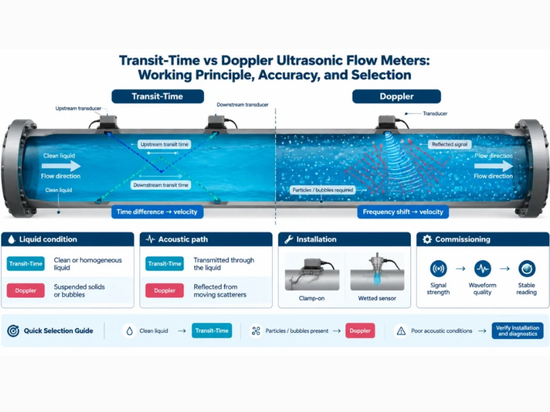
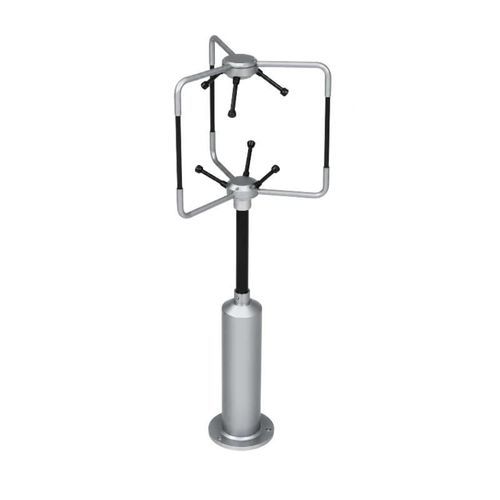
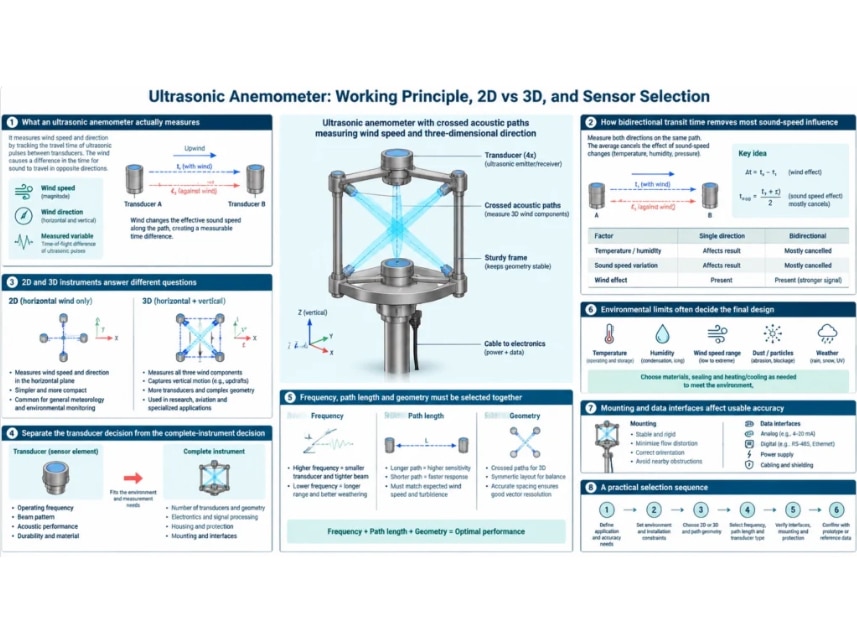
An ultrasonic anemometer measures the effect of moving air on the travel time of an acoustic pulse. Transducers face each other across one or more known paths. A pulse traveling with the wind arrives sooner than a pulse traveling against it. The difference between the two transit times yields the wind component along that path.
Two crossed horizontal paths can resolve horizontal wind speed and direction. A three-dimensional instrument adds inclined or vertical paths so it can also resolve vertical velocity. Because there are no cups, vanes or propellers, the measurement does not depend on the starting torque of a moving rotor. That is useful for low-speed response, rapid sampling and installations where mechanical wear is undesirable.
How bidirectional transit time removes most sound-speed influence
For a path length L, the downstream and upstream pulse times depend on both the speed of sound c and the wind component v. Measuring in both directions allows the electronics to separate the directional airflow term from the common sound-speed term. Temperature still matters to signal timing, acoustic attenuation and diagnostics, but it does not need to be converted directly into wind speed as it would in a one-way measurement.
The useful result depends on more than the timing formula. The instrument must identify the pulse consistently, control ringing, reject false arrivals and compensate fixed channel delays. Path length, transducer bandwidth, drive amplitude, gain and sampling rate therefore form one measurement system.