#Product Trends
Ultrasonic Cleaning Transducer Selection: Frequency, Power, Mounting, and Troubleshooting
Ultrasonic Cleaning Transducer Selection: Frequency, Power, Mounting, and Troubleshooting
Start with the cleaning task, not a watt-per-liter rule
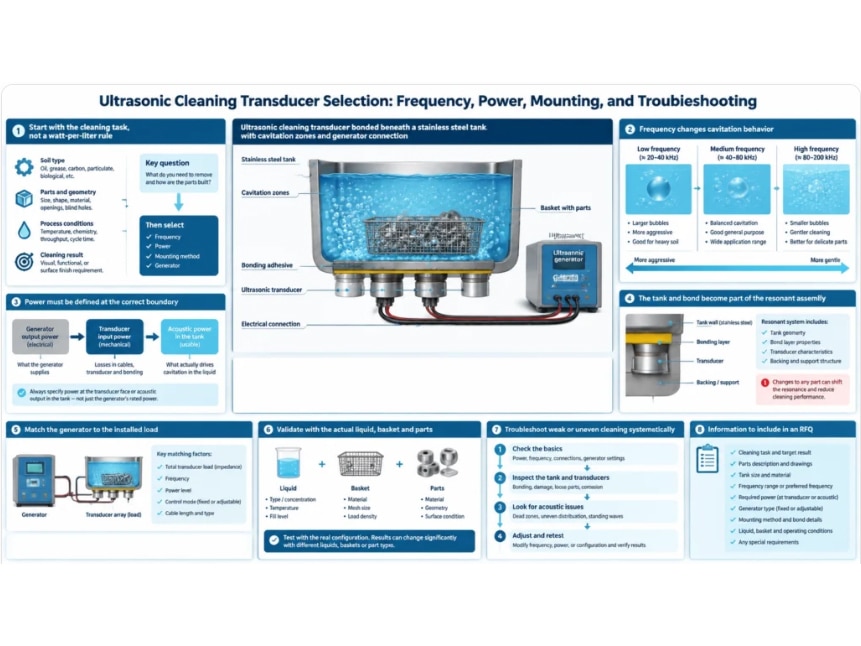
An ultrasonic cleaning transducer converts the generator output into vibration of the tank or immersible plate. That vibration creates alternating pressure in the liquid, producing cavitation that loosens contamination. The useful result depends on the entire chain: generator, transducer, bond, tank, liquid, temperature, basket, load and cleaning cycle.
Watts per liter is useful for an early estimate, but it cannot specify a system alone. Two tanks with the same volume may have different wall thickness, shape, liquid depth, fixtures and part loading. Define the contaminant, substrate, required cleanliness, throughput and risk of surface damage before selecting hardware.
Frequency changes cavitation behavior
Lower frequencies generally produce larger, more energetic cavitation events and are commonly chosen for robust parts and heavy contamination. Higher frequencies produce finer cavitation and can be better for small features or delicate surfaces. Frequency does not guarantee a result: chemistry, temperature, dissolved gas, acoustic field and exposure time remain important.
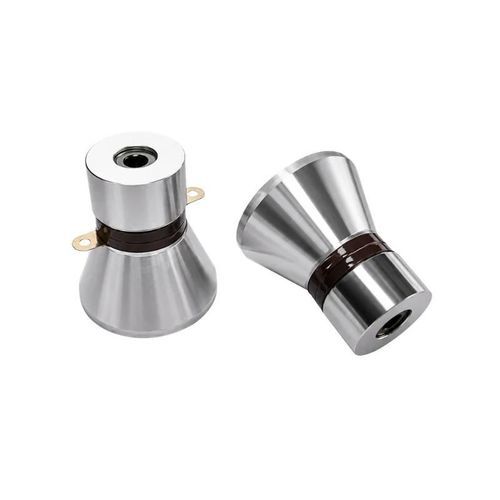
A 40 kHz system is a common industrial starting point because it balances cleaning action, component size and audible behavior for many general applications. The BBCL-40KP100 40 kHz 100 W cleaning transducer is a component for this type of system; its rating is not a promise that one unit will clean a particular tank or part.