#Product Trends
Air Knife Drying on Bakery Lines
Where the Pressure Window Sits
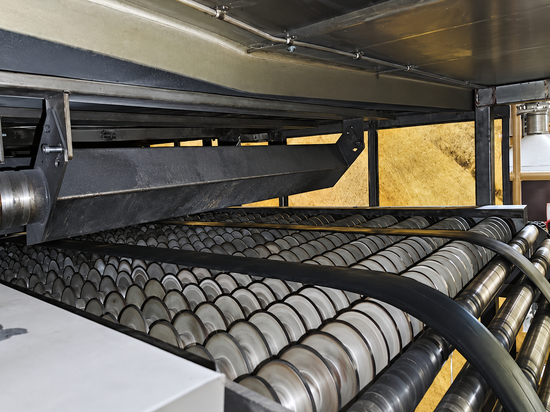
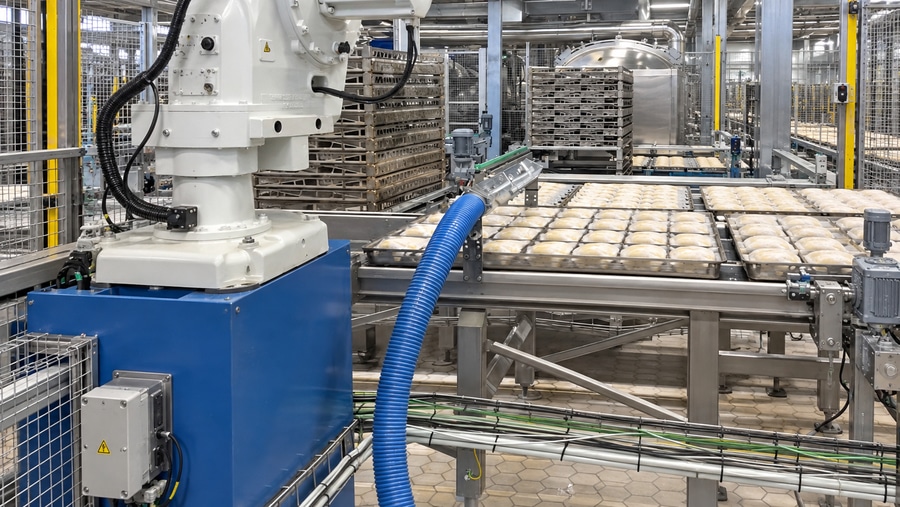
Packaged bakery products leave the wrapping section with moisture and crumbs on the film surface. Downstream operations do not tolerate it.
Moisture on a package is rarely an aesthetic problem. Corrugated cases lose compression strength as board moisture rises; literature commonly cites around 8% per 1% added moisture. A wet film blocks label adhesion and ink bonding. Water in the seal area weakens the seal. The cost of a wet package appears three stations later.
Removing it is a momentum task, not a thermal one. On a 500 ml container with a 20 micron water film, evaporation removes about 1% of the water in the available exposure time. The rest has to be stripped mechanically by a high-velocity air curtain.
That defines the pressure requirement. A droplet held by surface tension releases when aerodynamic drag exceeds the retention force. Droplets near 0.5 mm release at roughly 30 m/s impingement velocity. The 0.1 mm droplets and thin films that remain on a package surface need 60 to 80 m/s. Allowing for jet decay, this maps to a pressure rise of 15 to 20 kPa (150 to 200 mbar). Above roughly 25 kPa, the return falls away.
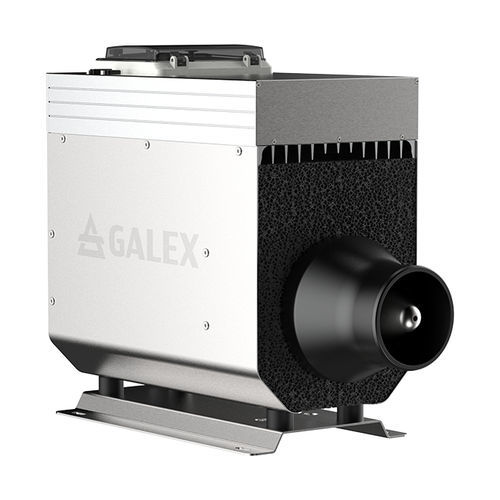
The GALEX X720 high-speed turbo blower is built for this band. Its 7.5 kW drive covers the pressure rise and air volume a knife spanning a standard conveyor width needs in continuous duty, as an alternative to conventional side-channel blowers.
Two factors decide the result. Mounting distance: moving a knife from 20 mm to 50 mm from the product cuts impingement velocity by about a third. Exposure time: at 1.5 m/s line speed, one knife gives roughly 10 milliseconds; a second knife in series doubles it and improves results more than raising pressure does.
For continuous blow-off, blower-driven knives replace compressed air at a fraction of the energy. Published comparisons put the reduction at more than 70%, which is why lines running several shifts make the change.