#Industry News
Electrostatics know how
Interesting facts
The appearance of electrostatic charge
The phenomena of electrostatic charge is permanent existing and is generated mainly by relative movement - in other words every time material surfaces have contact and are separated or have friction to each other. Static electricity in a working environment can for example be generated by fluids flowing through isolated pipelines or by production of endless insulated substrates (i.e. film and paper webs) moving through machines, or by granulates slipping over isolated surfaces, and even by a person walking on an isolated carpet.
Risk and damage caused by electrostatic charges
Damage to persons caused by startle response to sudden electrostatic discharges is a major cause for accidents in the industry. Explosive vapours, gases and dusts can also (under special circumstances) be ignited because the minimum ignition energy (MIE) can easily be exceeded. Isolated film surfaces can catch irreparable damages. Attraction or accumulation of unwanted particles can take place. Undesirable influence to coating processes, damage of semiconductor circuit's and machine PLCs, Displays and 24 V DC or 5 V DC Signal transmitters can also appear.
Factors of main influence
The amount and the polarity for the charge are driven by:
-The material itself
-Environmental situation (Temperature, humidity)
-Surface structure (roughness)
-Ongoing contact and separation of the substrates (i.e. unwinding, banana roller
-S-peed of the web during separation - the higher the speed the higher is the corresponding charge on the substrate
Further more from:
Distortion
-Cooling / crystallisation
-Friction / aerial currents in isolated surfaces
-Demolition / separation
Efficient control and elimination
In the first steps the following measures are mandatory:
-Detection of dangerous areas and critical processes where electrostatic charge can develop.
-Construction of an electrostatic profile of the critical areas or processes focused on operator safety, process problems and eventually material damages or surface changes based on electrostatic field measurements at the most dominate points in process with final risk assessment.
-Correct ground connection of conductive machine parts, work out the correct positioning of active Ionisation equipment in the machine and connect to Master control of the machine to have long time control over safety and the process.
-Use electrostatic training for operator and process engineers in regular intervals too insure up to date information for hazardous locations and critical process.
Conclusion:
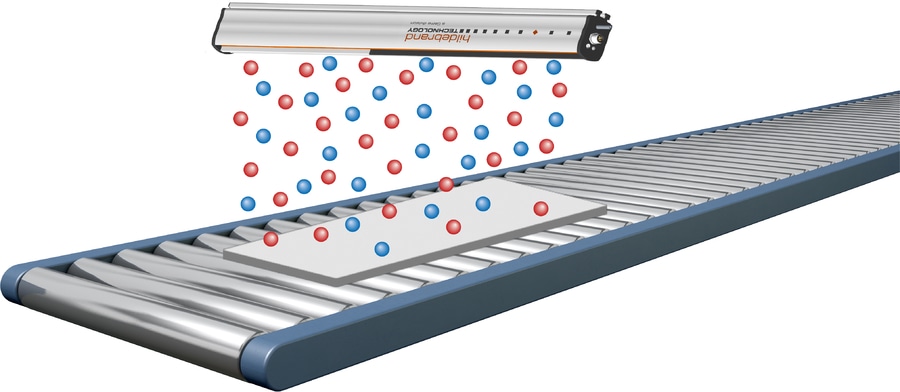
Hildebrand Technology offers a number of electrostatic solutions for charging and antistatic applications. Every solution has some critical parameters which need to clarify before a decision is taken.
Which amount of charge is to be eliminated or supplied?
What is the maximum web speed?
What is the maximum expected residual charge?
What hazardous locations are we dealing with?
What is the planed Budget?
With above actions we can find together the best solution with the best Electrostatic Technology, where efficiency is high enough to solve the problem and stay inside the budget through reduction of waste material and machine downtime.
Our Engineers are ready to assist you in finding the best solution!