#White Papers
How HYTORC's STEALTH Tool Cut Labor and Boosted Precision for an Indonesian Company
How HYTORC Reduced Heat Exchanger Bolting From 4 Operators to 1 — With Greater Precision and Zero Crush Risk
An Indonesian industrial company eliminated a four-operator manual bolting process for heat exchanger flange assembly by deploying a single HYTORC STEALTH hydraulic torque wrench operating four simultaneous tools via Simultorc.
The result: a 75% reduction in labour requirement, hands-free operation that removed crush-point injury risk entirely, and consistent parallel joint closure — an outcome the previous manual method could not reliably achieve at all.
What Is the Core Problem With Manual Torque Wrenches on Heat Exchanger Flanges?
Heat exchanger bolting requires parallel joint closure — a condition where all bolts across a flange are tightened simultaneously and evenly to achieve uniform gasket compression. Uneven bolt load causes gasket distortion, premature leaks, and joint failure. Achieving true parallel closure with handheld torque wrenches is technically extremely difficult, requiring four operators to apply identical torque at exactly the same moment.
In practice, this is not a process — it is a coordination exercise, and human coordination at that precision level is not repeatable across maintenance cycles.
The Indonesian company's four-wrench manual system created three compounding problems that were costing the business in downtime, labour, and component integrity.
What Challenges Did the Indonesian Company Face With Manual Heat Exchanger Bolting?
1. Labour Intensity and Operational Inefficiency
The existing process required four skilled technicians operating individual handheld torque wrenches simultaneously for every bolting cycle. Coordinating four operators to achieve synchronised torque application introduced significant delays — and any breakdown in timing or communication required the sequence to restart.
Four technicians per bolting event also meant four times the labour cost per maintenance cycle, compounded across every heat exchanger in the facility's maintenance schedule.
2. Safety Risks From High-Torque Manual Operation
Handheld torque wrenches in high-torque heat exchanger applications create sustained physical load on operators. Repeated use leads to fatigue, muscle strain, and elevated risk of hand and wrist injury — particularly when operators are required to hold position and maintain force simultaneously with colleagues.
The coordination requirement added a secondary hazard: a mistimed release or unexpected slip by one operator creates unpredictable force transfer across the joint, exposing all four operators to sudden load events.
3. Inconsistent Bolt Load and Risk of Gasket Failure
Manual torque wrench output varies between operators and between passes, even among skilled technicians. This inconsistency translates directly into uneven gasket compression across the flange face. Unevenly compressed gaskets leak, distort, and fail ahead of their design service life — requiring rework, unplanned shutdown, and early component replacement.
In heat exchanger applications, where internal media may be corrosive, high-temperature, or high-pressure, a compromised gasket joint is not just a maintenance issue — it is a process safety event.
According to the Hydraulic Institute, uneven flange bolt loading is among the leading causes of heat exchanger gasket failure and associated process fluid leakage in industrial plants — making bolt load consistency a direct operational safety variable.
What Is the HYTORC STEALTH Simultorc System and How Does It Work?
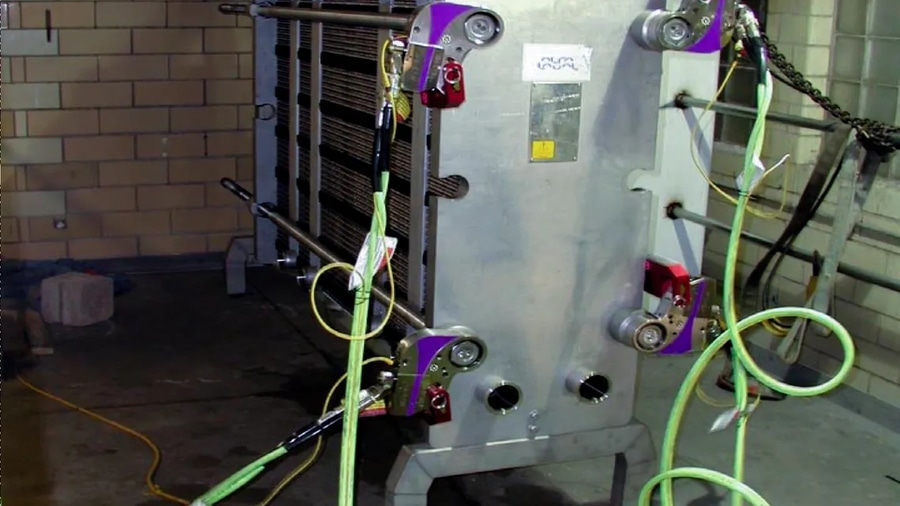
The HYTORC Simultorc system connects multiple STEALTH hydraulic torque tools to a single centralised hydraulic pump. When the operator activates the pump, all connected tools apply torque simultaneously — at identical pressure, therefore identical torque output — across all bolts in the same instant.
This is mechanically guaranteed parallel closure. It does not depend on operator coordination, timing, or physical consistency. The hydraulic system delivers the same pressure to every tool simultaneously, which is something four individual operators with handheld wrenches cannot replicate.
How the HYTORC STEALTH Simultorc system works:
• One centralised hydraulic pump feeds multiple STEALTH torque tools
• All tools pressurise and apply torque at the same moment from a single operator activation
• Torque output across all tools is equal because it is driven by a single, regulated pressure source
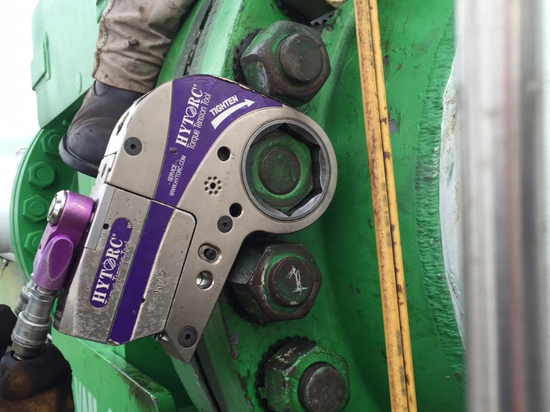
• The STEALTH's reaction arm-free design means no external bracing surface is required at any bolt position
• One operator monitors and controls the entire multi-tool bolting sequence
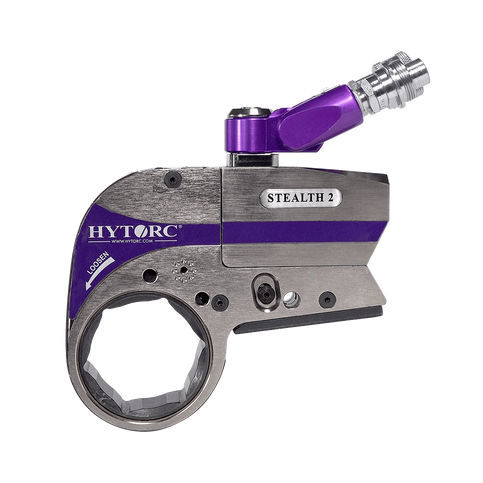
The STEALTH tool itself is a low-profile hydraulic torque wrench engineered for confined-space access. Its slim head profile fits into flange bolt positions where standard square-drive tools cannot engage without modification, and its reaction arm-free design — enabled by the HYTORC Washer system — removes the primary crush-point hazard from the bolting process entirely.
Why Parallel Joint Closure Matters in Heat Exchanger Maintenance
Heat exchangers operate under continuous thermal cycling — expanding and contracting as process temperatures rise and fall. The gasket between flange faces must maintain consistent compression across its full face to seal under this dynamic load. If bolt tension is uneven at assembly, the gasket begins its service life already compromised at the under-loaded positions.
Thermal cycling then works to open the low-load positions further, leading to micro-leakage, accelerated gasket degradation, and eventual full joint failure — often well before the component's design service interval.
True parallel closure — all bolts reaching target load simultaneously — is the engineering standard that prevents this failure mode. It is specified in ASME PCC-1 guidelines for pressure boundary joint assembly and in the European Pressure Equipment Directive's associated technical standards. Achieving it mechanically, through simultaneous hydraulic tool operation, is the only method that delivers it consistently across every maintenance cycle rather than on a best-effort basis.
What Industries and Applications Require Parallel Joint Closure Bolting?
The problem this Indonesian company faced — needing simultaneous, equal bolt load across multiple fasteners — is a standard engineering requirement wherever gasketed flange joints operate under pressure, temperature, or cyclic load. The HYTORC Simultorc approach applies directly to:
• Heat exchangers in petrochemical, refining, and chemical processing — the application in this case study
• Pressure vessels where full-face gasket compression is required for pressure boundary integrity
• Reactor flanges in chemical and pharmaceutical manufacturing
• Pipeline flanges in oil and gas transmission systems
• Turbine and compressor casing joints in power generation and industrial gas processing
• Offshore and subsea equipment where access constraints and safety requirements compound the challenge
• Any gasketed joint where uneven bolt load creates leak risk, rework cost, or process safety exposure
Frequently Asked Questions: HYTORC Heat Exchanger Bolting
What is Simultorc and how does it achieve parallel joint closure? Simultorc is HYTORC's simultaneous multi-tool bolting system. Multiple STEALTH hydraulic torque tools are connected to a single hydraulic pump. When the pump is activated, all tools receive equal pressure and apply equal torque at the same instant — mechanically guaranteeing parallel closure without relying on operator coordination.
How many operators does the HYTORC Simultorc system require? One. A single operator controls the hydraulic pump that drives all connected tools simultaneously. In this Indonesian case study, this replaced a four-operator manual process — reducing labour per bolting cycle by 75%.
Why can't skilled operators with manual torque wrenches achieve parallel closure? Manual torque wrenches — even when operated by four skilled technicians simultaneously — cannot guarantee identical torque application at identical moments. Minor differences in operator force, speed, and timing create differential bolt load across the flange face. These differences may be small per pass but accumulate across multiple tightening passes, resulting in measurable bolt load variation at final torque. Hydraulic systems eliminate this variable by applying a single regulated pressure to all tools from one source.
Is the HYTORC STEALTH suitable for confined flange bolt positions in heat exchangers? Yes. The STEALTH is specifically designed for low-clearance applications. Its slim head profile accesses bolt positions that standard square-drive hydraulic tools cannot reach without workarounds, making it the appropriate tool for heat exchanger and vessel flanges where bolt spacing and shrouding limit tool access.
What torque accuracy does the HYTORC STEALTH deliver? The STEALTH hydraulic torque wrench delivers torque accuracy within ±3% of target value. This compares to ±15–25% typical for manual torque wrenches and ±25–30% for impact wrenches, making hydraulic tooling the recognised standard for precision flange bolting in critical industrial applications.
What is the risk of not achieving parallel closure on a heat exchanger flange? Uneven gasket compression leads to localised over-stress and under-stress across the gasket face. Under-stressed areas are susceptible to leakage; over-stressed areas are susceptible to gasket crushing and permanent deformation. Either condition shortens gasket service life, increases leak frequency, and drives unplanned maintenance — in process environments, potentially triggering a safety or environmental incident.
Elevate Your Heat Exchanger Bolting Standards
If your facility is still using multiple manual torque wrenches for heat exchanger or pressure vessel flange assembly, the operational and safety case for change is clear. Four operators, variable outcomes, and elevated injury risk are not engineering constraints — they are symptoms of tooling that has not kept pace with what precision bolting now requires.
HYTORC works with maintenance and reliability teams across petrochemical, refining, power, and industrial manufacturing to replace manual bolting processes with hydraulic systems that deliver consistent, verifiable, and safe bolt load — every cycle.
Contact HYTORC to discuss your heat exchanger bolting requirements
Published by HYTORC | Updated May 2026 | Based on HYTORC field deployment, Indonesia
HYTORC is a global manufacturer of industrial bolting systems, serving petrochemical, oil and gas, power generation, aerospace, and heavy industry since 1968.