#Industry News
How HYTORC Bolting Solutions Support Deep Space Rocket Assembly and Engine Testing
What Bolting Challenges Does Aerospace and Space Exploration Present?
How HYTORC Bolting Solutions Support Deep Space Rocket Assembly and Engine Testing
HYTORC engineered custom bolting solutions for a national deep-space launch programme, eliminating manual load cell handling during engine testing and resolving a critical absence of reaction points in 75-ton component ground transport systems. The deployment of reaction fixtures, HYTORC Washers, Smart Studs, and STEALTH hydraulic torque tools reduced personnel injury risk, accelerated assembly timelines, and delivered the bolt load precision aerospace structural integrity demands.
What Bolting Challenges Does Aerospace and Space Exploration Present?
Space launch systems operate at the extreme end of engineering tolerance. Every bolted joint in a rocket assembly — from engine test stands to ground transport cradles — must meet exact torque specifications. Under-torqued joints risk structural failure; over-torqued fasteners risk thread damage in components that cannot be easily replaced or re-machined.
The aerospace sector presents three bolting conditions that standard industrial tools cannot reliably address:
• Extreme torque accuracy requirements where specification deviation of any kind is unacceptable
• Confined or geometrically complex assemblies where reaction arm access is restricted or impossible
• Safety-critical personnel exposure during manual handling of large, heavy test components
In this deployment, both of the primary challenges — load cell handling risk and transport system bolting — fell into categories where conventional tooling created unacceptable operational and safety exposure.
What Were the Specific Challenges in This Space Launch Programme?
Challenge 1 — Manual Load Cell Handling During Engine Testing
During engine test phases, personnel were required to manually position and handle oversized load cells — instruments used to measure thrust and structural force outputs during rocket engine firing sequences. These components are large, heavy, and must be positioned with precision in environments that carry additional hazard from proximity to active test systems.
Manual handling of this nature exposes highly skilled engineers and technicians to musculoskeletal injury risk and creates a bottleneck: if a handling incident occurs, the test sequence is delayed, potentially by days, at significant programme cost.
Challenge 2 — Bolting 75-Ton Components Without Reliable Reaction Points
Ground transport systems used to move 75-ton rocket components between assembly facilities presented a structural bolting problem. The geometry of these assemblies offered no reliable surface for a standard reaction arm to brace against during torque application. Without a stable reaction point, controlled torque delivery is impossible — and uncontrolled torque application in structural aerospace bolting is not a viable option.
This gap was causing assembly delays and workflow inefficiency across the programme's ground operations.
What HYTORC Solutions Were Deployed in the Space Programme?
HYTORC Louisiana worked directly with the programme's engineering team to develop application-specific solutions for each challenge rather than adapting off-the-shelf tooling to conditions it was not designed for.
1. Custom-Engineered Reaction Fixtures for Load Cell Operations
HYTORC designed and fabricated custom reaction fixtures for the engine test load cell workflow. These fixtures replaced manual positioning and handling with a mechanical system, removing personnel from the high-risk manual handling exposure entirely.
The result was a safer testing environment and a more repeatable, documentable process — both critical requirements in aerospace quality assurance frameworks.
2. HYTORC Washers and Smart Studs for Reaction-Free Bolting
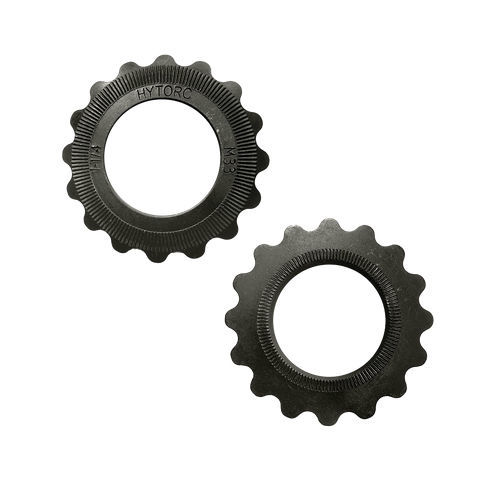
To resolve the absent reaction point problem in ground transport system assembly, HYTORC introduced its Washer and Smart Stud system. The HYTORC Washer sits beneath the nut and provides the tool's bracing surface directly at the joint — eliminating the need for any external reaction point.
How the HYTORC Washer system works in practice:
• The washer is installed beneath the nut before bolting begins
• The torque tool reacts against the washer rather than an external arm
• The operator's hands remain clear of pinch points throughout the bolting cycle
• Simultaneous multi-tool bolting becomes achievable, compressing overall cycle time
Smart Studs extend this capability by providing integrated tension verification at the fastener level, enabling engineers to confirm correct bolt load without secondary measurement steps.
3. HYTORC STEALTH Hydraulic Torque Tools for Precision Torque Delivery
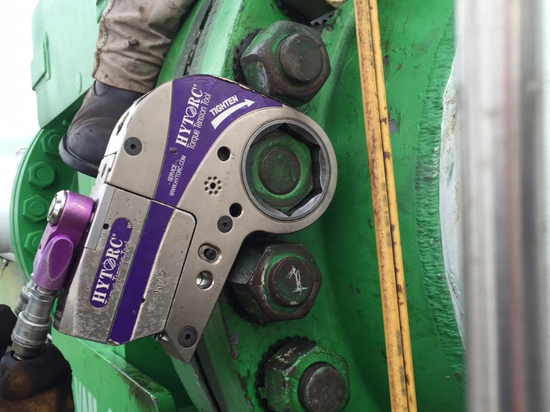
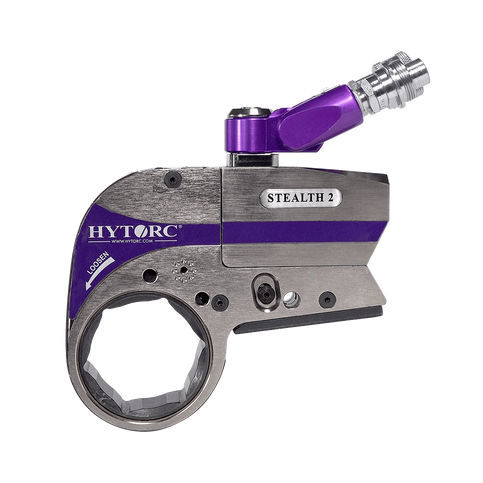
The STEALTH hydraulic torque wrench was deployed across bolting operations requiring both confined-space access and calibrated torque output. In aerospace assembly, where fastener specifications are defined to precise ft-lb values and deviation is not permissible, the STEALTH's accuracy profile directly supports structural certification requirements.
While programme-specific performance data remains confidential, the outcomes across all three solution areas — safety, efficiency, and torque accuracy — were confirmed as transformative by the engineering team.
Why Bolting Precision Is Mission-Critical in Aerospace
In commercial and industrial applications, a bolting error may result in a leak, a maintenance call, or an unplanned shutdown. In aerospace, the consequences of a joint failure are categorically different.
Rocket structures operate under simultaneous thermal, vibrational, and compressive loads that exceed those of virtually any other engineering environment. A single under-torqued fastener in a structural flange or engine mount can compromise the entire assembly's load path. This is why aerospace bolting standards — including those referenced in NASA technical standards and ESA mechanical design requirements — specify not just torque values but tool calibration, process documentation, and verification methodology.
HYTORC's bolting systems are used across aerospace and defence applications precisely because they deliver the combination of accuracy, repeatability, and safety performance that mission-critical environments require.
According to industry engineering data, hydraulic torque tools achieve torque accuracy within ±3% of target value — compared to ±25–30% for standard impact wrenches — making calibrated hydraulic tooling the recognised standard for structural aerospace fastening.
What Industries and Applications Benefit From HYTORC's Aerospace Bolting Solutions?
The bolting challenges encountered in space launch programmes are not unique to that sector. The same combination of high torque accuracy, confined geometry, absent reaction points, and safety-critical personnel exposure appears across:
• Aerospace and defence — aircraft engine assembly, launch vehicle structures, ground support equipment
• Power generation — gas turbine assembly, nuclear containment bolting, large generator flanges
• Oil and gas — subsea assembly, offshore platform structural connections, refinery critical flanges
• Heavy industrial — mining equipment assembly, large rotating machinery, bridge and civil infrastructure bolting
• Research and test facilities — structural test rigs, load frame assembly, precision measurement systems
In each case, the core requirement is the same: controlled, verifiable bolt load, delivered safely, in the geometry the application presents.
Frequently Asked Questions: HYTORC Aerospace and Precision Bolting
What makes HYTORC suitable for aerospace bolting applications? HYTORC hydraulic torque tools deliver calibrated torque output within ±3% of target value — the accuracy level required for structural aerospace fastening. Combined with the HYTORC Washer system for reaction-free operation and Smart Studs for integrated load verification, the system supports the precision, safety, and documentation requirements of aerospace quality assurance standards.
What is a HYTORC Smart Stud? A HYTORC Smart Stud is an instrumented fastener that provides real-time bolt load feedback during tightening. Rather than relying solely on applied torque as a proxy for bolt tension, Smart Studs allow engineers to verify actual clamp load — a critical distinction in high-specification structural assemblies.
Can HYTORC develop custom bolting solutions for non-standard applications? Yes. HYTORC Louisiana operates a custom engineering capability that works directly with programme engineers to design application-specific fixtures, tooling configurations, and bolting systems for conditions where standard products are insufficient. The reaction fixtures developed for this space programme's load cell operations are one example of this capability.
How does the HYTORC Washer system eliminate reaction points? The HYTORC Washer provides the torque tool's bracing surface at the joint itself — beneath the nut — rather than requiring an external reaction arm braced against an adjacent structure. This makes it possible to bolt in geometries that offer no suitable external reaction surface, and removes the crush-point injury risk associated with reaction arm operation.
What torque range does the HYTORC STEALTH cover? The STEALTH hydraulic torque wrench range covers applications from light structural to heavy industrial torque requirements. Specific range and configuration recommendations depend on fastener size, specification, and access geometry — contact HYTORC for application-specific guidance.
Work With HYTORC on High-Specification Bolting Applications
Whether your project involves rocket assembly, turbine installation, subsea infrastructure, or any application where standard bolting approaches fall short of what the engineering demands, HYTORC has the tooling, the engineering capability, and the field experience to deliver.
HYTORC Louisiana specialises in custom bolting solutions for complex, safety-critical, and high-accuracy applications across aerospace, energy, and heavy industry.
Published by HYTORC | Updated May 2026 | Based on HYTORC Louisiana field deployment in support of a national deep-space launch programme
HYTORC is a global manufacturer of industrial bolting systems, serving aerospace, oil and gas, power generation, and heavy industry since 1968.