#Industry News
How do you calculate the protection area of an ESE lightning rod?
One of the most important aspects of designing a lightning protection system is to check that the entire installation is effectively protected. To do this, it is necessary to determine the protection zone provided by the lightning conductor and ensur
PROTECTION BEGINS AT THE DESIGN STAGE
Before selecting an air terminal or defining its location, it is essential to answer a fundamental question: does the installation require a lightning protection system?
In Spain, this assessment is carried out in accordance with the Technical Building Code (CTE), and more specifically according to Basic Document DB SUA 8, which establishes a risk analysis procedure to determine in which cases a structure must be protected and what level of protection must be applied. However, the CTE does not specify how to design the system or how to calculate the protection zone. Once the need to protect the structure has been established, reference must be made to the specific standards governing the design of these systems.
WHAT IS THE PROTECTION ZONE?
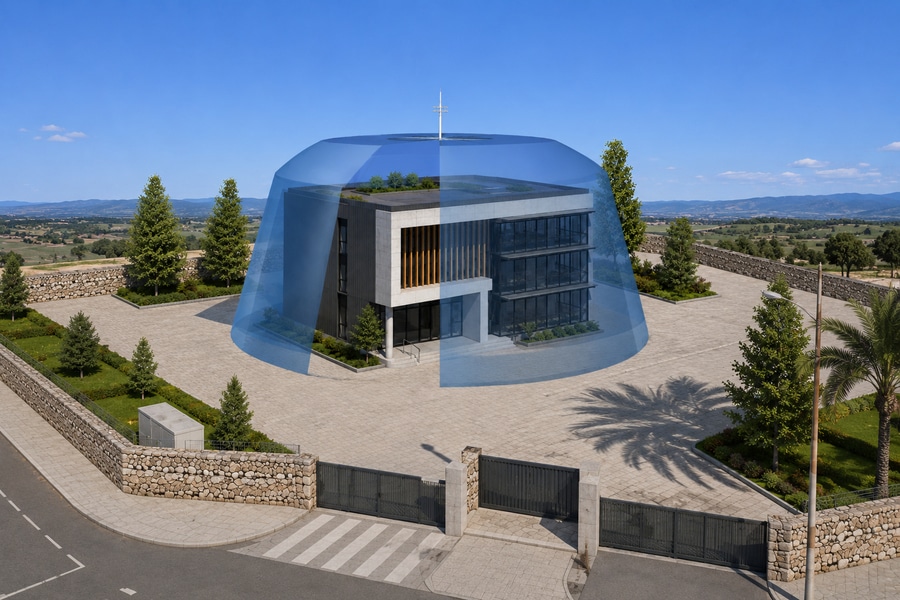
The protection zone is the volume within which a structure is protected against direct lightning strikes, in accordance with the criteria defined by the regulations. In the case of Early Streamer Emission air terminals (ESE), the UNE 21186 standard establishes the method for determining this protection zone from different project parameters.
The main factors taken into account in the calculation are the following:
- The height of the air terminal with respect to the reference plane.
- The protection level required for the installation (I, II, III or IV).
- The initiation advance time (ΔT) of the ESE air terminal.
- The geometry of the structure to be protected.
From these parameters, it is possible to determine the corresponding protection radius and to verify that all exposed elements lie within the protected zone. Although this method is based on mathematical formulas defined by the standard, its purpose is to ensure that the designed system provides sufficient coverage to protect the entire installation.