
#Product Trends
From EV Charging to V2G: Why Bidirectional MID Metering Is Becoming the Trust Layer of Smart Energy
As Europe accelerates charging infrastructure in buildings, transparent import/export metering is becoming essential for EV charging, solar PV and future vehicle-to-grid applications.
The next stage of EV charging is not only about installing more chargers. It is about making every kilowatt-hour visible, verifiable and easy to manage. In Europe, the revised Energy Performance of Buildings Directive is pushing charging infrastructure closer to where vehicles spend most of their time: homes, workplaces and commercial buildings. The European Commission notes that cars are parked for an average of 23 hours per day, and that by 2030 a large share of charging is expected to happen at private charging points. This shift makes metering a strategic component rather than a small accessory inside a charger.
For charge point operators, building owners and energy service companies, accurate metering supports three basic needs: fair billing, operational visibility and compliance readiness. A meter must record consumption reliably for each charging session, help operators monitor load and energy quality, and provide data that can be integrated into management platforms. This is why industry discussions are increasingly moving from “which charger” to “which metering architecture”.
Bidirectional energy flow makes this requirement even more important. Vehicle-to-Grid (V2G) and Vehicle-to-Home (V2H) turn an electric vehicle into more than a load. The vehicle can store electricity when energy is abundant and feed it back when the grid, a building or a household needs support. In this scenario, a one-way meter is not enough. The system must clearly distinguish import energy from export energy, and it must do so in a way that is trusted by all parties involved.
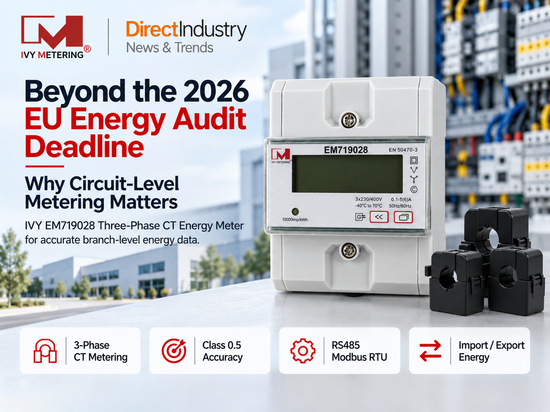
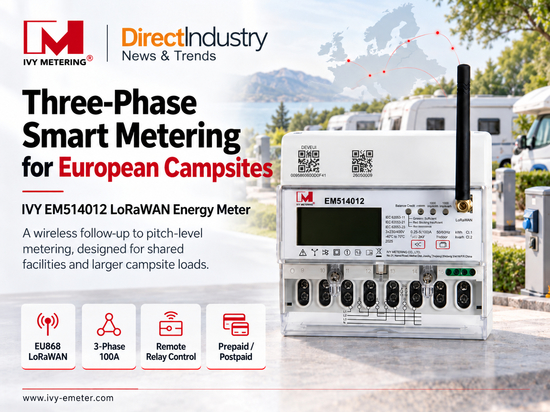
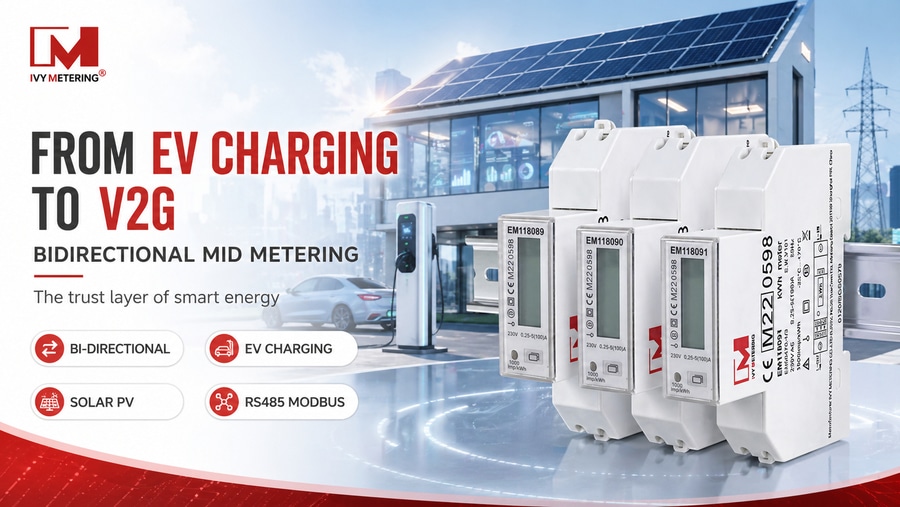
IVY METERING focuses on this trust layer with AC and DC metering solutions for EV charging and renewable energy applications. For AC charging and solar PV scenarios, IVY METERING provides compact DIN-rail bidirectional meters such as the EM118089/EM118090/EM118091 series and three-phase models including EM519032/EM519033/EM519024. These meters are designed for import/export measurement, RS485 Modbus communication, multi-tariff operation and MID-related applications. For DC charging scenarios, IVY also provides DC metering options for high-current and high-voltage installations.
For system integrators, the value is practical. A compact DIN-rail design helps save space inside chargers or distribution cabinets. RS485 Modbus makes data integration easier for charger controllers and energy management systems. Bidirectional active and reactive energy measurement helps operators build transparent records for EV charging, solar PV self-consumption, net metering and future V2G use cases. When projects expand from a single charger to a network of buildings, these details directly affect installation efficiency, maintenance and long-term scalability.
The market message is clear: the energy transition requires more than new power devices. It requires measurement that can connect hardware, software, users and regulation. As EV charging, solar PV and flexible demand response become part of the same energy ecosystem, bidirectional MID-ready metering will become one of the foundations for transparent billing and smarter energy management.
For manufacturers and operators building the next generation of charging infrastructure, IVY METERING offers a practical path: compact metering hardware, flexible communication and application experience across EV charging and solar energy metering. The result is simple but powerful: every kilowatt-hour can be measured in the right direction, at the right time and with the right level of confidence.