
#Product Trends
From Energy Audits to Actionable Data: Why CT-Type Three-Phase Metering Matters for Retrofit Energy Projects
Energy efficiency targets are becoming more data-driven. For existing buildings and commercial distribution systems, CT-type meters help collect branch-level energy data without replacing the whole electrical infrastructure.
Energy efficiency is moving from a compliance topic to an operational priority. In Europe, the revised Energy Efficiency Directive strengthens the 'energy efficiency first' principle and sets a binding 2030 target for reducing energy consumption. At the same time, ISO 50001 encourages organizations to use data to understand energy use, measure results and continually improve energy performance. For industrial and commercial sites, the message is clear: without reliable metering data, energy-saving plans are difficult to verify.
In many retrofit projects, the challenge is not whether managers want more energy data. The real challenge is how to obtain that data without redesigning the entire distribution system. Existing switchboards, tenant panels, production lines, HVAC equipment and EV charging areas often need branch-level monitoring, but installation space and downtime are limited. A practical submetering solution must therefore be compact, reliable and easy to integrate into existing electrical cabinets.
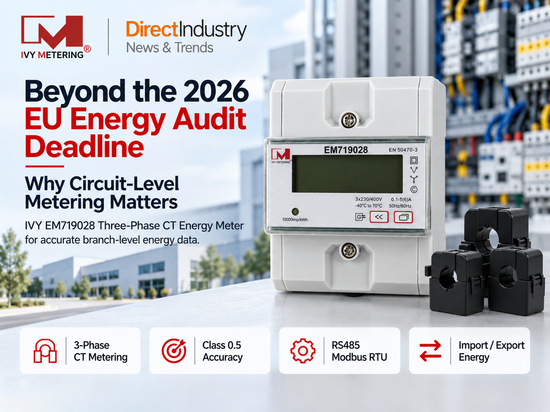
This is where CT-type three-phase metering becomes valuable. Compared with direct-connected meters, a CT-connected energy meter is suitable for higher-current circuits where current transformers are used for measurement. It helps integrators monitor large loads while keeping the metering device compact. For building owners and facility teams, this makes it easier to compare different branches, identify abnormal consumption, support tenant billing and build a clearer energy baseline.
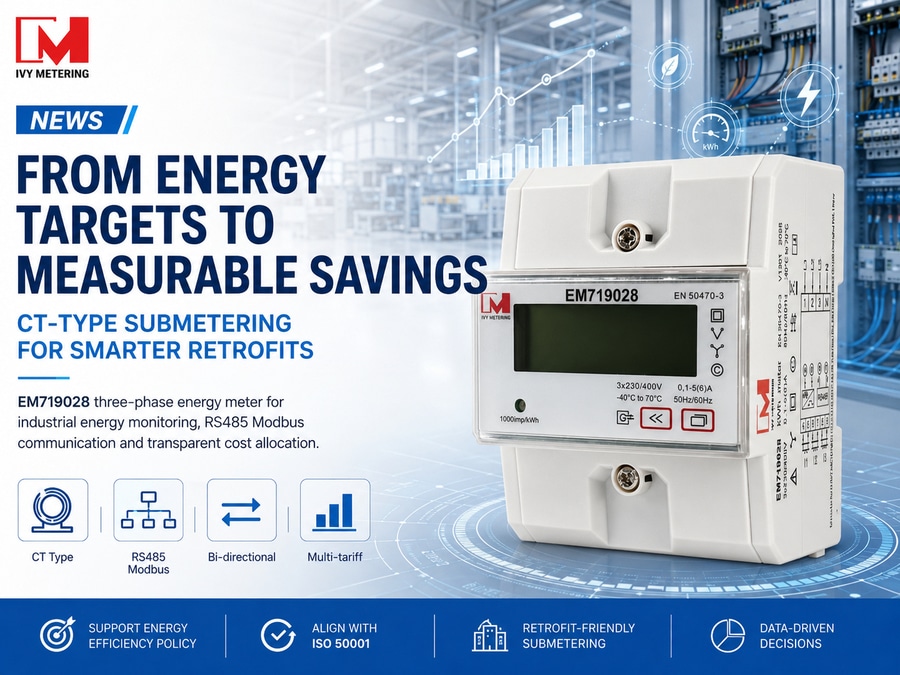
IVY METERING's EM719028 is a three-phase DIN-rail CT-type energy meter designed for these metering applications. On DirectIndustry, the product is presented as a three-phase electric energy meter with DIN-rail assembly, RS485 communication, Modbus, MID certification, LCD display, pulse output, smart metering, multi-tariff and bidirectional characteristics. The product description also highlights RS485 communication, DL/T645 and Modbus-RTU protocol compatibility, multi-tariff functions and multiple metering methods.
For system integrators, dual-protocol RS485 communication is a practical advantage. Modbus-RTU is widely used in energy management systems and building automation, while DL/T645 compatibility can support specific metering environments. This allows the meter to connect with data loggers, gateways or energy management platforms, helping operators move from manual reading to digital monitoring.
Multi-tariff capability also matters as electricity pricing becomes more dynamic. In commercial buildings, campuses and shared facilities, energy cost is not only a monthly total. It may need to be allocated by time period, department, tenant or operating area. A meter that supports configurable tariffs can help project owners create a more flexible and transparent cost-allocation structure.
The broader industry trend is straightforward: energy management depends on field-level data. Policies can define targets and software can visualize dashboards, but reliable decisions still start from the meter installed in the cabinet. For retrofit energy projects, IVY METERING EM719028 offers a practical path to collect three-phase CT metering data, support RS485 integration and make energy-saving actions easier to measure, compare and improve.