


#Industry News
Laser cleaning of automotive headlight molds: the mirror stays intact
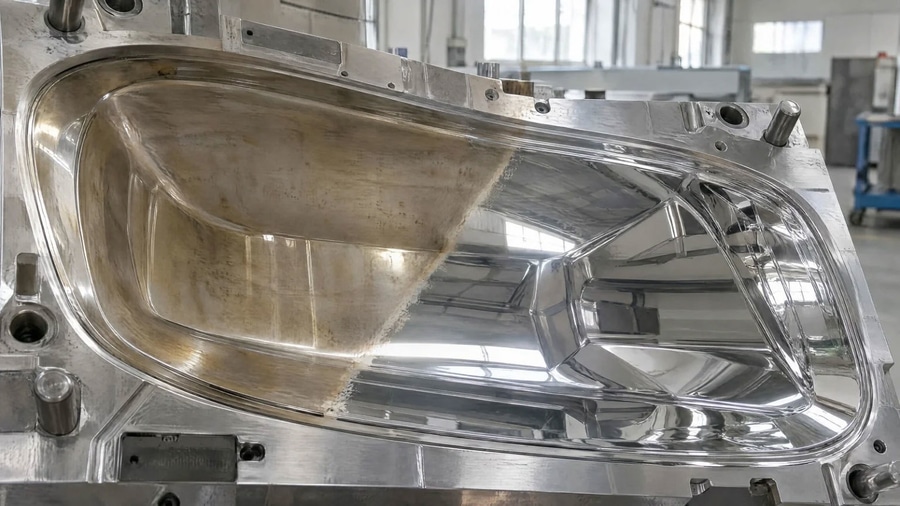
Deposits on automotive headlight molds that transfer onto the lens: laser cleaning removes them with no contact and without affecting the mirror finish
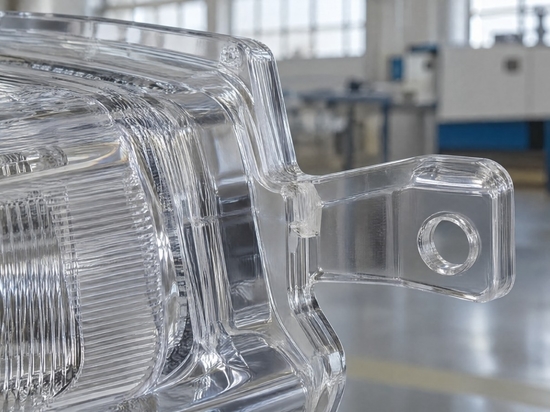
Companies that produce lenses, reflectors, and optical assemblies for automotive lighting work with molds whose cavity is no ordinary surface: it’s a piece of optics in every sense. The headlight beam is born from the geometry and finish of that cavity, and any defect that forms on the mold steel transfers in positive onto the molded part. That’s why a thin film of deposit on the mold becomes, on the finished lens, a haze, a cloudiness, or a distortion of the light beam.
The problem is that optical molds build up deposits with annoying regularity. Molding polycarbonate and PMMA releases degradation products and volatile substances that condense on the cold walls of the cavity; to these are added release-agent residues and the byproducts of additives and stabilizers. Shot after shot, a thin film builds up that first dulls the brilliance of the part and then sends it out of spec.
The temptation is to clean the mold the way it has always been done: solvents, cloths, abrasive pastes, hand polishing. But on a mirror-polished surface every mechanical action is a risk: a single abrasive residue or micro-scratch is enough to compromise the very optical finish that gives the mold its value. Laser cleaning addresses exactly this dilemma, because it removes the deposit without contact and without abrasives, acting selectively on the dirt and not on the metal underneath.
Why deposits form on optical molds
In molding transparent parts, mold contamination is a process phenomenon, not an accident. Optically transparent polymers are processed at high temperatures and, as they degrade, release volatile fractions that migrate toward the colder zones of the cavity and settle there. The foggy effect in automotive lighting comes from the same family of residues, except here what condenses is not the part but the wall that forms it.
The deposit is typically a thin, adherent, uneven organic film. It isn’t always visible to the eye on the polished cavity, but it shows up immediately on the molded part as a loss of transparency, halos, or reduced optical contrast. The moment the lens is no longer optically clean, the mold has to be stopped and treated: and this is where the cleaning method becomes a critical choice.
Why traditional cleaning puts the mirror polish at risk
The mirror finish of an optical mold is the result of progressive polishing—long and costly, often carried down to the micron level. It’s a surface that is fragile precisely in its perfection: anything that drags across it leaves a mark. Abrasive pastes remove a fraction of the metal along with the dirt and tend to round off the sharp edges of the optical geometry; aggressive solvents can leave halos or attack any coatings; hand cleaning depends on the operator’s touch and is not repeatable.
Compared with blasting methods the issue is even clearer: as already discussed regarding laser cleaning versus sandblasting, any abrasive projected against a polished surface alters its micro-roughness. On an optical mold this means turning a mirror wall into a satin wall—in other words, throwing away the polishing work. Traditional cleaning, in short, solves the deposit problem while often creating a worse problem on the finish.
How laser cleaning removes deposits without contact
Laser cleaning exploits a physical difference between the deposit and the mold metal. The organic film absorbs the radiation of the pulsed fiber laser far more than the polished steel beneath it, and for every material there is an ablation threshold, a value of energy above which the material is removed. By setting the process so that the energy exceeds the deposit’s threshold but stays below the steel’s, the dirt is removed while leaving the surface intact.
Pulse energy Material removed Deposit has lower threshold than polished steel
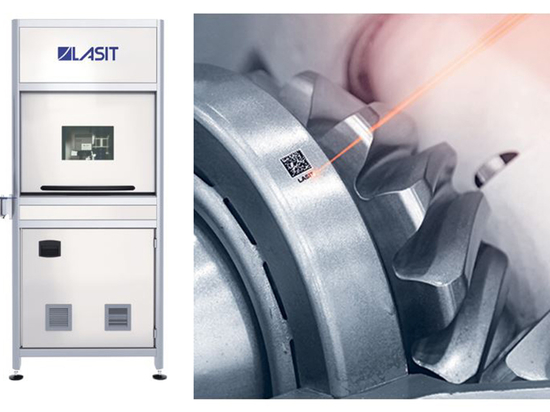
The short pulse concentrates the energy in a very brief span of time: the deposit vaporizes or detaches through micro-expansion, while the heat that reaches the metal stays contained. It’s the same principle behind surface decontamination with cleaning lasers: a selective process, controllable at the parameter level and repeatable, because it doesn’t depend on the pressure of a hand but on set, recallable values. On top of that, it’s a dry process that introduces no abrasive consumables and no solvents to dispose of.
Mirror or textured mold: the finish changes the process
Not all optical molds have the same finish, and that matters. On mirror-polished cavities for transparent lenses the goal is to remove the film without touching the brilliance: the process window must be tuned tight, favoring gentleness over speed. On textured or microstructured surfaces, typical of certain reflectors, the deposit nests inside the texture and the cleaning has to reach it without flattening the relief that produces the intended optical effect.
In both cases the premise is the same: before treating a mold in production, the process is qualified on a sample or a test area, verifying under the microscope that the original finish is preserved. The laser’s selectivity makes it possible to adapt the parameters to the finish, but precisely because every surface has its own threshold, the cycle must be defined case by case and not transferred blindly from one mold to another.

 鄂公网安备42018502009509号