#Product Trends
A Practical Checklist for Emitter-Detector Matching in NDIR Gas Sensing
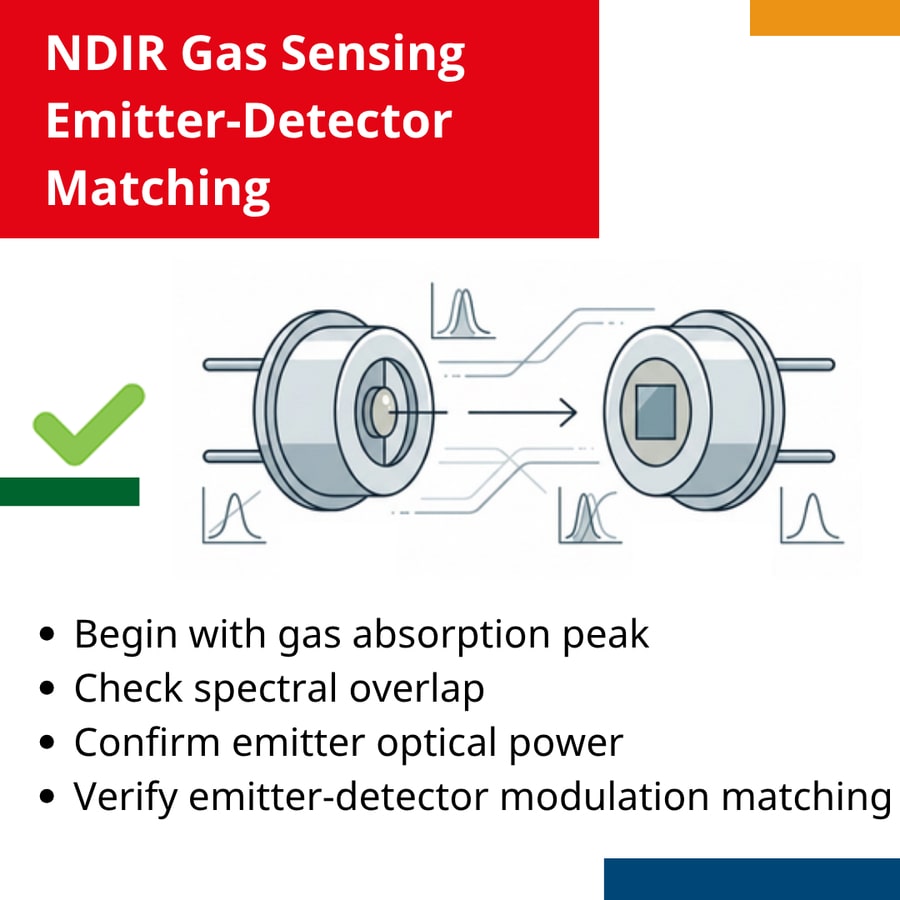
Matching an IR emitter and a pyroelectric detector for NDIR sensing is not just about picking two compatible parts.
The critical checks are spectral overlap, filter alignment, modulation behavior, and the use of sensing/reference channels where needed.
A simple rule: define the gas first, then match the emitter output and detector filter to that absorption band, and finally verify time-constant behavior and real-world operating conditions.
Checklist: matching IR emitters and pyroelectric detectors for NDIR gas sensing
Start with the target gas and identify its main IR absorption wavelength before choosing components.
Check for spectral overlap between the gas absorption band, the emitter output spectrum, and the detector sensitivity range.
Confirm that the emitter delivers enough radiation in the wavelength region where the target gas absorbs.
Verify that the detector filter’s center wavelength (CWL) is aligned with the gas absorption peak.
Choose a half bandwidth (HBW) that balances selectivity and signal strength, since narrower bands improve specificity while wider bands admit more IR energy.
Review filter tolerances as well, because CWL and HBW variation affects real-world matching.
For CO₂, use the ~4.26 µm absorption band as the reference point for emitter and detector selection.
Consider whether you need a reference channel in addition to the sensing channel to compensate for drift, temperature effects, and emitter aging.
If you use a multi-channel detector, make sure the emitter can support all filtered channels with sufficient optical power.
Match the emitter’s modulation behavior to the detector’s thermal response, because pyroelectric detectors only generate a signal when temperature changes.
Aim for an emitter that is slightly faster than the detector, since that produces a cleaner modulated signal and stronger response.
Check ambient conditions and possible cross-gas interference before finalizing the pairing.
Treat emitter-detector matching as a system decision, not a parts decision, because accuracy and reliability depend on how the whole optical path works together.
Getting NDIR gas sensing right starts long before calibration. Our white paper explains how to match IR emitters and pyroelectric detectors for stronger signal quality, better selectivity, and more reliable sensing performance. It covers the essentials behind spectral overlap, detector filter selection, emitter-detector time constants, and why these details matter so much in real sensor design, using CO₂ detection as a practical example.
The link is in the comments below:
https://www.microhybrid.com/en/blog/post/optimierung-der-ndir-gasmessung-das-perfekte-zusammenspiel-von-ir-emittern-und-pyroelektrischen-detektoren