#Product Trends
Need a Five Point Checklist for Matching IR Emitters and Detectors?
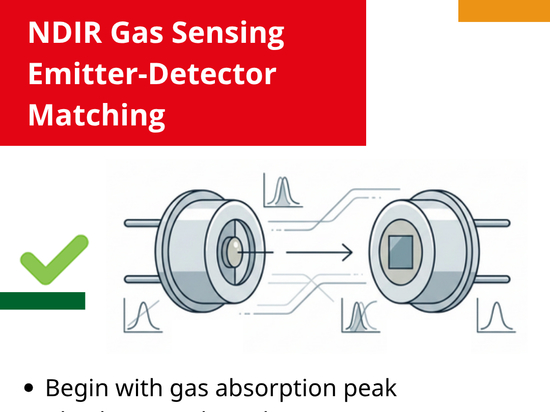
We’ve turned the first five points of our Checklist for Matching IR Emitters and Detectors into a quick slideshow to highlight the fundamentals of effective emitter-detector pairing in NDIR gas sensing, including target gas definition, spectral overl
It’s a short teaser, but these early decisions have a big impact on measurement quality and system performance.
You’ll find the full blog post in the comments, where the complete process is outlined step by step – and a downloadable PDF to help you through the process.
Optimizing NDIR Gas Sensing: Matching IR Emitters and Pyroelectric Detectors
Assembling an effective pyroelectric NDIR gas sensor involves more than simply combining a few off-the-shelf components. The performance, accuracy, and reliability of Non-Dispersive Infrared (NDIR) gas sensors depend heavily on how well the IR emitter and pyroelectric detector are matched to the specific gas being measured.
That matching process can be more complex than it first appears. To achieve reliable sensing, both components must be selected with the gas’s absorption behavior in mind, along with the optical, thermal, and system-level requirements of the application. Using carbon dioxide (CO₂) monitoring as a case study, this guide explains the core principles behind effective emitter-detector pairing and includes a downloadable PDF checklist at the end.
1) Identify the target gas and its absorption wavelength
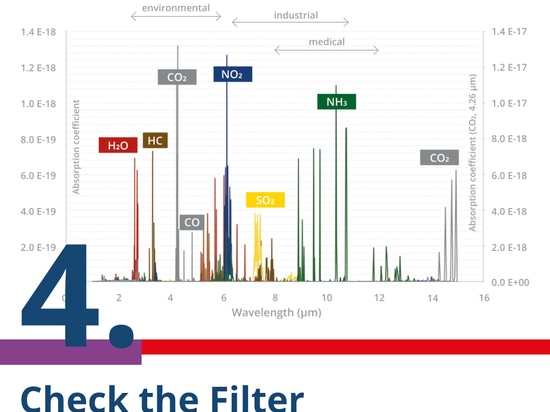
The first step in designing an effective pyroelectric NDIR gas sensor is to define the gas you want to measure, because that choice determines the rest of the system design. In NDIR sensing, each gas absorbs infrared radiation at specific wavelengths, so the emitter and detector must be matched to the absorption behavior of the target gas.
Using CO₂ as an example, the main absorption band is around 4.26 µm, which means the sensing system must be designed to generate, transmit, and detect radiation in that region of the spectrum. If the target wavelength is not identified correctly at the beginning, the overall sensor design will be misaligned from the start.
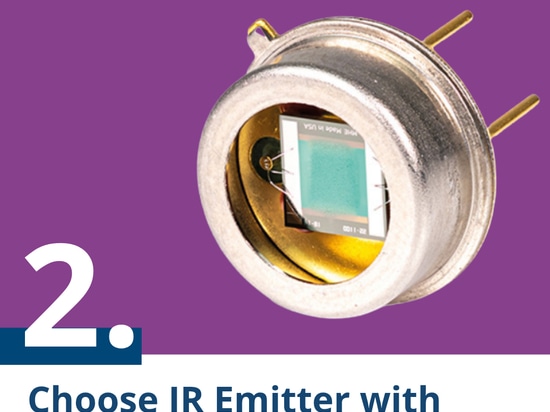
2) Choose an IR emitter with spectral overlap
Once the target gas and absorption wavelength are known, the next step is to choose an IR emitter that produces sufficient radiation in the relevant spectral range. The key requirement is not just broad output, but meaningful output at the wavelength where the gas absorbs.
For this CO₂ example, the emitter must provide strong usable radiation around 4.26 µm. The JSIR350-4-AL-R-D6.0-N2-A2 is a suitable example because its emission range extends broadly from about 2 to 15 µm, which includes the CO₂ absorption region described above. Broad overlap alone is not enough, however, if the intensity at the target wavelength is too low to support reliable sensing.
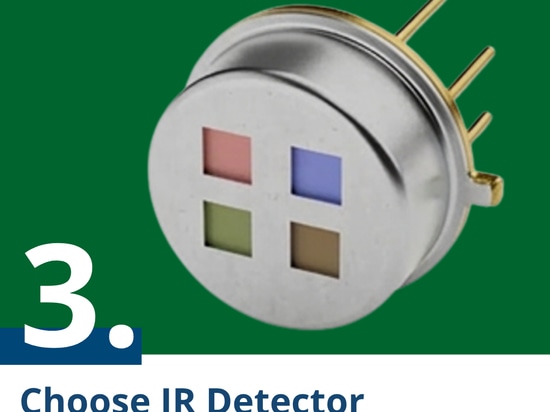
3) Choose an IR detector with the right filter
After selecting the emitter, the detector must be chosen so that its optical filter aligns with the gas absorption peak. In a pyroelectric NDIR sensor, the detector does not simply respond to all incoming IR radiation equally; the filter determines which part of the spectrum reaches the sensing element.
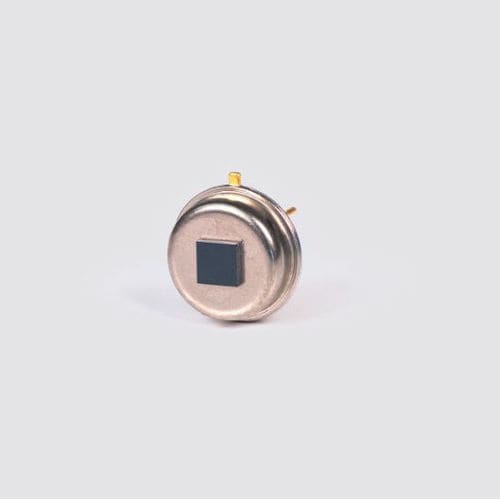
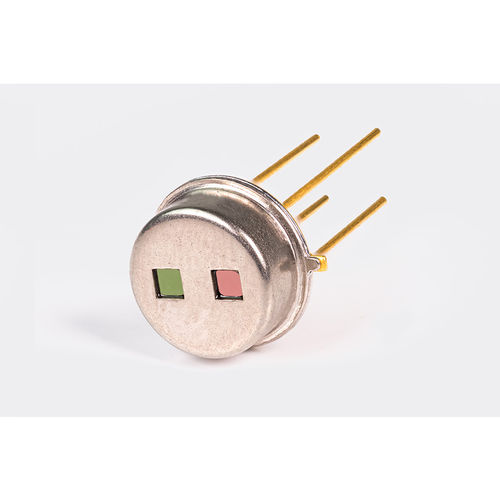
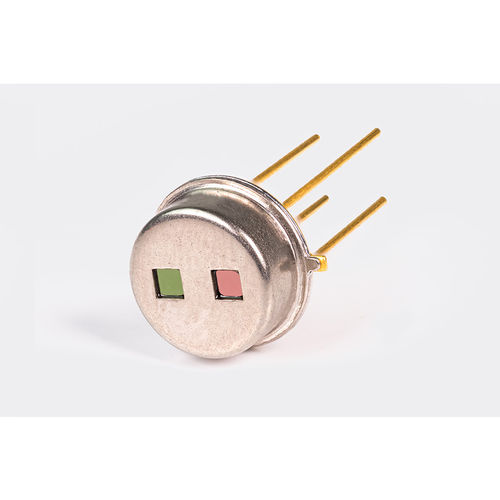
For this example, the PS2x4C2-A-U-S1.5-Kr-E1/D2 is an appropriate detector because its filter configuration is intended to align with the CO₂ absorption band and the emitter output. This pairing is important because the detector’s sensitivity range must match both the radiation produced by the emitter and the wavelength region where the target gas absorbs.
4) Check the filter center wavelength
A well-matched detector filter must be centered very close to the target gas absorption wavelength. For CO₂, a filter centered near 4.265 µm is a strong match, because that closely aligns with the gas absorption peak.
In the case of the PS2x4C2-A-U-S1.5-Kr-E1/D2, the filter specification is 4265 ± 25 nm, which places it appropriately in the CO₂ absorption region. This kind of alignment is one of the most important principles in NDIR design, because the emitter spectrum, gas absorption band, and detector filter all need to overlap in the same useful region.
5) Check the bandwidth and tolerances
Filter bandwidth must also be reviewed carefully, because it affects both selectivity and signal strength. A narrower half bandwidth improves gas selectivity, while a wider half bandwidth allows more IR energy to pass through and can improve the usable signal level.
For the detector in this example, the half bandwidth is 120 ± 10 nm, which represents a practical balance between isolating the CO₂ signature and allowing enough radiation to reach the sensing element. Tolerances matter as well, because real manufacturing variation in CWL (Center Wavelength) and HBW (Half Bandwidth) can influence real-world sensor behavior even when the nominal specifications look ideal on paper.
Read the whole blog post and downlad the PDF here...
https://www.microhybrid.com/en/blog/post/Optimizing-NDIR-Gas-Sensing-Matching-IR-Emitters-and-Pyroelectric-Detectors