#Product Trends
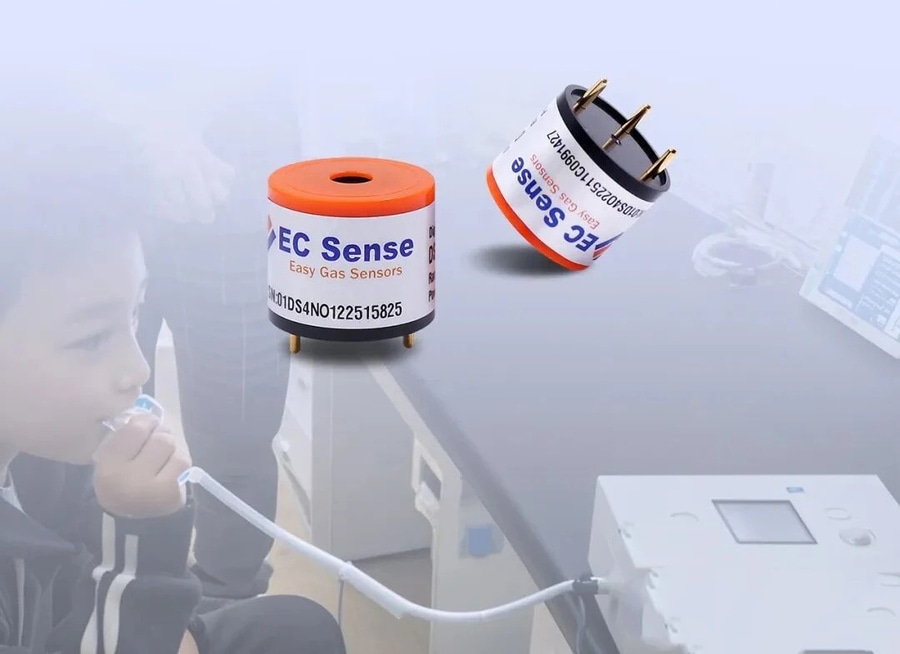
EC Sense Nitric Oxide Sensor
Precisely Capturing Every Breath to Facilitate Disease Screening Based on Exhaled Breath Analysis
In current precision medicine, chronic disease screening and clinical auxiliary diagnosis, exhaled gas detection has gradually become a non-invasive and efficient monitoring method. As an important marker for inflammation, respiratory diseases and metabolic abnormalities, the detection sensitivity and data stability of nitric oxide (NO) are directly related to the application effect.
The DS4-NO intelligent digital PPB-level nitric oxide sensor is tailor-made for harsh application environments such as exhaled breath detection. It has multiple performance advantages including high precision, fast response and ultra-low drift, helping medical and health monitoring achieve precise perception "starting from molecules".
Application Requirements, Pain Points and Solutions
User Pain Points
•The NO concentration in exhaled breath detection is as low as tens of PPB, and conventional sensors cannot respond stably.
•The humidity in exhaled breath reaches more than 95% RH instantly, making the sensor prone to drift or inaccuracy.
•The zero point is easily disturbed by temperature and humidity background fluctuations, leading to measurement errors.
•The exhalation scenario involves non-continuous gas exposure, which has extremely high requirements for the response and recovery of the sensor.
•Multiple devices are used in parallel, requiring batch consistency and long-term stability.
•Short service life, sensors need to be replaced every 1-2 years, resulting in high after-sales maintenance costs.
DS4-NO Solutions
•Adopting solid polymer electrochemical technology with ultra-low detection limit (resolution down to 5ppb).
•Capable of long-term stable operation, resistant to high humidity environments above 95% RH, and no risk of liquid migration in the internal electrode structure.
•Built-in open zero calibration protocol, adaptable to different background air environments to ensure zero stability.
•Fast response and fast return to zero, customizable higher sampling frequency to adapt to the pulsed ventilation rhythm of exhalation.
•Full-scale drift and consistency deviation are both less than ±0.5% FS, meeting the integrated assembly requirements of medical equipment.
•The solid polymer sensor has a service life of 5-10 years, which can be extended with proper maintenance and cleaning.
Product Highlights and Technical Advantages
01 Linear Test
DS4-NO-PPB "Linear Test"
(Schematic description: The linear test chart shows the relationship between sensing PB and ventilation concentration (ppm) over sampling time (times/1s). For sensor No. 1958712, the linear equation is y=1.0047x+0.441 with R²=0.9992; for sensor No. 1958715, the linear equation is y=1.0139x-2.1339 with R²=0.9996.)
02 Repeatability Test
DS4-NO-PPB "Repeatability Test"
(Schematic description: The repeatability test chart reflects the variation of sensing PB with sampling time (times/1s), involving S1 concentration and S2 concentration.)
03 Full-Scale Accuracy Error Test
DS4-NO-PPB "Full-Scale Accuracy Error Test"
(Schematic description: The full-scale accuracy error test chart shows the change of sensing PB with sampling time (times/1s), involving S1 concentration and S2 concentration.)
Application Scenarios
•Auxiliary diagnosis of chronic respiratory diseases (e.g., asthma, COPD)
◦Monitor the degree of airway inflammation using changes in exhaled NO concentration
◦Conduct joint analysis with lung function data to provide long-term trend support
◦Realize individualized precision medication evaluation
•Early screening and follow-up management of childhood asthma
◦Exhaled breath detection for children is more inclined to non-invasive and real-time response
◦The fast response and zero-calibratable characteristics of DS4-NO adapt to screening needs in different places
•Exhaled NO monitoring in clinical research
◦Assist in evaluating patients' responsiveness to drugs or treatment plans
◦Monitor NO changes during drug trials
•Integration into sleep-disordered breathing screening equipment
◦Changes in NO emission during apnea and hypopnea
◦Can be built into portable sleep monitoring instruments for real-time data collection
•Intelligent health wearable devices/portable detectors
◦Support low-power Bluetooth/WiFi wireless applications
◦Connect with smart terminals to realize family health early warning
User Value
•Precisely identify tiny changes in exhaled NO concentration, providing key data support for disease screening and chronic disease management
•Reliable and durable, adaptable to high-humidity and dynamic environments, significantly reducing maintenance and replacement frequency
•Integrated intelligent design, supporting protocol integration and batch deployment, reducing the integrated development cost of equipment manufacturers
•High consistency and low drift, ensuring the stability of long-term use in clinical and scientific research
•Open zero calibration mechanism to meet the needs of precise monitoring in complex environmental backgrounds
Product Selection
DS4-O2-25%-FT
(Application scenarios: Evaluate respiratory function and oxygenation status; intra-operative and post-operative anesthesia monitoring; management of chronic respiratory diseases (COPD, interstitial lung disease); first aid and intensive care (hypoxemia early warning))
DS4-CO-50-FT
(Application scenarios: Smoking status assessment, CO poisoning diagnosis, inflammation/hemoglobin metabolism abnormality monitoring)
DS4-H2-100-FT
(Application scenarios: Lactose/fructose intolerance detection (lactose load test); small intestinal bacterial overgrowth (SIBO) breath test; evaluation of abnormal intestinal fermentation)
DS4-H2S-1-FT
(Application scenarios: Marker of oral malodor (halitosis), metabolite of intestinal sulfur-producing bacteria, related to digestive system diseases and periodontal disease)