#Industry News
How Laser-Based Gas Detection Works: The Science Behind TDLAS
The Science Behind TDLAS
Introduction
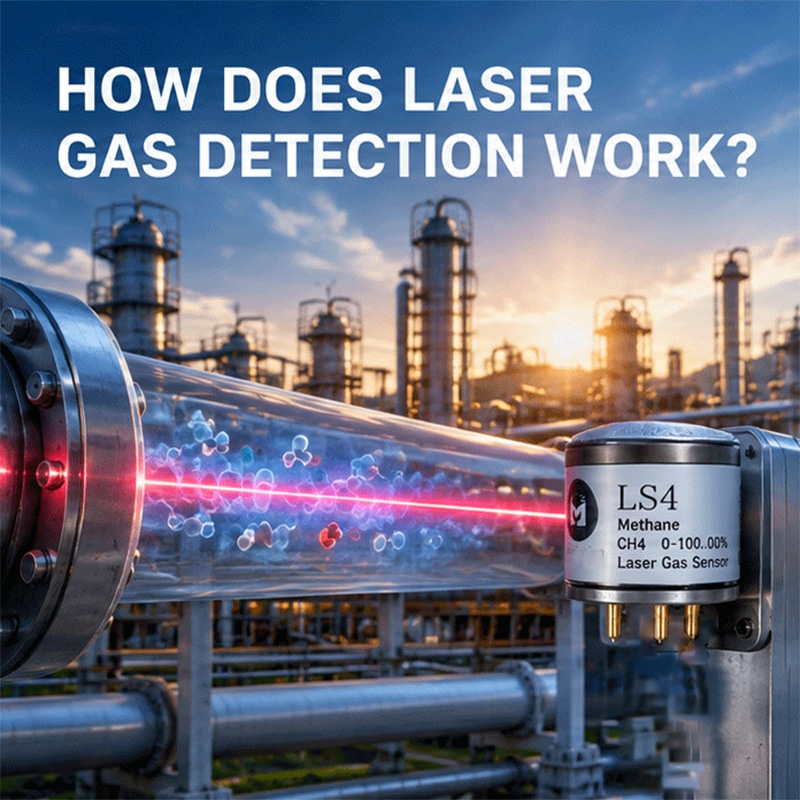
Laser-based gas detection is widely used in industrial applications where reliable, selective and precise gas measurement is required. Among the established techniques, Tunable Diode Laser Absorption Spectroscopy (TDLAS) is particularly valuable for monitoring specific gases in industrial processes and safety-critical environments.
The underlying principle is based on two fundamental concepts: the unique absorption characteristics of gas molecules and the Beer–Lambert law. By selecting an appropriate laser wavelength and measuring how much light is absorbed as it passes through a gas sample, a detection system can determine the presence and concentration of a target gas.
1. Molecular Absorption: Every Gas Has a Spectral Fingerprint
Gas molecules absorb light at specific wavelengths corresponding to transitions between their molecular energy levels. These absorption features are determined by the molecular structure and can be used to distinguish one gas from another.
This characteristic is often described as a molecular spectral fingerprint. When the emitted laser wavelength matches an absorption line of the target gas, the molecules absorb part of the laser energy. As a result, the intensity of the transmitted light decreases.
By choosing a wavelength associated with a suitable absorption feature, a laser-based detector can focus on a specific gas while reducing interference from other components in the sample.
2. The Beer–Lambert Law
The relationship between light absorption and gas concentration is described by the Beer–Lambert law:
[I=I_0e^{-\alpha(\lambda)L}]
Here, (I_0) represents the incident light intensity, (I) is the transmitted intensity, (\alpha(\lambda)) is the wavelength-dependent absorption coefficient, and (L) is the optical path length through the gas.
Under controlled conditions, absorption increases with the concentration of the absorbing gas and the optical path length. By measuring the change in light intensity, the system can estimate the gas concentration.
In practical instruments, accurate measurement also depends on factors such as temperature, pressure, optical alignment, background gas composition and the characteristics of the target absorption line.
3. Why Use a Tunable Laser?
A key advantage of TDLAS is the ability to adjust the laser wavelength across a selected absorption feature. Rather than measuring broad-band infrared absorption, the instrument can scan or lock onto a narrow spectral region associated with the target gas.
This approach can improve selectivity and help distinguish the target absorption signal from background effects. Depending on the system design, wavelength modulation and advanced signal processing may further improve sensitivity and measurement stability.
However, selectivity is not absolute. Overlapping absorption lines, interfering gases and environmental conditions must still be considered when designing and calibrating the instrument.
4. What Determines Detection Performance?
The performance of a laser gas detector depends on more than the laser source alone. Important factors include the strength of the target gas's absorption feature, laser linewidth and wavelength stability, optical path length, detector sensitivity and signal-processing methods.
The measurement environment also matters. Dust, condensation, vibration, temperature changes and pressure variations can affect the optical system or the measured signal. Industrial instruments must therefore be designed for the conditions in which they will operate.
Conclusion
Laser-based gas detection combines molecular spectroscopy with precise optical measurement to identify and quantify selected gases. By targeting characteristic absorption features, TDLAS can provide highly selective measurements for suitable applications.
Understanding the absorption mechanism, the Beer–Lambert law and the factors affecting measurement performance is an essential first step in selecting a laser-based gas detection solution for an industrial application.