


#Industry News
Emission and Absorption Spectroscopy
Understanding the Fundamentals of Light
Introduction
Light provides valuable information about the physical and chemical properties of matter. From the colours of fireworks to the characteristic glow of gas-discharge lamps, different substances interact with light in different ways. These phenomena are not only part of everyday life; they also form the scientific foundation of spectroscopy, a technique used to analyse materials and detect gases.
In industrial gas detection, understanding the difference between emission and absorption spectroscopy is particularly important. While both involve the interaction of light with matter, they rely on different processes. Emission spectroscopy examines the light released by a substance, whereas absorption spectroscopy examines the wavelengths of light absorbed as it passes through a substance.
This distinction helps explain how optical gas detection technologies work and why methods such as tunable diode laser absorption spectroscopy (TDLAS), non-dispersive infrared (NDIR) spectroscopy, Fourier-transform infrared (FTIR) spectroscopy and differential optical absorption spectroscopy (DOAS) are used in gas analysis.
1. Spectroscopy in Everyday Life
Spectral phenomena can be observed in many familiar situations. Colourful fireworks, xenon automotive headlights, lightning, neon lights, ultraviolet lamps and the blue flame of a gas stove all illustrate different ways in which light is generated or interacts with matter.
Some of these phenomena are associated with emission spectra. When atoms or molecules in an excited state release energy, they can emit light at particular wavelengths. The wavelengths and relative intensities of the emitted light depend on the properties of the emitting species and the conditions under which the light is produced.
The resulting spectrum can contain characteristic spectral lines or bands. By analysing these features, scientists can obtain information about the substance responsible for the emission.
Astronomical spectroscopy is a well-known example. Light collected from stars and other celestial objects can be analysed to identify elements and investigate properties such as temperature and motion. The wavelengths and shifts of spectral features provide important clues about the composition and physical conditions of distant objects.
The same general principle—that light carries information about matter—also underpins optical measurement technologies used in industrial environments.
2. What Is an Emission Spectrum?
An emission spectrum is produced when a substance releases light at particular wavelengths.
At the atomic and molecular levels, energy is not exchanged arbitrarily. Atoms and molecules have discrete energy states, and transitions between these states can involve the release of photons with specific energies. Each photon energy corresponds to a particular wavelength.
Because different substances have different energy structures, their emission spectra can contain distinctive features. These features can be used to help identify the emitting species.
The visible colours produced by certain gas-discharge lamps provide a useful illustration. Different gases can produce characteristic colours under suitable excitation conditions. Neon is commonly associated with orange-red light, helium with pinkish-orange light, argon with blue-violet light, krypton with pale blue light and xenon with blue-white light.
Sodium emission is associated with a prominent bright-yellow feature, while excited nitrogen can produce orange-yellow or pinkish emissions under suitable conditions. Gold vapour can produce multiple spectral lines across different parts of the visible spectrum.
These colours are simplified visual descriptions rather than complete spectral signatures. The actual appearance of an emission spectrum depends on the excitation conditions, the spectral lines present and the characteristics of the light source.
3. What Is an Absorption Spectrum?
Absorption spectroscopy examines what happens when light passes through a substance.
When incoming light contains wavelengths that correspond to allowed energy transitions in the atoms or molecules present, those species can absorb photons at the relevant wavelengths. As a result, the intensity of the transmitted light decreases at those wavelengths.
The resulting absorption spectrum shows which wavelengths have been absorbed and to what extent.
A useful way to understand the difference is to consider the direction of energy transfer. In emission spectroscopy, a substance releases photons. In absorption spectroscopy, a substance takes up energy from incoming photons.
The two processes are related through the energy structure of matter, but they are not identical measurement methods. Emission spectroscopy examines emitted light, while absorption spectroscopy measures changes in light passing through a sample.
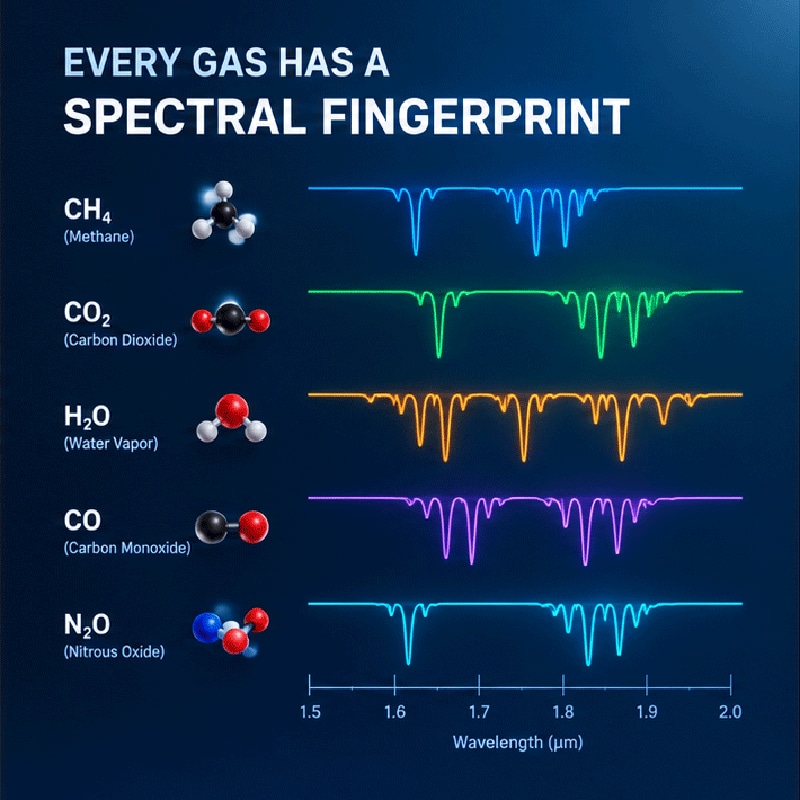
The missing or weakened wavelengths in an absorption spectrum provide information about the absorbing substance. Under suitable measurement conditions, this information can be used to identify a gas and determine its concentration.
4. Why Do Substances Interact with Specific Wavelengths?
The underlying explanation is the discrete energy structure of atoms and molecules.
Electrons in atoms occupy specific energy states. Molecules also have quantised energy states associated with electronic, vibrational and rotational motion. Transitions between allowed states involve particular energy differences.
The energy of a photon is related to its frequency and wavelength. Therefore, a transition involving a particular energy difference corresponds to a particular photon frequency and wavelength.
When incoming light matches an allowed transition and the relevant transition conditions are satisfied, absorption can occur. Conversely, when an excited species undergoes a suitable transition to a lower energy state, it can emit a photon.
This is why the interaction between light and matter is wavelength-dependent. A substance does not absorb all wavelengths equally. Instead, its spectral characteristics determine where absorption features appear.
For gas analysis, these features are especially useful because the absorption pattern can provide a characteristic signature of the target gas.
5. From Spectral Principles to Gas Detection
Optical gas detection applies the principles of light absorption to determine the presence or concentration of a gas.
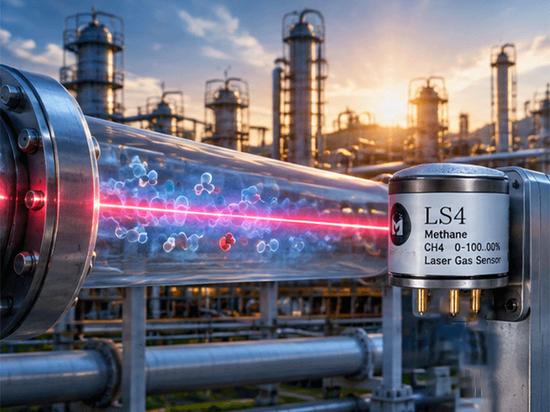
In a typical absorption measurement, light passes through a region containing the gas under investigation. The gas absorbs light at wavelengths corresponding to its absorption features. A detector measures the transmitted light, and the measurement system analyses the change in intensity.
The measured absorption can then be related to gas concentration under appropriate conditions.
This approach allows gas detection systems to obtain information from the interaction between light and gas molecules without relying solely on an electrochemical reaction at a sensing electrode.
However, the performance of an optical gas detector depends on more than the general principle of absorption. The selected wavelength, optical arrangement, light source, measurement path and signal-processing method all influence how the system performs in a particular application.
Understanding emission and absorption spectroscopy is therefore the first step towards understanding the optical technologies used in modern gas analysis.

 鄂公网安备42018502009509号