

#Product Trends
Pin hinges with swan-neck or double-joint design for flush-mounted and movable systems
Hinges provide the connection between the various components and allow for the reliable operation of doors, shutters, or formwork panels.
Their function becomes more challenging when enclosure faces must be flush, or when edges, profiles, or seals lie within the opening path. In such cases, hinges that do more than simply connect two parts are required. For these applications, norelem offers highly versatile pin hinges, including offset (gooseneck) and double-jointed models.
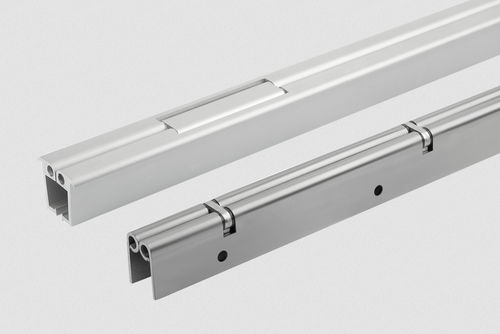
For enclosures and panels with flush faces—as well as for complex designs—norelem’s pin hinges offer two specialized solutions: offset hinges and double-jointed hinges. Both types enable the safe, space-saving operation of doors and flaps, even when contours obstruct the opening path.
Offset pin hinges: flexible, precise, and robust
Offset pin hinges are mounted inside the enclosure and are designed for applications where the hinges must remain concealed. This protects them against vandalism, dirt, and the elements. They are typically used in electrical cabinet construction, machinery and vehicle manufacturing, high-end furniture making, and interior fitting.
They are available in two versions: either with a 90° opening angle for space-saving right-angle openings, or with a 120° opening angle that provides easy access for maintenance and servicing.
Double-pivot rod hinges: even greater movement flexibility
Rod hinges with an integrated double-pivot mechanism offer an alternative solution for applications where standard hinges fall short. Two pivot points guide and control doors or flaps as they move over protruding contours.
In addition to the aluminum version—ideal for standard machine building, electrical cabinets, and industrial enclosures—a corrosion-resistant version made of high-quality stainless steel is also available. This version offers lasting resistance to moisture, harsh environments, and cleaning agents, making it ideal for outdoor applications, shipbuilding, and the automotive industry, as well as for areas where components are subject to regular wet cleaning.