#Product Trends
The Critical Importance of Soil Compaction Control in Modern Earthworks
In modern civil engineering and foundation work, the load-bearing capacity of the subsoil represents the fundamental prerequisite for the longevity and safety of any structure.
In modern civil engineering and foundation work, the load-bearing capacity of the subsoil represents the fundamental prerequisite for the longevity and safety of any structure. Precise soil compaction is the decisive process used to reduce the pore volume between soil particles and specifically increase the packing density. In practice, insufficient control of this compaction often leads to delayed, massive structural damage, the remediation of which can exceed the original construction costs many times over. Therefore, regular testing of soil density is not an optional service but a critical quality assurance measure that determines the long-term success of a construction project.
The technical reasons for comprehensive density testing are manifold. Primarily, it serves to prevent uneven settlement, which under load can lead to cracks in foundations, subsidence in road construction, or even consequential pipe bursts in utility lines. Professional compaction also significantly increases the shear strength of the soil, enabling it to absorb higher mechanical loads without plastic deformation. Another essential aspect is frost resistance: by minimizing voids, the capillary action of the soil is reduced, which limits water absorption and thus prevents dangerous frost heaves during winter. Last but not least, seamless documentation of density values provides the construction company with the necessary legal certainty towards clients and insurance providers.
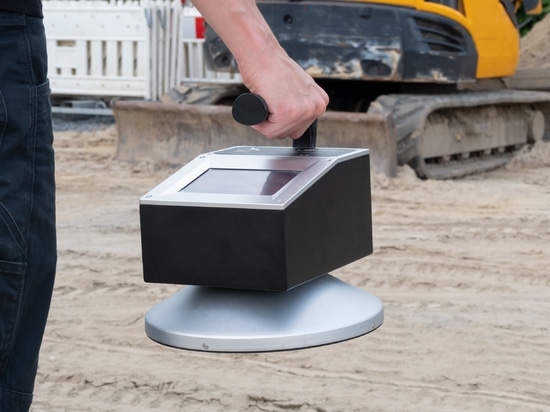
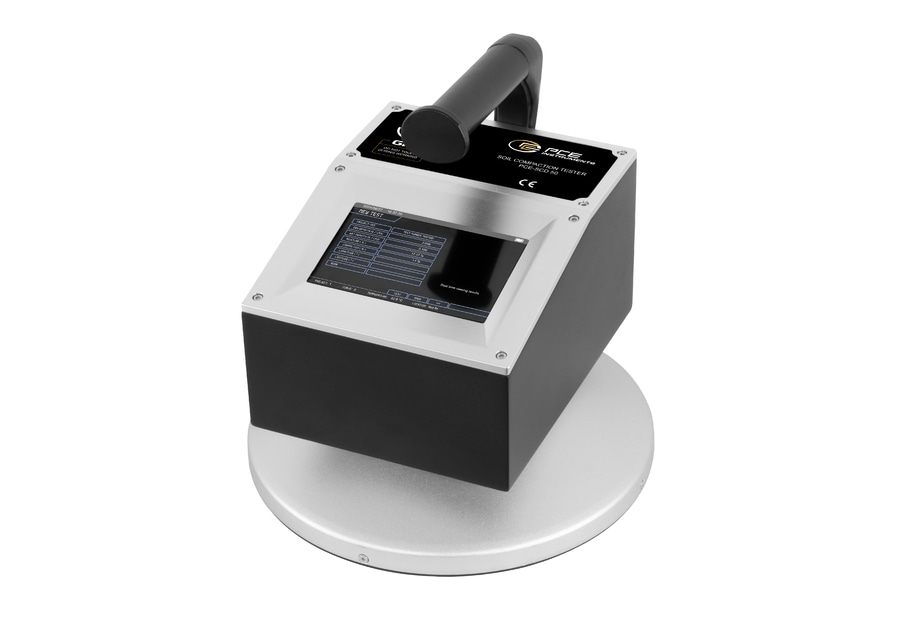
Despite this necessity, site managers often face the challenge that classic testing methods, such as the static plate load test or the sand replacement method, are very time-consuming and sometimes require heavy equipment or external laboratory analysis. In the rush of daily construction operations, there is a risk that measurements may be neglected to avoid halting progress. This is where the PCE-SCD 50 soil density meter provides an optimal and cost-effective solution. It bridges the gap between theoretical requirements and practical feasibility on the construction site by making modern sensor technology accessible for daily quality assurance.
The PCE-SCD 50 is characterized by its precise measurement methodology, specifically developed for the demands of the construction site. The device operates at a measurement frequency of 12.5 MHz and is capable of reliably detecting density within a range of 0 to 100%. In doing so, it achieves an impressive measurement accuracy of ±2%, which is more than sufficient for rapid on-site decision-making. A key technical advantage is the sensor's penetration depth of up to 30 cm, allowing not only the immediate surface but also the underlying layers to be effectively monitored. This is of crucial importance, especially during layer-by-layer compaction in earthworks.
The handling of the device is intentionally kept simple: measurement is carried out via a robust electrode inserted directly into the soil, while the device remains operational across a wide temperature range of 0 to 50 °C. Power is supplied by a rechargeable battery that ensures long operating times without interruption. Since results are immediately available on the digital display, site personnel can instantly decide whether further passes with a roller are necessary or if the next layer of soil can be applied. Thanks to its compact design and low weight, the device can be easily operated even in narrow trenches or hard-to-reach areas. Due to its low acquisition costs, the PCE-SCD 50 pays for itself in a short time by avoiding expensive downtime and reducing dependence on external consultants.
In summary, testing soil density remains indispensable for the stability and durability of structural facilities. Those who cut corners here run a high risk of future liability for defects. However, with a precise and economical tool like the PCE-SCD 50, which combines technical reliability with high practical suitability, this process can be integrated so seamlessly into the workflow that safety and cost-effectiveness go hand in hand.