#White Papers
What is Acoustic Emission (AE)?
An Engineering Perspective
In modern structural health monitoring, one question matters more than anything:
“Is damage happening right now?”
This is exactly where Acoustic Emission (AE) stands out.
1. What is Acoustic Emission?
Acoustic Emission is a passive nondestructive testing (NDT) method that detects transient elastic waves generated when materials undergo irreversible changes.
In simpler engineering terms:
When a structure releases energy due to damage (like cracking or deformation), it “talks” — AE systems listen.
2. How AE Works (From Physics to Data)
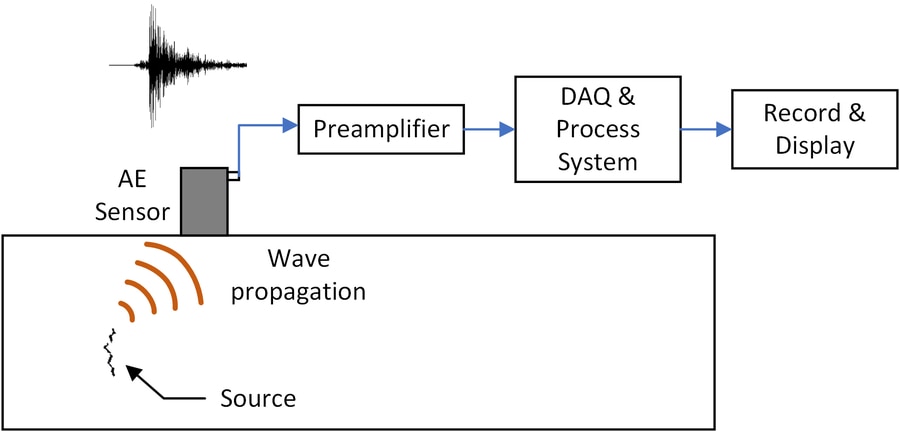
AE is fundamentally a mechanics → wave propagation → signal processing chain:
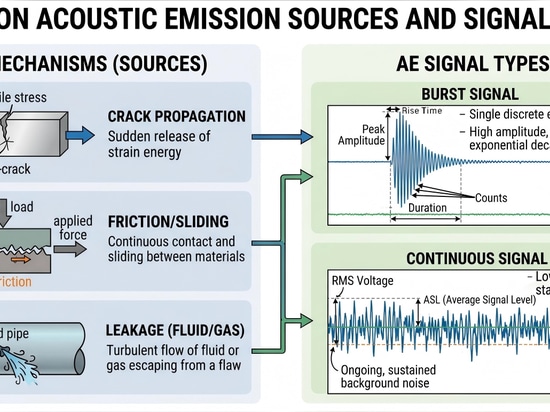
a. Damage activity occurs: Crack growth, plastic deformation, leakage, etc.
b. Energy release generates stress waves: These waves propagate through the material
c. Sensors capture surface motion: Piezoelectric sensors convert waves into electrical signals
d. Signal conditioning & acquisition: Amplification, filtering, digitization
e. Feature extraction & interpretation: Amplitude, energy, frequency, duration → damage characterization
In essence: AE does not measure defects — it measures damage activity.
3. Signal Types Engineers Should Know
AE signals typically fall into two categories:
1) Burst signals
→ Short, high amplitude
→ Associated with discrete events (e.g., crack growth)
2) Continuous signals
→ Long duration, lower amplitude
→ Associated with processes like leakage or friction
4. What Can AE Detect?
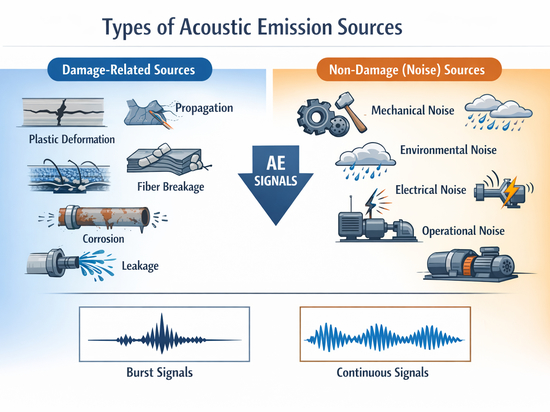
AE sources are always tied to active mechanisms, such as:
- Crack initiation and propagation
- Plastic deformation
- Corrosion processes
- Fiber breakage (composites)
- Leakage and friction
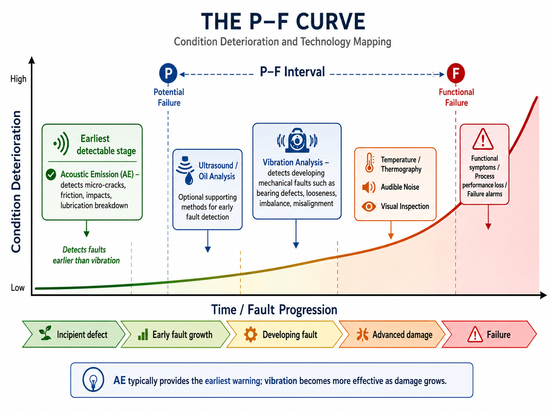
This is why AE is especially powerful for early-stage damage detection.
5. Key Engineering Advantages
AE is widely used because it enables:
✔ Early warning before visible damage
✔ Global monitoring with fewer sensors
✔ Real-time, in-service inspection
✔ Detection under actual operating conditions
For large assets (bridges, tanks, pipelines), this is a game changer.
6. Limitations (And Why They Matter)
AE is not a silver bullet. Engineers must consider:
- Sensitive to environmental noise
- Requires active damage or loading
- Interpretation depends heavily on expertise
- Difficult to directly size defects
AE tells you that something is happening, not always how big it is.
7. Where AE Creates the Most Value
AE is particularly effective in:
- Bridges & civil infrastructure
- Pressure vessels & storage tanks
- Pipelines & leak detection
- Wind turbine blades
- Aerospace & composites
In practice, AE is often used as part of a hybrid SHM strategy.
8. Final Takeaway
Acoustic Emission shifts the paradigm:
❌ From “Where is the defect?”
✅ To “Where is damage actively evolving right now?”
That’s why AE is not just another NDT method — it’s a real-time insight tool for structural behavior.