#Product Trends
Indoor air quality and employee performance
Cognition, productivity and business outcomes
Indoor air quality has a direct and measurable impact on cognitive performance, productivity and overall organisational results.
Employee performance is no longer driven solely by tools, processes or management practices. It is increasingly shaped by the physical environment in which people work, and indoor air quality has emerged as a critical, yet often underestimated, factor. Once viewed primarily as a comfort issue, indoor air quality is now recognised as a measurable determinant of cognitive performance and organisational efficiency.
A growing body of scientific research clearly demonstrates the link between air quality and brain function. Elevated concentrations of CO₂, fine particulate matter and volatile organic compounds impair attention, working memory and decision-making capacity. In the short term, this leads to reduced concentration and an increased risk of errors. Over time, poor air quality contributes to mental fatigue, lower engagement and higher absenteeism. In offices, conference centres and educational environments, where cognitive performance is central, air quality becomes a strategic performance variable.
The challenge for organisations is no longer to acknowledge this link, but to effectively control it. Conventional ventilation systems, often designed for standard occupancy assumptions, struggle to adapt to real-life variations in space usage, internal emissions and energy constraints. Insufficient ventilation allows CO₂ and pollutants to accumulate, while excessive ventilation can drive energy costs without guaranteeing healthy indoor air. In many cases, ventilation alone is not enough to ensure consistent air quality.
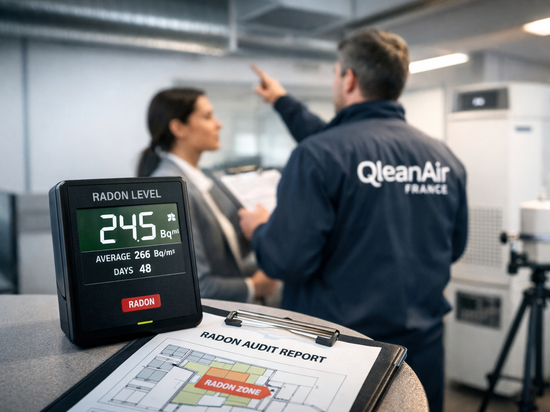
Within this context, QleanAir France supports organisations in implementing measurable and controllable air purification solutions. The approach is based on analysing indoor environments, measuring pollutant concentrations and treating the air in a targeted manner, without requiring structural modifications to buildings. This makes it possible to objectively assess improvements in air quality and to maintain performance over time.
By controlling indoor air quality, organisations create working environments that actively support concentration, collaboration and cognitive efficiency. Cleaner air contributes to higher productivity, improved employee engagement and stronger employer attractiveness, particularly in a context where quality of working life has become a decisive factor. Indoor air quality therefore stands as a strategic lever, directly linking health, economic performance and corporate responsibility.