#White Papers
Particle distribution in indoor spaces: understanding to treat effectively
Airflow dynamics, aerosol behaviour and real-world air treatment performance
The behaviour of airborne particles in indoor environments directly determines the effectiveness of air treatment and exposure control strategies.
The distribution of particles within an indoor space is governed by complex physical mechanisms related to airflow dynamics, aerosol physics and real building use. Contrary to a common assumption, particles do not disperse uniformly within a room, nor are they simply diluted and removed by general ventilation. Their behaviour is shaped by particle size, gravitational forces, induced air movements and, critically, the location and intensity of emission sources.
Coarse particles tend to settle relatively quickly under the effect of gravity. Fine and ultrafine particles, by contrast, can remain suspended in the air for extended periods. These particles follow airflow patterns, are easily transported across spaces and can accumulate far from their point of origin. Field measurements carried out in office, industrial and mixed-use environments consistently show that fine particles are predominantly present within the breathing zone, typically below 2.5 metres from the floor. In practical terms, this means that particulate pollution tends to circulate at human height, precisely where inhalation exposure occurs.
This physical reality highlights the limitations of strategies relying solely on general ventilation. Ventilation systems are designed to renew indoor air volumes, but they are not inherently optimised to capture pollutants emitted locally, especially when emissions are continuous, fine or activity-related. In some configurations, airflow patterns generated by ventilation can even redistribute contaminants throughout the space, unintentionally increasing exposure in occupied zones.
Understanding particle distribution therefore requires a detailed analysis of emission sources, airflow trajectories and accumulation areas. This approach is grounded in on-site observations and real-time measurements rather than theoretical airflow assumptions. It explains why spaces with similar ventilation rates and layouts can exhibit markedly different exposure levels, depending on how particles are generated and transported within the environment.
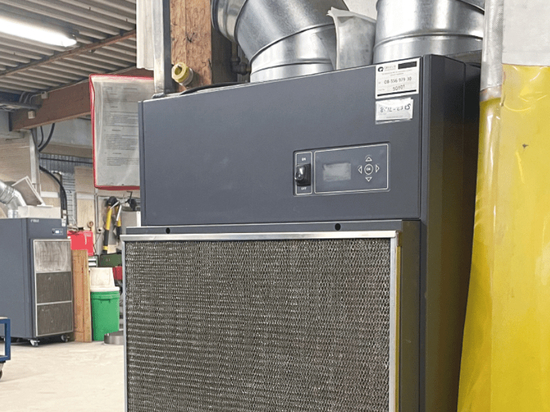
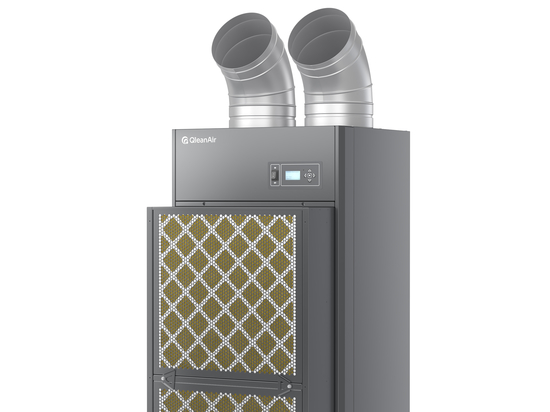
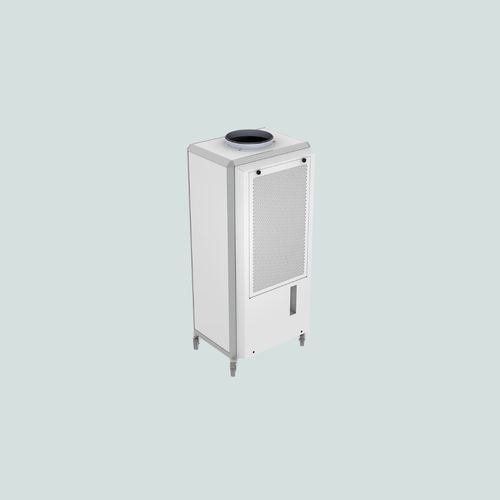
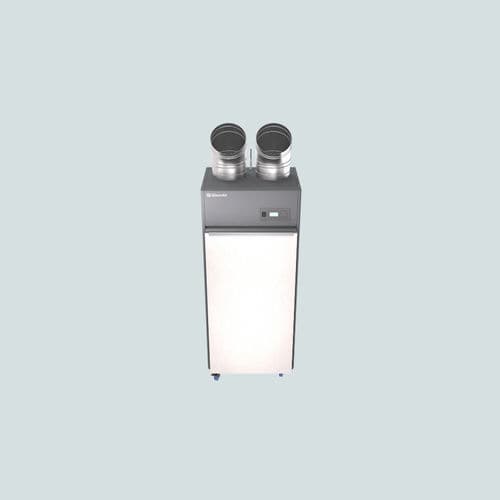
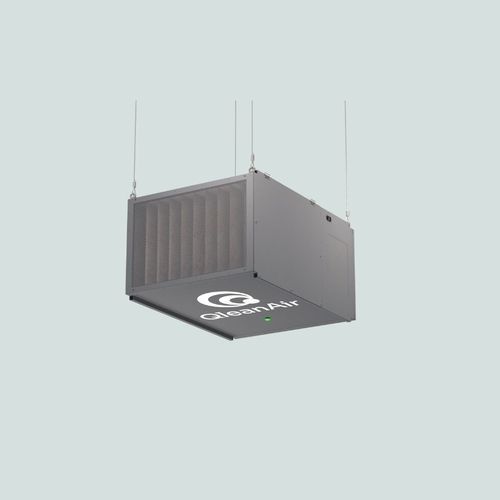
Within this framework, QleanAir France adopts a pragmatic strategy focused on treating air as close as possible to the emission source. Mobile and adaptable air purification solutions enable the capture of particles before they disperse into the room volume, where concentrations are highest and health impact is most significant. This targeted approach reduces reliance on building geometry and existing ventilation constraints.
By treating air where pollutants are actually generated and transported, it becomes possible to significantly reduce particle concentrations within the breathing zone, regardless of ceiling height or architectural configuration. This strategy is based on a precise understanding of aerosol behaviour and on risk control through measurement, analysis and targeted action.
Particle distribution within a room is not an abstract concept. It is a central parameter in any credible indoor air quality strategy. By integrating airflow dynamics and real usage conditions, organisations can implement air treatment solutions that are more effective, measurable and sustainably aligned with health, performance and regulatory objectives.