#Product Trends
What Is NUC in a Thermal Camera?
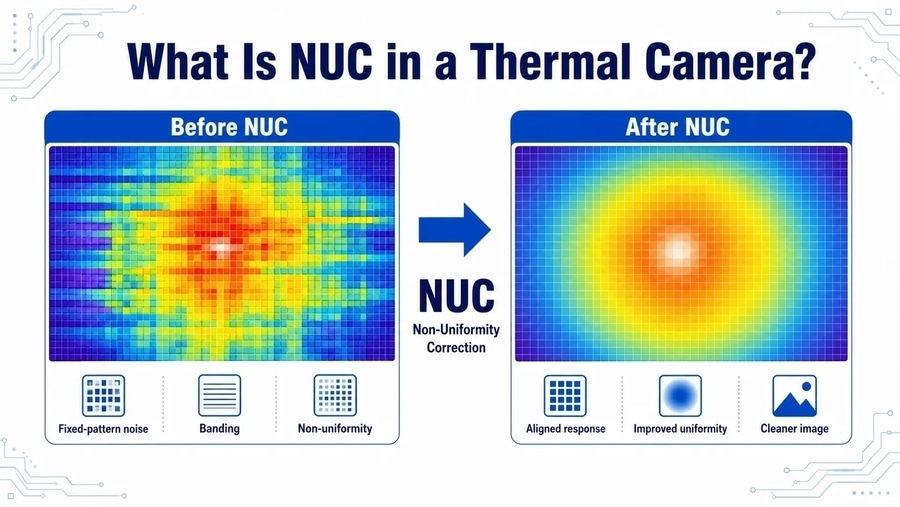
NUC stands for non-uniformity correction. It aligns the responses of detector pixels so that a uniform thermal scene appears more uniform in the image. In many shuttered thermal cameras, a NUC cycle causes a soft click and a brief pause because an in
NUC stands for non-uniformity correction. It aligns the responses of detector pixels so that a uniform thermal scene appears more uniform in the image. In many shuttered thermal cameras, a NUC cycle causes a soft click and a brief pause because an internal shutter moves in front of the detector to provide a reference.
The brief click and pause are normal in many shuttered cameras. NUC compensates for pixel-to-pixel variation and drift as internal conditions change. It supports stable imaging, but it is not the same as factory calibration and does not guarantee field temperature accuracy on its own.
Why Do Thermal Detector Pixels Need Correction?
A thermal detector array contains many sensing elements. Even when all pixels are exposed to the same uniform reference, their individual responses vary slightly. Manufacturing variation, detector temperature, electronics, and heat from the camera and optics can change pixel response.
If those differences are left uncorrected, the image may show fixed-pattern noise, shading, or false structure that originates from the detector rather than the scene. NUC applies corrections to make all pixels respond uniformly.
In plain terms, NUC typically corrects for offset, and in some systems, it may also correct for gain. But exactly how this works depends on the specific detector and camera design. NUC does not add optical resolution or repair every kind of image problem. Soft focus, contamination on the optical window, reflections, saturation, compression, and atmospheric loss require separate checks.
What Happens During a Shuttered NUC?
In a shuttered camera, an internal shutter moves between the lens and detector. The shutter presents a comparatively uniform reference across the array. The camera measures the pixel responses to that reference and updates its correction terms.
The detector cannot view the scene while the shutter is in place, so the live image may freeze briefly. The movement may produce a soft click. The interruption is brief, although its duration and frequency depend on the camera design and operating mode.
Automatic NUC occurs more often after startup or during changes in internal or ambient temperature. As the camera stabilizes, the interval may change. Do not apply a universal warm-up time or NUC schedule to every product; follow the manual for the exact model.
On some cameras, you can also start a NUC manually or coordinate when it happens. That’s handy if you want to control exactly when the interruption occurs, though the specific options and recommended settings depend on the camera.
What Does Shutterless NUC Mean?
Shutterless NUC eliminates the mechanical shutter in the optical path during normal image capture. The correction method is specific to the detector and camera design.
The benefit is uninterrupted image acquisition, with no pause for a shutter. A shutterless design must still control residual non-uniformity as detector temperature changes. Scene-based methods must also prevent correction errors when the viewed scene changes rapidly. Radiometric performance requires separate validation for the specific camera and operating range.
NUC, Calibration, and Accuracy Are Different
Term What it describes
NUC Correction of pixel-response non-uniformity and drift
Calibration Relationship between camera response and known reference conditions
Measurement accuracy Expected agreement with a reference under defined conditions
NETD Ability to distinguish low thermal contrast under stated test conditions
NUC supports a stable detector response, but it does not prove that a reported temperature is correct. Reliable field measurement accuracy also requires appropriate calibration and enough target detail at the selected focus and distance. Emissivity, reflected radiation, atmospheric transmission, and transmission through any external optical window affect the radiation used for the temperature measurement.
A camera can therefore produce a clean-looking image after NUC while still giving a poor measurement because the target or measurement setup is unsuitable. That is because NUC addresses uniformity, not absolute radiometric accuracy. By the same token, NETD describes sensitivity to small thermal differences—not absolute temperature error.
Use the terms separately in procedures and specifications. Calling NUC a complete “calibration” can hide the additional controls required for radiometric measurement.
When Should You Trigger NUC or Investigate Further?
Use manual NUC only when the camera documentation recommends it or when an approved operating procedure calls for it. Do not improvise an external reference or change automatic timing without model-specific guidance.
A brief click and pause are normally expected in a shuttered design. Investigate when strong non-uniformity remains after the camera stabilizes and completes its normal correction, when the shutter cannot complete its movement, or when abnormal interruptions persist under stable conditions.
First check the manual, focus, optical-window cleanliness, image settings, operating temperature, and any relevant error logs. Persistent artifacts or failed measurement verification may require manufacturer-approved service or calibration checks. Repeated NUC is not a substitute for optical maintenance or calibration verification.
Conclusion
NUC keeps a thermal detector’s pixel responses more uniform as internal conditions change. Shuttered cameras may click and pause while using an internal reference; shutterless designs apply other correction methods.
Turing A640H Uncooled Infrared Module, Uncooled Thermal Module
TF384 Uncooled Infrared Imaging Module
When evaluating thermal camera modules, treat NUC as one part of image stability. It does not replace suitable optics, correct measurement inputs, calibration verification, or maintenance. For exact timing, controls, and service criteria, use the documentation for the specific thermal camera.
FAQ
Is a clicking thermal camera faulty?
Not necessarily. In a shuttered design, a soft click and brief image pause commonly indicate a NUC cycle. Consult the manual if the behavior changes or persistent artifacts remain.
Is shutterless NUC always better?
No. It avoids a shutter-induced interruption, but the camera still has to control drift as detector temperature changes. Scene-based methods must also handle changing scene content. For radiometric use, verify measurement performance for the exact model and operating range.
How long does a NUC cycle take?
The interruption is usually brief, but its duration varies by camera and operating mode. Use the exact model documentation when timing matters.
Can automatic NUC be disabled?
Only some cameras expose timing or manual controls. Do not disable or delay automatic correction unless the product documentation and approved procedure support it.