#Product Trends
Why Are Thermal Cameras So Low Resolution?
Thermal cameras often have fewer native pixels than visible cameras because every infrared pixel is part of a specialized system that combines the detector, optics, readout electronics, packaging, and calibration. Shrinking the pixels or adding more
Thermal cameras often have fewer native pixels than visible cameras because every infrared pixel is part of a specialized system that combines the detector, optics, readout electronics, packaging, and calibration. Shrinking the pixels or adding more of them is possible, but it changes how the detector absorbs heat, handles noise, transfers data, and works with the lens. The practical limit is therefore a system and cost tradeoff, not a rule that thermal cameras must be of low resolution.
Resolution is also not the whole image-quality story. A 640×512 detector can be more useful than a larger processed output image if its lens, focus, field of view, distance, target size, and thermal contrast suit the task. Start by confirming the native detector format, then judge the complete camera configuration.
Check Which Resolution the Specification Refers To
Native detector resolution refers to the number of sensing elements arranged in rows and columns in the infrared array. Display resolution, saved-image dimensions, digital zoom, visible-image overlays, and algorithmic enhancement may use different numbers.
Specification What it describes Adds real infrared detail?
Native detector resolution Physical infrared sensing array Yes — it defines the original infrared data available
Display resolution Pixels on the camera screen No — it only affects how the image is displayed
Saved image or video size Dimensions of the exported file Not necessarily — it may be resized or processed
Digital zoom Image enlargement or cropping No — it does not add new infrared information
Visible-image fusion Thermal data combined with visible-light details No — it adds visual context, not infrared detail
Super-resolution Processed output derived from a native input No — it enhances the output, not the detector samples
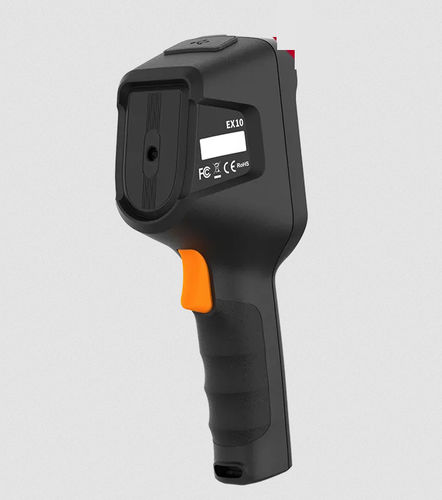
To see how these specifications differ in a real product, consider Raythink’s EX10 thermal camera. Its specifications list a 160 × 120 infrared detector separately from a 320 × 240 super-resolution output. This means the camera uses a 160 × 120 native infrared detector and applies image processing to produce a larger 320 × 240 output. The enhanced image may appear sharper or more detailed, but it does not mean the camera contains a physical 320 × 240 infrared detector.
EX10 Handheld Thermal Camera
This distinction helps prevent a common comparison error: treating a larger display, saved file, or processed image as evidence of a higher-resolution infrared sensor.
Thermal Detector Pixels Are Difficult to Shrink
Many uncooled thermal cameras use microbolometer arrays. Each pixel absorbs infrared energy, changes temperature, and produces an electrical signal. The absorbing structure, thermal isolation, response time, fill factor, noise, and readout circuit must work together.
When engineers reduce pixel pitch, they do more than shrink a square on a drawing. The smaller structure still needs to absorb useful energy, remain thermally isolated, respond at a suitable speed, and deliver a signal the readout can measure. Improving one part can affect another, so pixel pitch cannot be separated from the detector material, architecture, fabrication process, and electronics.
Research on microbolometer designs shows that reducing pixel pitch requires balancing factors such as thermal isolation, response speed, fill factor, and readout architecture. Smaller pixels are achieved through improvements in the entire detector system, not geometry alone.
Smaller pixels generally collect less infrared energy per pixel, which can make maintaining thermal sensitivity more challenging. Even so, these results do not create a universal relationship between pixel pitch and noise-equivalent temperature difference (NETD). They show that smaller pixels and larger arrays require co-design. Pixel pitch is the center-to-center distance between adjacent detector elements in the array, while detector resolution refers to the number of elements in the array. A smaller pitch may enable a smaller package, a larger array in a similar area, or another design goal.
Pixel Size Comparison
Infrared Optics Limit the Detail That Reaches the Detector
More detector elements improve image detail only when the optical system can resolve the additional information. One physical limit is diffraction: for an ideal circular aperture, the diffraction-limited angular resolution is approximately 1.22λ/D, where λ is wavelength and D is aperture diameter. Because infrared systems often operate at longer wavelengths than visible cameras, they generally face a larger diffraction-limited angle when using the same aperture size.
Diffraction is only one part of a real camera. Optical quality, focus, detector sampling, motion, atmosphere, processing, and thermal contrast may limit detail first. Wavelength therefore does not dictate how many elements an infrared array can contain.
Field of view and distance often matter more to the buying decision. A wide field of view spreads a large scene across the array, so a small target occupies fewer detector elements. A narrower field of view places more samples across that target but covers less of the scene. A longer working distance also makes the target smaller in angular terms. These factors also influence how far a thermal camera can detect or identify a target at different distances.
This is why a resolution number should be evaluated with the lens. If a small feature is out of focus or poorly resolved by the optics, adding detector samples alone may not restore the lost detail. Conversely, a good lens cannot create native samples beyond the detector array.
Higher Resolution Requires More Complex Manufacturing
Increasing thermal-camera resolution is not simply a matter of adding more pixels. Higher-resolution arrays require compatible fabrication, readout electronics, and packaging, which increases system complexity and cost. For this reason, increasing pixel count in thermal cameras can involve different manufacturing and cost constraints from those of visible-light cameras, where high-resolution sensor production is generally more mature.
Vacuum packaging illustrates this challenge. Uncooled infrared bolometers use a controlled vacuum environment to improve thermal isolation and sensitivity, but this packaging process adds manufacturing complexity. Research on MEMS and MOEMS devices identifies vacuum packaging as an important cost factor, although it does not define a universal cost-per-pixel relationship.
The final price reflects the complete detector, optics, electronics, calibration, and product design, so resolution alone does not predict cost. These same factors also explain why thermal cameras are expensive.
Resolution, NETD, and Accuracy Answer Different Questions
A larger native array provides more spatial samples across the same field of view when the optics are comparable. It does not automatically improve thermal sensitivity, temperature-measurement accuracy, focus, or total image quality.
Specification Main question
Native detector resolution How many infrared elements sample the scene?
NETD What thermal sensitivity value is stated under the named test conditions?
Display resolution How many pixels can the screen show?
Temperature accuracy How closely can the radiometric system estimate temperature under stated conditions?
Optics and focus How well does the lens form scene detail on the array?
Processing How is the captured signal corrected, enhanced, or displayed?
Raythink’s EX10 manual lists detector resolution, super-resolution output, IFOV, NETD, display resolution, video resolution, and measurement accuracy as separate specifications, with the individual values and test conditions given in its technical-data section.
The useful comparison is therefore not simply which camera has the highest number of pixels. It is which detector, lens, sensitivity, and measurement configuration fits the intended scene.
When More Native Pixels Help
Higher native resolution is most useful when the existing camera position, field of view, and optics do not place enough independent samples across the feature you need to see. Common examples include a wide scene that contains several small areas of interest, a fixed camera position that cannot move closer, or a target that must be viewed from a longer working distance. With the same field of view and comparable optics, a larger array can place more samples across those features.
Large FOV - 1280 Leading Thermal Resolution
That advantage still depends on the image reaching the detector. Soft focus, a poorly matched lens, weak thermal contrast, motion, or atmospheric loss can limit usable detail before detector count becomes the main constraint. Higher resolution also does not establish better NETD or temperature accuracy; those specifications must be checked separately.
A lower-resolution configuration may be adequate when the target is large in the image, the camera can move closer, the field of view can be narrowed, or the task only requires a clear thermal pattern rather than fine spatial detail. The right question is not whether the detector has fewer pixels than a visible camera. It is whether the proposed detector and lens capture enough useful information for the actual decision.
Choose Resolution From the Target and Scene
Start with the smallest feature, component, or temperature pattern you must detect or compare. Then work outward:
Record the target’s physical width and height.
Record the normal working distance and allowed camera positions.
Define the scene width, height, or field of view that must fit in one image.
State whether the task is anomaly detection, shape interpretation, component comparison, or radiometric measurement.
Describe the smallest meaningful thermal contrast, focus constraints, motion, atmosphere, and any infrared window in the optical path.
Compare native detector resolution and the proposed lens as one configuration, then validate the chosen configuration under representative conditions.
There is no universal pixels-on-target threshold for every task. With comparable optics, more native samples can help when one frame must cover a wide scene, a distant target, or several small areas. In another setup, moving closer, narrowing the field of view, or improving focus may add more useful detail than buying a larger array.
When the target and scene require more native samples, Raythink’s guide to high-resolution thermal cameras explains their benefits and application contexts.
Specify the Scene Before the Pixel Count
Thermal cameras often have fewer native pixels because the detector, optics, readout, fabrication, vacuum packaging, calibration, and product economics must work as one system. Higher native resolutions are available, but their value depends on the scene and task.
Prepare a short application brief with target dimensions, working distance, required field of view, meaningful thermal contrast, environmental and motion conditions, and whether radiometric temperature data are needed. You can then contact Raythink to clarify detector and lens tradeoffs and identify what needs to be validated in the actual application.