#Product Trends
EV Battery Connection Inspection with Thermal Imaging
Thermal imaging can screen accessible EV battery connections for abnormal heating during end-of-line (EOL) testing. During a defined electrical test, a connection with an abnormal thermal response may show a different surface-temperature pattern from
Thermal imaging can screen accessible EV battery connections for abnormal heating during end-of-line (EOL) testing. During a defined electrical test, a connection with an abnormal thermal response may show a different surface-temperature pattern from equivalent connections in the same pack.
A fixed thermal camera captures the surface-temperature pattern without contacting the target. The configured analysis layer can compare visible tabs, terminals, busbar areas, or other exposed connection surfaces and pass the screening result to the production system. The thermal camera does not see through an opaque cover, measure contact resistance, or prove that a connection is mechanically loose.
The practical task is therefore straightforward: identify the visible connection, capture it at a repeatable point in the EOL test, ensure that the connection spans enough detector pixels for the intended comparison, and compare its response with an appropriate reference.
Battery Production and Assembly Monitoring Applications
Why a poor connection can produce a thermal pattern
An electrical connection carries current and transfers heat into nearby materials. If the connection condition changes how heat is generated or conducted, the visible tab, terminal, busbar, or adjacent surface may develop a localized or uneven temperature pattern. Thermal imaging makes these spatial differences visible across the connection surface.
In practice, the camera should compare equivalent connection areas under the same test conditions. A connection that repeatedly shows a different thermal pattern from comparable normal connections can be flagged for further electrical or manufacturing inspection.
Start with the connection surface the camera can see
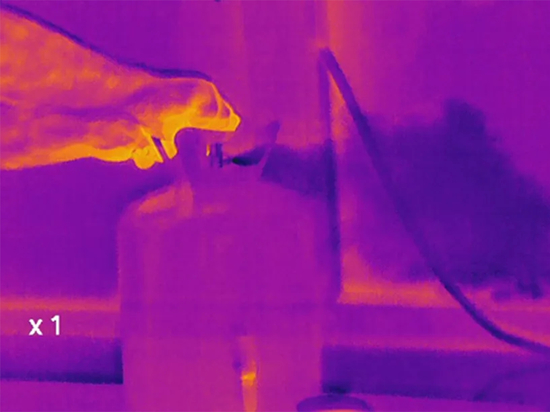
battery case leakage detection using an online thermal camera
The first design question is not which camera to buy. It is which surface represents the connection and whether that surface is visible at a practical station position.
Possible targets include exposed tabs, terminal faces, busbar regions, fastener areas, or another surface thermally connected to the joint. Pack covers, guards, fixtures, cables, handling tools, and neighboring components may block the target or force a steep viewing angle. A concealed joint can be screened only if its condition creates a repeatable response at an accessible surface.
For each target, record the connection type, visible face, smallest relevant dimension, nearest and farthest camera positions, available viewing angle, and expected obstruction. These inputs determine the lens, field of view, camera position, and number of views.
The battery pack manufacturer also defines the electrical test that produces the observation window. The camera trigger and capture timing must align with that test. Images taken at different points in a changing current event should not be treated as equivalent.
Consider the camera, lens, and field of view together
Seeing a connection in a wide thermal image does not mean it occupies enough detector pixels for the intended comparison. Target size, distance, detector resolution, lens field of view, focus, and viewing angle work together.
Check the camera position and target size:
Start with the smallest connection target at the farthest permitted camera position.
Select a candidate lens and calculate how many pixels cover that target.
Test the view with normal pack-position, fixture, focus, and obstruction variation.
A wider lens may cover more connections but place fewer pixels on each one. A narrower lens can improve target sampling but may require another camera or station view. The final choice should follow the actual pack geometry rather than a generic resolution recommendation.
TN430 for compact integration and faster capture
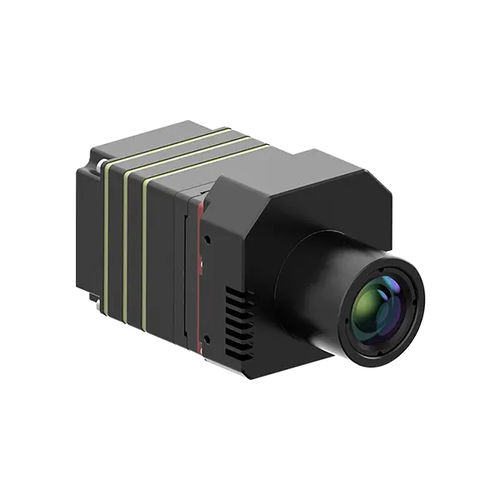
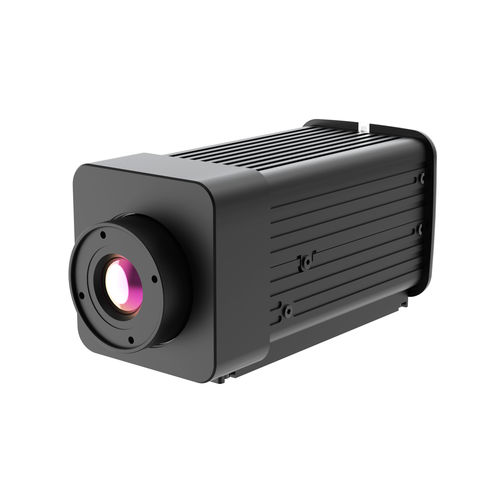
The Raythink TN430 fixed-mount thermal camera provides 384 × 288 infrared resolution, frame rates up to 50 Hz, multiple lens options, and industrial communication protocols in a compact body.
It is a candidate when the selected lens provides enough pixels on each connection and the station needs faster capture of a changing thermal event or straightforward industrial integration. Its suitability still depends on the target size, distance, lens, timing, and required data path.
AT61 for more pixels and motorized focusing
The Raythink AT61 motorized-focusing thermal camera provides 640 × 512 infrared resolution and motorized focus.
It is a candidate when the connection points are small and require more pixels for temperature measurement, or when motorized focus adjustment is useful for the installation. Higher detector resolution does not remove the need to verify the lens, working distance, target pixels, capture timing, and interface requirements.
Compare temperatures across different connection points
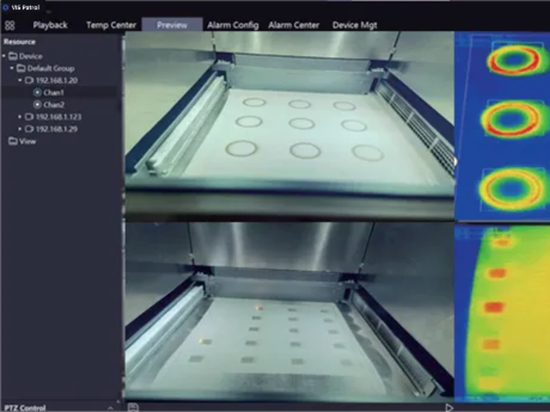
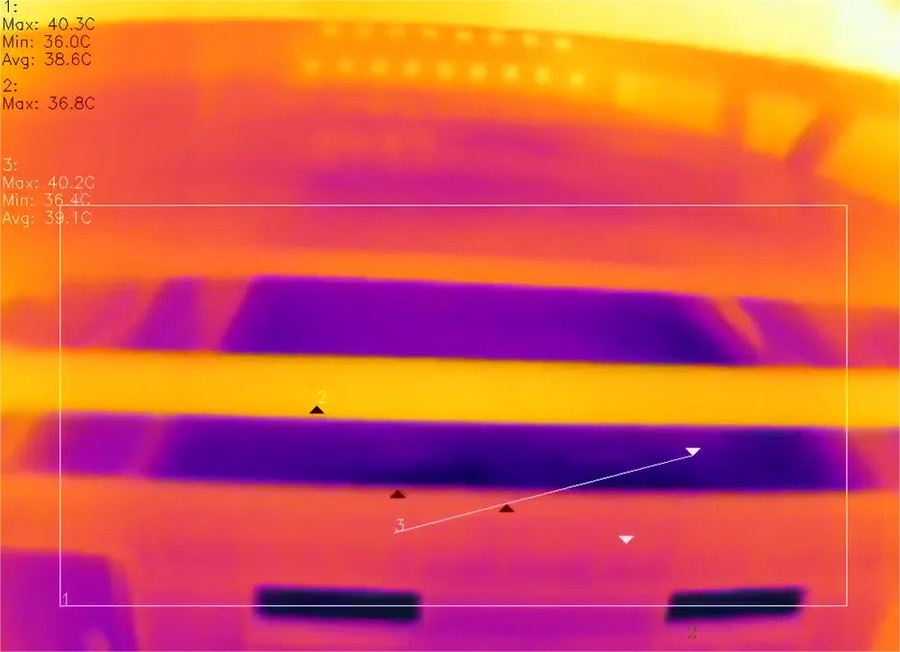
Each visible connection can be assigned a consistent measurement region. The station can then compare equivalent connection regions, compare a target with an adjacent reference area, measure spatial non-uniformity across the connection, or track how the measurement region changes during the capture window.
The most useful comparison depends on the pack design. Equivalent connections can be compared by position, while repeated production units of the same pack variant can establish a normal reference range. A short time sequence may be more useful when the electrical test produces a brief temperature change.
Before the inspection is used on the production line, the battery pack manufacturer should establish the normal range from representative good packs. If poor-connection samples can be tested safely, they can help confirm whether the comparison reveals a meaningful difference. The resulting limits apply only to that connection design and test condition.
Thermal output What it means Production use
Capture not usable The target, focus, timing, or view was unsuitable Repeat or review the capture
ROI result matches the reference No unusual thermal response was found Continue under the line’s normal EOL process
ROI result differs from the reference The connection requires further checking Send it for electrical or manufacturing inspection
This separation matters because a blocked target or mistimed image is not evidence of a bad connection. Likewise, a thermal deviation identifies an unusual surface response, not the root cause by itself.
Control reflections from metallic connection surfaces
Bare or polished metal can have low emissivity and strong reflections. Surface finish, coatings, oxidation, cleanliness, viewing angle, and nearby hot objects may change the apparent temperature even when the connection itself has not changed. Raythink’s guide to how emissivity affects thermal imaging explains why material and surface condition matter when interpreting a thermal reading.
For the EOL setup, document the target material and finish, viewing angle, reflected heat sources, distance, focus, ambient conditions, airflow, and any protective window. If the setup cannot support reliable absolute surface-temperature measurement, compare apparent-temperature values from matched surfaces under the same conditions instead of treating them as absolute temperatures.
Send a clear thermal result to the production line
The thermal system needs a clearly defined interface with the EOL station. Typical inputs are pack identity, recipe selection, and the capture trigger. Useful outputs are acquisition validity, ROI measurements, the comparison result, timestamp, and configuration identifier.
The battery pack manufacturer’s controller or quality system determines whether the pack passes, is retested, goes for further review, or is rejected. The camera provides radiometric data, and the configured analysis layer produces the screening result; neither replaces the manufacturer’s electrical confirmation or quality decision.
Teams can use Raythink | Raytron Industrial’s overview of thermal-camera analysis and data workflows to define their ROI and data-handling needs. Exact calculations, interfaces, retained data, and software compatibility must be confirmed for the selected camera and configuration.
Prepare the application details for Raythink | Raytron Industrial
To evaluate an EV battery connection-inspection station, provide:
pack and connection drawings or photographs;
the visible target material and smallest dimensions;
nearest and farthest working distances;
available viewing angles and expected obstructions;
the EOL electrical event and proposed capture timing;
relevant ambient, airflow, and reflective conditions;
the comparison or confirmation method; and
required trigger, data, and line interfaces.
Contact Raythink | Raytron Industrial with these inputs. We can assess target visibility, camera and lens options, pixels on target, capture timing, measurement controls, ROI requirements, and the thermal interface for the proposed station.