#Industry News
How to Choose an SF₆ Leak Detection Camera
Sulfur hexafluoride (SF₆) leaks hide at small interfaces on gas-insulated equipment, so the right SF₆ leak detection camera is the one that fits your role, your gas, and your views. Settle role, spectral fit, and view fit for a gas leak detection cam
Sulfur hexafluoride (SF₆) leaks hide at small interfaces on gas-insulated equipment, so the right SF₆ leak detection camera is the one that fits your role, your gas, and your views. Settle role, spectral fit, and view fit for a gas leak detection camera first; compare price after those are clear.
Camera, sniffer, or both?
An optical gas imaging (OGI) camera and a sniffer do different jobs, and many maintenance programs need both.
An SF₆ camera lets an inspector scan equipment without contact and see where a possible plume is coming from. That helps when leaks may occur at many interfaces or where a probe cannot reach safely. A sniffer, also called a handheld SF₆ leak detector or point SF₆ gas detector, samples air at the probe tip. It confirms a suspected point once you know where to look.
Many utility programs pair the two—optical gas imaging with sniffers, pressure monitoring, repair prioritization, and testing before and after repair. Tie the camera decision to a clear role in that workflow:
Camera: area screening, hard-to-reach views, and locating a leak on energized equipment from permitted positions.
Sniffer: confirmation at the located point and checks in tight spaces.
Both: when your program must locate a leak, confirm it, and document the repair.
If your team already knows where leaks occur and only needs point checks, a sniffer may be enough. If leaks are often hard to find, a camera is worth evaluating.
The First Thing to Check: is it actually built for SF₆?
Before you compare screens, batteries, or prices, confirm that the exact camera configuration on the quote is designed for SF₆. If it is not, stop there.
SF₆ has strong absorption near 10.55 μm in the long-wave infrared (LWIR), so an SF₆ camera depends on a band-matched filter. A label that says “gas camera” or “thermal camera” does not prove the camera can detect SF₆. An ordinary thermal camera without the right filter is not an SF₆ tool.
Ask the supplier for current documentation that:
Names SF₆ for the exact model, lens, and filter you are being quoted.
States the spectral range, so you can check it against the SF₆ absorption band.
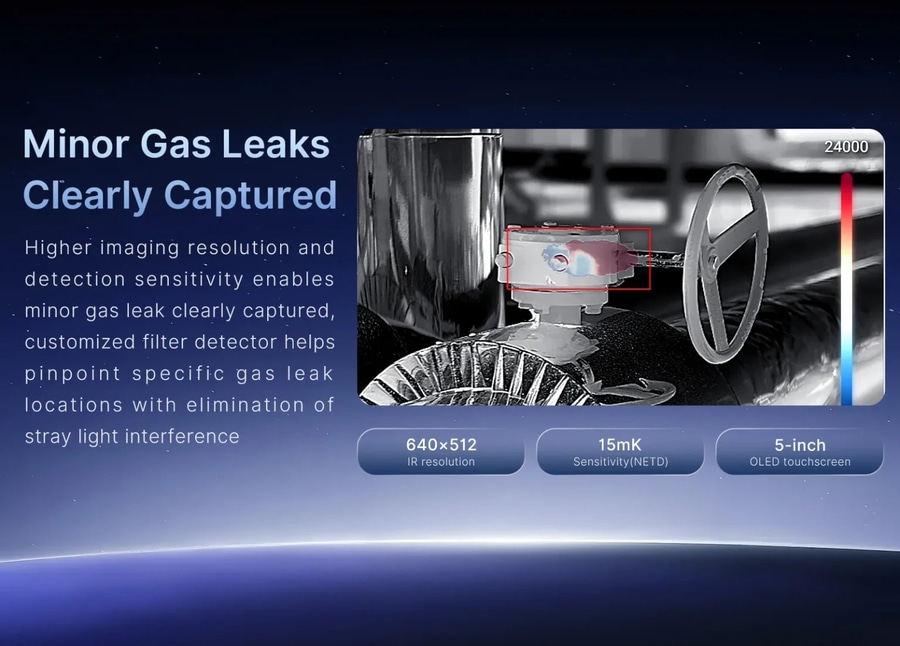
The RG630F, for example, covers 10.3–10.7 μm and detects sulfur hexafluoride.
A matching band shows the camera is designed for the gas. It does not tell you how far away the camera can see a leak or how small a leak it can show; those depend on the scene. When you browse an optical gas imaging camera range, apply this to each configuration, not to the product family name.
Cooled or uncooled thermal detector for your inspection work?
After you confirm the camera is built for SF₆, the next choice is the detector type. Cooled cameras use a cryocooler to chill the detector. Uncooled cameras do not.
Cooled detectors generally offer higher thermal sensitivity, which can help with smaller leaks or longer standoff views. The tradeoff is a higher purchase price and a cooler that needs service and has a finite life. Uncooled designs avoid that cooler service path.
Manufacturers rate SF₆ sensitivity under fixed laboratory conditions, such as a set temperature difference and a short test distance. A lab value describes the camera under one stated condition. It is not a field detection distance or a leak rate. Wind, background, and thermal contrast at your site will change what you see.
Questions to settle before you choose:
Can your team support cooler service, and what does the supplier say about service intervals and cost?
Do your own tryouts show that uncooled candidates miss leaks you must find on your views?
Are long standoff views or very small leaks decisive for your program? If so, include a cooled candidate in the tryout.
Match the camera to your GIS and switchgear views
You also need clear images of each flange, fitting, seal, bushing, or casting from the spots where your approach limits let people stand.
Know the equipment and interfaces. In electric power systems, SF₆ is used in high-voltage circuit breakers, gas-insulated substations, and other switchgear. Gas-insulated substations can include SF₆-insulated breakers, busbars, and monitoring equipment. Leaks typically occur at flanges, fittings, seals, bushings, and castings. Use that list as a starting point, then confirm the actual interfaces from your drawings and OEM documents. Not every asset has every interface.
Write down the survey types the camera must support:
Routine screening of a bay or breaker.
Locating a leak after a density alarm or a pressure trend.
Retesting after repair.
Also list the records you need, such as images labeled with the equipment ID, video, and location data.
Check the optical fit. For each mapped view, check four things:
Field of view: Can the lens frame the interface from where you are allowed to stand?
Working distance: where the operator can stand under your approach limits.
Focus: Can the operator keep the interface in sharp focus? Manual focus needs to be checked on site.
Scene: Note indoor GIS halls versus outdoor yards, wind, and background contrast. Background contrast and temperature difference can affect how clearly a plume appears.
Utilities inspecting substations across a network will find more examples in Raytron Industrial’s power and utilities applications.
One real bay or breaker tells you more than a sensitivity value without conditions. On site, note each view, the operator position, the interface, and whether it frames and focuses cleanly.
From plume image to repair and retest
An OGI image screens equipment and shows where a possible leak is. On its own, it does not measure the leak rate or settle your SF₆ inventory accounts. Measurement and accounting follow your site procedure and the instruments chosen for that job.
A practical handoff after the camera shows a possible plume:
Record the image or video and label it with the equipment ID and the gas compartment.
Confirm at the located point, typically with a sniffer.
Review pressure or density history for that compartment.
Prioritize the repair and open a work order.
Retest after repair under comparable conditions, and log the result.
The camera’s job is to make step 1 fast and clear and to support step 5. Choose a camera whose records fit into that chain without extra manual work.
What to require before you buy
Before you sign a purchase order, ask the supplier for:
SF₆ and spectral documentation for the exact quoted configuration.
The detector type, cooled or uncooled, plus cooler service terms and cost if it is cooled.
File formats your maintenance system accepts, with images labeled with the equipment ID.
Support terms for training, service, and accessories.
FAQ
Can the camera measure leak rate by itself?
No. An SF₆ leak detection camera shows and locates a possible leak. Leak-rate measurement and inventory accounting need separate instruments.
Does a plume image prove the gas is SF₆?
Not on its own. The camera shows any gas that absorbs in its filter band, and the RG630F also detects ammonia, ethylene, and propylene. At a GIS gas compartment, a plume is usually SF₆, since that is the gas inside. Confirm it at the located point with a point detector.
When is a cooled camera worth choosing over an uncooled one?
When tryouts on your own views show you need sensitivity your uncooled candidates do not deliver, and you can support cooler cost and service. For routine compartment-level screening, uncooled is often enough. Either way, run the SF₆ band check first.
What should a site tryout prove?
That operators can frame and focus your mapped interfaces from permitted positions, record an image labeled with the equipment ID, and pass it to confirmation and work-order steps.
Plan your SF₆ camera review
Contact Raythink | Raytron Industrial to discuss the RG630F for your view map. Send your equipment types, the interfaces and compartments in scope, your planned viewing positions, and the records you need. If your view map calls for it, include a cooled camera in the tryout.