#Product Trends
Precision under Wear: Properly De-signing Flow Measurement for Abrasive Bulk Materials
This article shows how abrasive bulk materials can be measured reliably over the long term, because the problem with these measurements is the gradual changes over the course of operation.
Fundamentals of Accurate Flow Measurement
In this context, inline flow measurement refers to the meas-urement of material flows in processes, e.g., for dosing or monitoring purposes. A basic distinction can be made be-tween systems that measure discontinuously and those that measure continuously. Discontinuous measurements use, for example, an intermediate hopper for weighing. As soon as this hopper is full, the feed is stopped and the hopper is weighed.
The C-Lever measuring system from REMBE® Kersting GmbH, on the other hand, measures continuously via a measuring chute. For the C-Lever, it makes no difference whether the material is discharged from a conveyor belt, conveyed by a screw conveyor, or discharged directly from a silo.
In general, however, professional users expect not only an explicit measurement value but also additional operational benefits, such as
• Greater plant availability: fewer unplanned downtimes
• More consistent quality: a constant mass flow im-proves dosing, recipe accuracy, and process control
• Lower costs over the service life: not just the purchase price, but also maintenance, part replacements, down-time, and scrap are factored in
In applications involving abrasive bulk materials, the winner isn’t the system with the best lab numbers, but the one that remains reliable under real-world wear and tear. This is re-ferred to as long-term stability.
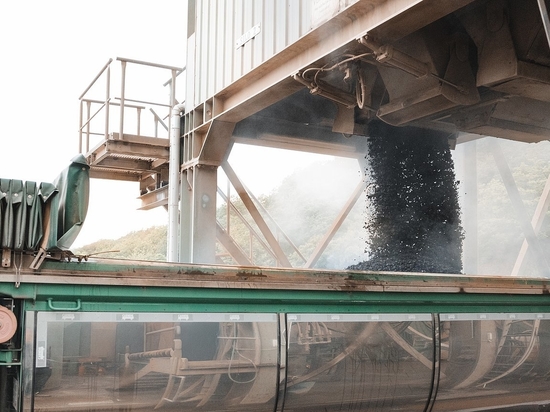
Abrasive media act like a continuous abrasive in the con-veying process. This leads to typical problems in flow mea-surement:
• Wear on components in contact with the media, such as inlet plates or measuring chutes
• Measurement drift/loss of accuracy as soon as surface geometry and friction conditions change due to abra-sion.
• Maintenance costs and downtime—usually the biggest cost driver over the service life
• Risk of contamination if abrasives enter the product—particularly relevant in sensitive applications, such as chemicals, building materials, and specialty products
• High total cost of ownership: inexpensive measure-ment solutions result in significantly higher long-term costs due to the need for replacement parts and pro-duction downtime
For this reason, it is essential to keep track of the material parameters and design the flowmeter accordingly.
• Particle shape and hardness
• Particle size distribution
• Moisture/caking
• Temperature
Wear Concept for Flow Measurement Using the C-Lever
The combination of the C-lever with extremely durable ma-terials makes this measuring system ideally suited for long-lasting and accurate measurement of abrasive materials.
Material Linings
• Hardox Lining: These highly wear-resistant steels are used for extremely abrasive materials to increase the service life of the measuring devices.
• Ceramic Lining: Ceramics with high hardness and abra-sion resistance are primarily used where there are very high wear loads or where metallic abrasion in the product must be avoided.
Influence of Installation Position
In addition to the measurement principle, the installation position significantly influences the achievable accuracy and reproducibility.
• Flow smoothing: A defined inlet with as little turbu-lence as possible is required for reliable measurement values.
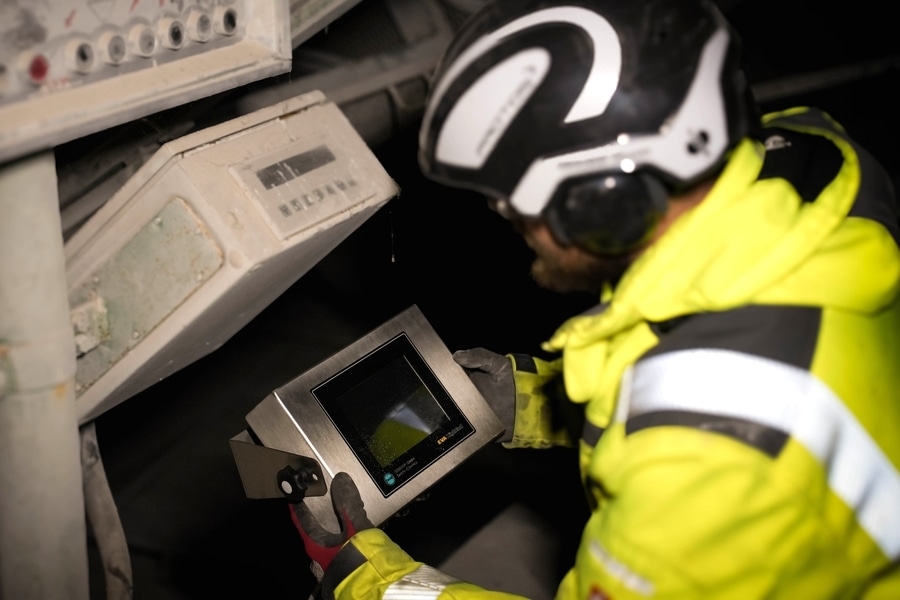
• Dust and Pneumatic Integration: In dusty or partially pneumatic applications, the sensor is typically en-closed in a housing. The C-Lever is certified for use in dust explosion-hazardous areas as well as for specific pressure ranges. Additional protection is provided by cleaning and sensor chamber ventilation.
C-Lever für 50 m^3 in einer ATEX-Umgebung
Conclusion
Anyone handling abrasive bulk materials cannot afford to compromise on flow measurement. It is a key factor in availability, quality, and costs—provided the solution is consistently designed to withstand the realities of wear and tear. By aligning the measurement principle, wear protection concept, and installation conditions, you can achieve stable, long-term processes instead of constant readjustments.
The experts at REMBE® Kersting provide support with design, wear-optimized adaptation, and on-site calibration.