#Product Trends
High Altitude Outdoor Monitoring Energy Storage Battery
Low-Temperature Special Lithium Battery for High-Altitude Snow Mountain Solar Weather Monitoring Station
1. Application Scenario Background
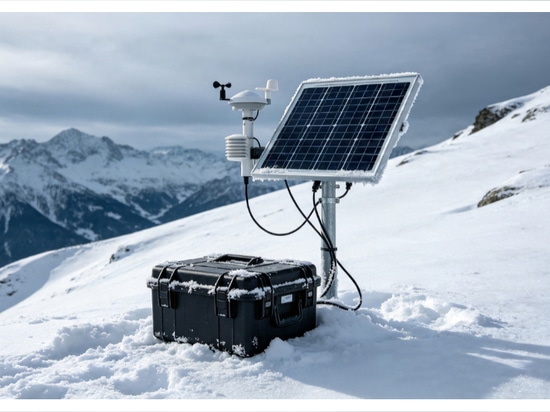
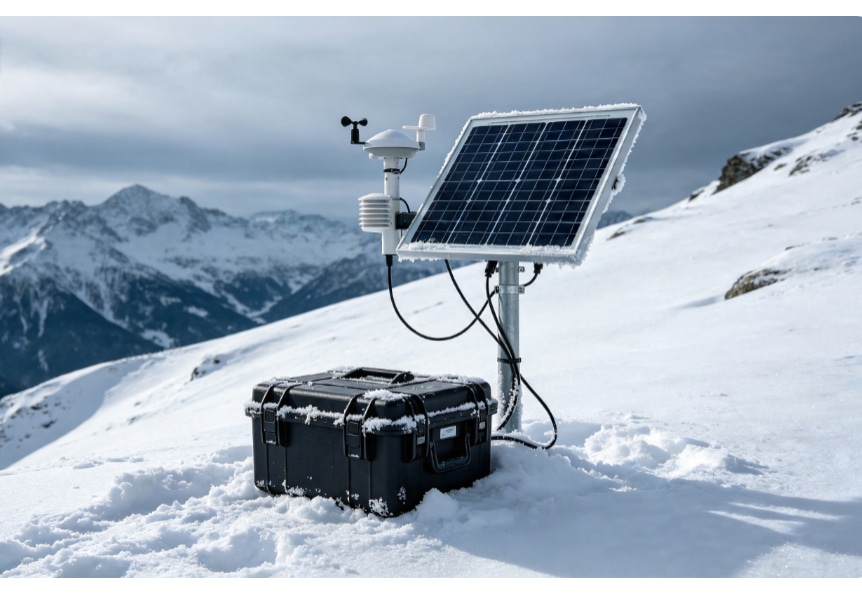
Automatic weather monitoring stations are widely deployed on snow-covered alpine slopes, mountain ridges and remote plateau areas, as shown in the picture. These off-grid meteorological devices rely entirely on solar panels for power generation, equipped with wind anemometers, temperature-humidity sensors, precipitation monitors and data transmission modules.
High-altitude snow mountain sites bring severe challenges to supporting power batteries: long-term ultra-low temperature down to -40℃, heavy snow frost coverage, large day-night temperature difference, no mains power access and unattended operation all year round. Ordinary lithium batteries suffer severe capacity attenuation, rapid aging and even shutdown failure under freezing alpine climate, which breaks meteorological data collection. Our low-temperature resistant special lithium battery pack is tailor-made for high-altitude solar weather stations to solve outdoor cold-region power supply pain points.
2. Core Industry Pain Points for Alpine Weather Station Energy Storage
Severe capacity attenuation in ultra-low temperature snow environment
Conventional lithium cells lose over 40% discharge capacity below -20℃. Snow mountain areas stay below zero Celsius for most of the year, and solar power generation is insufficient in cloudy & snowy weather. Standard batteries cannot store enough power to sustain 24-hour continuous meteorological monitoring.
Frost & snow infiltration damages common battery shells
Outdoor plastic battery boxes lack full waterproof and anti-freezing sealing. Melting snow water penetrates the battery compartment, causing circuit short-circuit, corrosion of wiring harness and early scrapping of power systems.
Short service life under wide temperature fluctuation
Alpine regions feature drastic temperature swings from daytime sunshine to night freezing. Frequent cold & heat cycles accelerate electrolyte aging, shorten battery cycle life, requiring frequent field replacement with high labor & transportation costs in remote mountains.
Unattended long-term operation requires ultra-low self-discharge
Remote mountain weather stations are unmanned for months. Ordinary batteries have high self-discharge rate, easily run out of stored power during continuous cloudy snow days, leading to long-term interruption of meteorological data upload.
3. Our Special Low-Temp Lithium Battery Targeted Solutions
Ultra-low temperature customized cell formula
Adopt low-temperature lithium iron phosphate cells with special electrolyte additives, stable discharge performance at -40℃, capacity attenuation controlled within 10% under freezing environment, match weak solar power generation in snowy days.
IP67 full-sealed thermal insulation integrated cabinet
Equipped with thickened thermal insulation shell and snow-proof sealing structure, resist snow frost accumulation, prevent meltwater infiltration, built-in constant temperature heating film to maintain internal cell working temperature.
Wide temperature adaptive BMS protection system
Independent heating & balance management board, automatically activate heating function when ambient temperature drops below 0℃, slow down aging caused by temperature cycling, extend whole battery service life to 6–8 years.
Ultra-low self-discharge design for long unattended work
Low self-discharge core material, monthly self-discharge rate less than 3%, can maintain sufficient power supply for meteorological sensors during weeks of continuous snow overcast days without sunlight.
4. Matching Scene Advantages (Match the Snow Mountain Weather Station Picture)
Perfectly compatible with snow mountain solar weather stations in the image: cooperate with outdoor solar panels to form an independent off-grid power system, stably supply power to anemometer, weather sensor, data transmission host stored in the black waterproof protection case at the bottom of the pole. Fully adapt to high altitude, heavy snow, low temperature unattended mountain monitoring scenarios, widely used in plateau meteorology, mountain flood early warning, alpine ecological environment monitoring projects.