#Product Trends
Battery Solutions for Smart Meter Applications
Why Batteries Are Important for Smart Meters
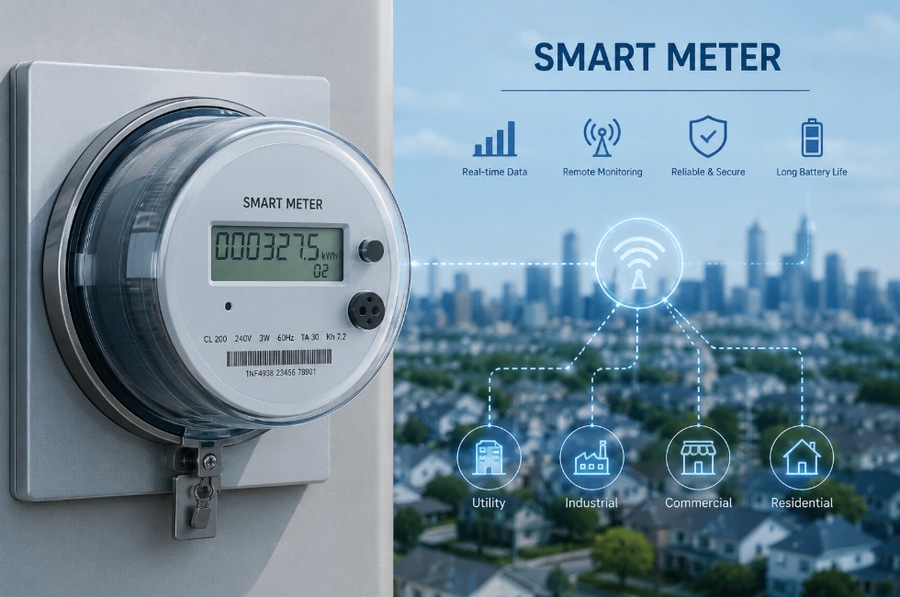
Smart meters are becoming an essential part of modern energy and utility management. Electricity meters, gas meters, and water meters are increasingly equipped with wireless communication and IoT functions, allowing utility companies to collect consumption data remotely and manage infrastructure more efficiently.
As smart meters are often installed in residential buildings, commercial facilities, outdoor utility cabinets, and remote locations, a reliable battery is critical to maintaining uninterrupted operation. The right smart meter battery must provide long service life, low self-discharge, stable voltage output, and reliable performance across a wide range of operating conditions.
## Why Batteries Are Important for Smart Meters
Unlike conventional meters, smart meters continuously collect, process, store, and transmit data. Depending on the system design, the battery may serve as the primary power source, backup power source, or power supply for the communication module and electronic components.
Battery failure can result in communication interruptions, inaccurate data transmission, additional maintenance costs, and unnecessary service visits. Therefore, battery selection should be considered an important part of the overall smart meter design.
For remote or difficult-to-access installations, a **long-life smart meter battery** can significantly reduce the frequency of battery replacement and help lower long-term maintenance costs.
## Key Requirements for Smart Meter Batteries
### Long Service Life
Smart meters are normally designed for long-term deployment. Their batteries therefore need to provide reliable energy over extended periods.
Lithium battery technologies are widely considered for smart meter applications because they can provide high energy density and low self-discharge, helping support long operating periods without frequent replacement.
### Low Self-Discharge
Many smart meters spend most of their operating time in standby mode, periodically waking up to collect data or communicate with a remote system.
A battery with low self-discharge helps preserve available energy during long standby periods, making it particularly suitable for low-power IoT smart meter applications.
### Stable Power Output
Communication modules, sensors, microcontrollers, and memory components require dependable power to operate correctly. A suitable battery should provide stable electrical performance throughout its service life.
For smart meter manufacturers, battery characteristics such as nominal voltage, capacity, internal resistance, pulse discharge capability, and discharge profile should be evaluated together with the actual power consumption of the meter.
### Wide Operating Temperature
Smart meters may be installed indoors, outdoors, underground, or inside utility cabinets. As a result, the battery may need to operate under changing ambient temperatures.
For applications exposed to cold or hot environments, battery chemistry and cell construction should be selected according to the actual operating temperature range.
### Compact Size
Space inside a smart meter is often limited. The battery must fit within the available compartment without interfering with other electronic components.
Custom battery configurations can help manufacturers optimize the battery's dimensions, terminal design, wiring, and installation method according to the meter's internal structure.
## Smart Meter Battery Applications
### Electricity Meters
Smart electricity meters use connected electronics and communication systems to record electricity consumption and transmit data remotely. Batteries may be used for backup power, memory retention, communication functions, or other low-power electronic components.
A dependable battery solution helps maintain critical functions when the primary power supply is interrupted.
### Gas Meters
Battery-powered electronics are particularly important in smart gas meters because the metering system may need to operate for many years with limited maintenance.
Long-life lithium batteries can provide reliable energy for data acquisition, display functions, wireless communication, and other electronic components.
### Water Meters
Smart water meters are frequently installed in locations where replacing a battery can be inconvenient or expensive. Long-life battery technology can therefore help extend maintenance intervals.
Low self-discharge and stable long-term performance are especially important for water meter applications that operate continuously with relatively low power consumption.
## Choosing the Right Smart Meter Battery
There is no single battery that is suitable for every smart meter. Battery selection should be based on the complete power profile of the device.
Important parameters include:
* Nominal voltage
* Battery capacity
* Continuous discharge current
* Pulse discharge requirements
* Standby current
* Communication frequency
* Operating temperature
* Battery dimensions
* Expected service life
* Installation method
* Required certifications
For example, a meter that communicates frequently through cellular, RF, NB-IoT, or other wireless technologies may have significantly different peak power requirements from a simple low-power monitoring device.
Therefore, battery capacity alone should not be used as the only selection criterion.
## Customized Battery Solutions for Smart Meter Manufacturers
Smart meter manufacturers often require batteries with specific dimensions, electrical characteristics, connectors, wires, and packaging configurations.
PKCELL provides customized battery solutions for smart meter and IoT applications. Battery configurations can be developed according to the customer's voltage, capacity, dimensions, discharge requirements, operating environment, and expected service life.
Depending on the application, manufacturers can evaluate different battery chemistries, including primary lithium batteries and rechargeable lithium battery solutions.
A properly designed **smart meter battery solution** can help manufacturers achieve longer operating life, reduce maintenance requirements, and improve the reliability of connected metering systems.
## Conclusion
Smart meters are an important component of modern IoT-enabled utility infrastructure, and battery performance can directly influence the reliability and maintenance requirements of these devices.
For electricity, gas, and water meter applications, factors such as long service life, low self-discharge, stable voltage, compact size, temperature performance, and appropriate discharge characteristics should all be considered when selecting a battery.
By combining the right battery chemistry with application-specific engineering, smart meter manufacturers can develop reliable power solutions designed for long-term field operation.
**PKCELL provides OEM and ODM battery solutions for smart meters and other IoT applications, supporting customized battery specifications for different device requirements.**