
#Product Trends
Ruicom WDS826FL Dynamic Inclinometer Brings Continuous Low-Frequency Sensing to Wind Turbine Tower Sway Monitoring
0.0005° resolution and 20 Hz low-frequency response give condition-monitoring systems a real-time picture of tower attitude, sway amplitude and structural resonance
0.0005° resolution and 20 Hz low-frequency response give condition-monitoring systems a real-time picture of tower attitude, sway amplitude and structural resonance
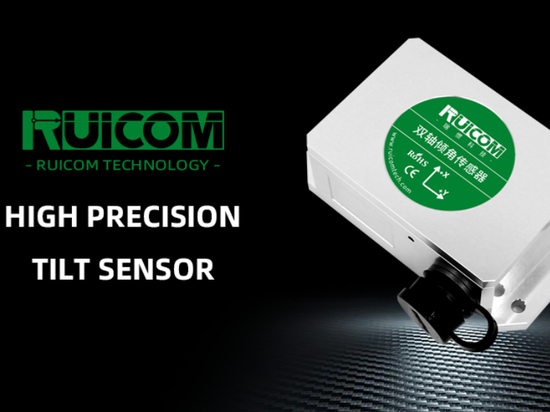
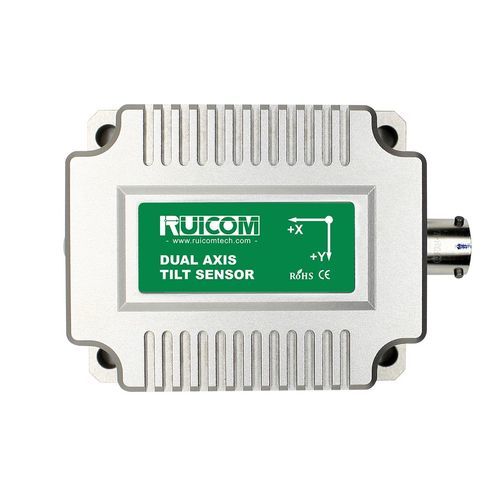
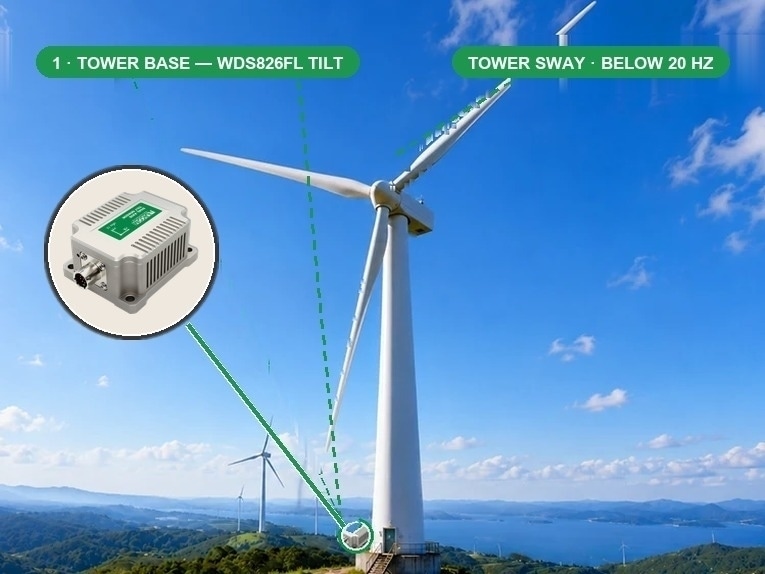
Ruicom today introduced the WDS826FL dynamic inclinometer, a dual-axis dynamic tilt sensor designed specifically for wind turbine tower sway monitoring. Together with the GKP3 low-frequency vibration sensor, it is designed to give condition-monitoring systems a continuous picture of tower attitude, sway amplitude and structural resonance — so developing issues can be identified long before they become serious.
Why wind towers need dedicated low-frequency sensing
A 100-metre tower is a flexible structure that is rarely completely still. Wind turbine towers oscillate continually under rotor thrust, wind gusts and blade imbalance, and these signals generally sit below 20 Hz — a band where conventional tilt switches and vibration switches tend to be less effective. Dedicated low-frequency sensors turn this hard-to-capture information into earlier indications of yaw misalignment, foundation softening and structural fatigue.
From slow sway to structural resonance
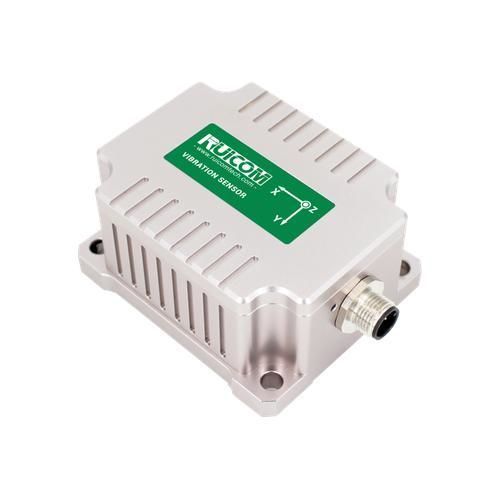
Tower resonance tracking — the GKP3 resolves vibration down to 1 μg in the 0.1–100 Hz band, so blade imbalance, yaw misalignment and foundation softening may show up in the spectrum well before they are visible on site.
Slow-sway attitude — the WDS826FL is designed for low-frequency dynamic tilt, capturing the slowly changing tower lean that static sensors are not intended to resolve.
Foundation settlement — a stable zero-reference at the tower base helps detect settlement and tilt of the foundation ring itself.
Fatigue life management — paired tilt and vibration data feeds the turbine CMS, so maintenance is scheduled by condition instead of by calendar.
Key specifications — WDS826FL
Range: ±10° (XY dual-axis)
Resolution: 0.0005°
Accuracy: 0.05° (room temperature)
Response frequency: 20 Hz (low-frequency dynamic)
Output rate: 5–100 Hz (settable)
Interface: RS485 / RS422 / RS232 · MODBUS
Temperature coefficient: 0.0003 °/°C (zero, −40 ~ +85 °C)
Protection: IP67 · 100 g shock · 10 grms vibration
Weight: ≤447 g (excl. cable)
With excellent low-frequency response, full-temperature-range factory calibration and long-term stability testing, the WDS826FL provides wind turbine operators with a reliable foundation reference for smarter, condition-based maintenance.