#Industry News
Certified fume extraction for automated welding: the TBH TFS Series
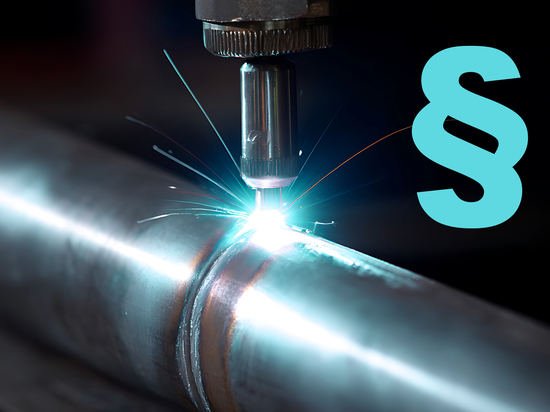
Automated welding is transforming industrial production—from higher throughput to more consistent quality. But there’s a hidden side effect: welding fumes
Even in automated cells, health-relevant particles are generated, and many of them are smaller than 1 µm—exactly the size range that can bypass the body’s natural filters and penetrate deep into the respiratory system.
In fact, TBH’s technical documentation highlights that welding fumes consist of hazardous particles below 1 µm, and that the fume concentration produced during welding processes is considered carcinogenic under the Technical Rules related to hazardous substances. That makes professional fume extraction a key topic in today’s automation landscape.
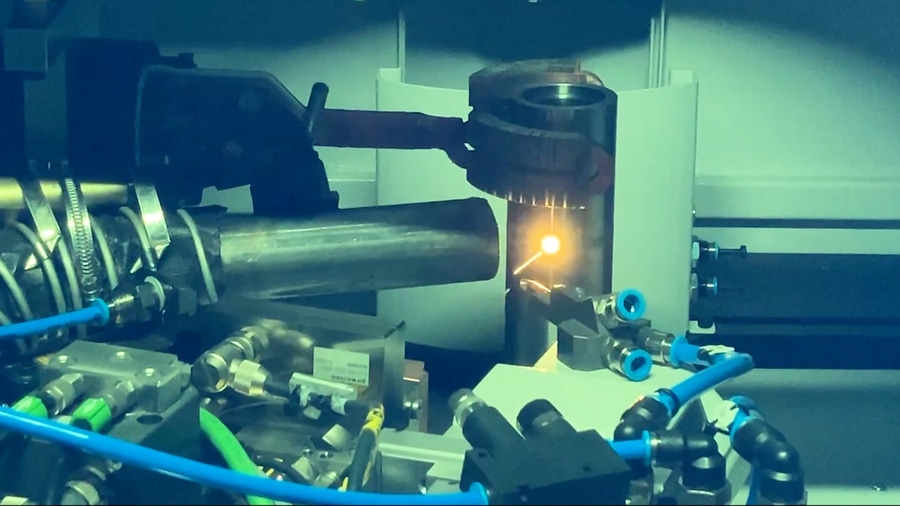
Below this article, you can watch a video showing an automated welding process supported by a certified extraction concept. Why automated welding still needs certified fume extraction
A common misconception: “The process is automated, so the risk is gone.” In reality, automated welding cells still create exposure points—during loading/unloading, rework, inspections, maintenance, and filter servicing. And because the particles are so small, they can remain airborne and spread through the work area if not captured effectively.
TBH’s catalogue explicitly notes that automated welding releases extremely fine, partly carcinogenic particles, and that W3-marked, DGUV-certified extraction systems tested to N ISO 21904-1/-2 provide effective protection, in line with the German TRGS 528 requirements.
What “certified” means in practice: EN ISO 21904, W3 and dust class H
When selecting an extraction system for welding automation, “powerful suction” is only part of the story. The more important question is: Can the system’s protective performance be proven and documented?
TBH’s documentation points to internationally recognised frameworks:
• Tested according to ISO 21904 (W3) and DIN EN 60335-2-69 Annex AA (dust class H) to reliably filter fine welding and laser fumes as well as hazardous dusts
• Confirmed by the German Institute IFA and listed in the “IFA positive list” according to the German TRGS 528; systems carry W3 and DGUV seals
Why W3 matters: welding fumes are associated with extremely small particles, and W3 classification is linked to very high separation performance. TBH’s W3 explainer notes that W3 filtration corresponds to an extraction efficiency > 99% for relevant applications, and recommends checking filter effectiveness at least annually.
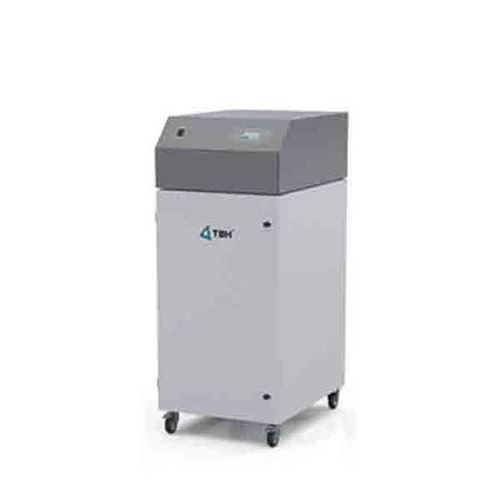
The solution: TBH TFS Series for automated welding environments
The TBH TFS Series is positioned for industrial processes where certified protection is required—especially where automation increases arc-on time and aerosol generation.
Configurable for real-world welding cells
Automated welding setups are rarely identical. The TFS ecosystem supports practical add-ons such as:
• Extraction arm systems for flexible capture near the source
• Spark extinguisher / gravity separator modules (important for hot particle loads in welding processes)
• Activated carbon option (e.g., for additional gas/odour components depending on application) – shown for TFS250 Plus with activated carbon filter (30 L)
Safer maintenance: low-contamination filter change
In automation, maintenance time is production time. But maintenance must also be safe—especially when dealing with hazardous dusts.
TBH describes a patented, contamination-controlled filter change concept where the intake area remains sealed during replacement, which is particularly recommended for hazardous processes.
Integration into automated environments
For certified “W3” operation, the catalogue notes that a signal module with volume flow monitoring (or equivalent customer-side functions) must be used—a relevant point for automated welding lines where monitoring and documentation are part of compliance.
Practical checklist: what to consider for automated welding extraction
When engineering or upgrading an automated welding cell, use this quick checklist:
1. Capture strategy: Can you extract close to the source (arm/ducting) and avoid fume spreading?
2. Certification: Is performance verified to EN ISO 21904-1/-2 and aligned with W3 requirements for welding fumes?
3. Fire & spark protection: Do you need a spark extinguisher/gravity separator based on process intensity?
4. Filter handling: Is filter replacement designed to reduce exposure and dust release?
5. Monitoring & documentation: Are airflow and operating conditions monitored to support safe, compliant operation? Find out more about the TBH TFS Series: