
#Product Trends
ISPM-15: The Essential Phytosanitary Marking for Export Pallets
The international standard that ensures the safe movement of goods — and how UBS helps you comply.
The ISPM-15 (International Standards for Phytosanitary Measures No. 15) regulation, adopted by more than 100 countries, governs the use of wood packaging materials to prevent the spread of pests. Compliance is mandatory, and failure to meet the requirements may result in customs holds, financial penalties, or even the destruction of the shipment.
Main Requirements
The standard establishes two key conditions:
• Phytosanitary treatment of the wood, either by heat treatment (HT) or dielectric heating (DH). The use of methyl bromide (MB) is increasingly restricted due to its environmental impact.
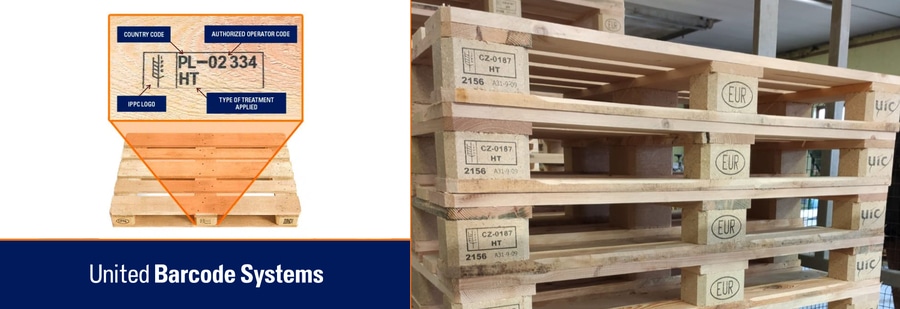
• Official IPPC marking, which must be permanent, legible, and durable. It must include the IPPC logo, the country code, the authorized operator number, and the type of treatment applied.
A poorly printed or barely visible stamp can invalidate an entire pallet and jeopardize the logistics operation.
The Marking Challenge
Many manufacturers face printing issues: low legibility, non-durable inks, or incorrect dimensions that cause customs rejections and additional costs.
The UBS Solution
To address this, United Barcode Systems (UBS) has developed the APLINK HRX GS05 printer, designed to print directly onto wood in demanding industrial environments. This system ensures sharp, long-lasting, and ISPM-15-compliant marking, and is also EPAL-certified.
The benefits are clear:
• Guaranteed compliance with international regulations.
• Reduced costs due to incidents or rejections.
• Increased productivity on packaging lines.
At UBS, we help you comply with ISPM-15 safely, precisely, and efficiently — ensuring your pallets are always ready for export.