
#Product Trends
Labeling and Coding in Wineries: 5 Challenges on Bottling Lines and How to Solve Them
Bottling lines must manage different wines, vintages, formats, and markets without compromising traceability.
Direct printing, automation, and centralized data management help reduce errors, optimize production changeovers, and maintain reliable identification from bottle to pallet.
The wine industry handles a wide variety of product references that require accurate identification throughout the production process. Every change in wine, batch, vintage, or destination market may require changes to the information printed on bottles, cases, and pallets, increasing the complexity of industrial labeling and coding processes.
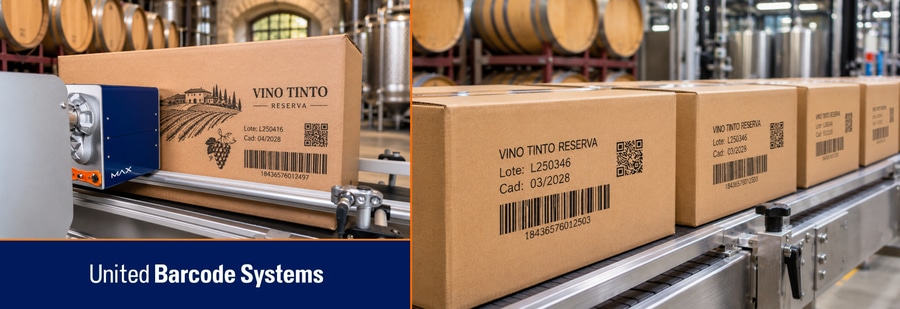
One of the main challenges is managing multiple preprinted case variants. When each wine, vintage, or market requires specific packaging, storage requirements, purchasing planning, and the risk of obsolescence increase. One alternative is to use generic cases and print variable information directly during production, allowing the same packaging to be adapted to different product references when its characteristics permit.
Frequent product changeovers also pose a risk to traceability. An incorrect date, batch number, or product reference can lead to logistics issues, rework, and difficulties tracking goods. For this reason, automating print data management and linking it to production orders is essential to reducing manual intervention and maintaining control over information.
Another key factor is ensuring traceability from bottle to pallet. The information used at each identification level must correspond to the product and its logistics grouping. Connecting production, labeling, and coding systems helps improve data consistency and facilitates product tracking throughout storage, shipping, and distribution.
Print quality on cardboard cases also directly affects identification reliability. Factors such as material porosity, ink type, printing distance, line speed, and case stability can affect code readability. For this reason, it is important to evaluate actual production conditions and select technologies capable of maintaining accurate and consistent printing.
In addition, wineries need to adapt their processes to increasingly flexible production requirements. Managing different bottle formats, gift boxes, cases, and international orders requires solutions that streamline product changeovers without compromising line efficiency or relying on constant manual adjustments.
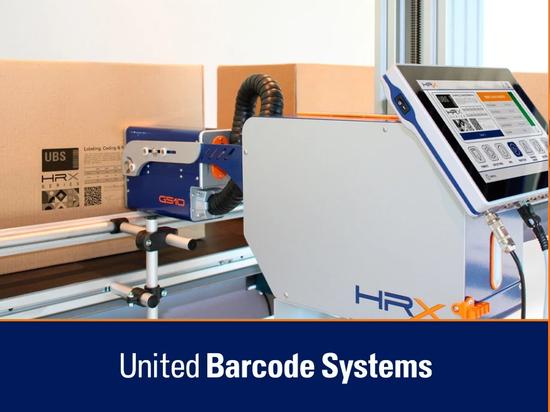
To address these challenges, at United Barcode Systems, we develop industrial labeling, coding, and marking solutions tailored to the needs of the wine industry. Equipment such as APLINK HRX MAX makes it possible to print large-format messages directly on cases and packaging, incorporating variable information, codes, and graphic elements at high resolution. This technology provides an alternative to using multiple preprinted packaging variants, enabling more flexible identification on secondary packaging.
In addition, our UBS LABMAN software enables centralized management of equipment and print messages, user and permission management, and integration of information from ERP or MES systems. This makes it possible to link data from each production run to the messages being used, reduce manual errors, and improve coordination between different identification levels.
The combination of direct printing, automation, and centralized data control makes it possible to address bottling line challenges through a comprehensive approach. Adapting technologies to the specific characteristics of each winery helps optimize resources, improve production flexibility, and maintain reliable traceability throughout the entire supply chain.
Want to improve the traceability and efficiency of your bottling line? Contact our team and discover how our industrial labeling, coding, and marking solutions can be tailored to your winery's needs.