#Product Trends
How to Achieve Stable Feeding of Large Parts in the Automotive Industry
Automated Feeding of Large Parts in the Automotive Industry
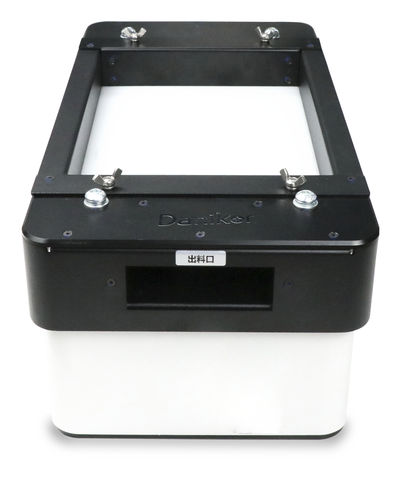
In the parts assembly scenarios of the automotive industry, the automated feeding of large parts has always been a critical link for production efficiency and stability. Traditional feeding solutions often struggle to balance cost, stability, and precision. The emergence of DANIKOR's centrifugal bowl feeder offers an efficient solution to this challenge.
I. Core Pain Points in Feeding Large Parts in the Automotive Industry
The production and assembly of automotive parts impose strict requirements on the feeding process. The pain points associated with feeding large parts are particularly prominent, directly impacting production takt time and product quality.
Scarcity of Low-Cost, Stable Feeding Solutions
For large parts like big hardware components, solutions using 3D guidance for feeding are costly and offer limited options. Most low-cost solutions struggle to accommodate the volume and weight characteristics of large parts, failing to achieve stable material supply.
Difficulty in Guaranteeing High Stability and Takt Time
Automotive production lines operate on a fixed takt time, requiring the feeding process to consistently provide parts in the correct orientation within the allotted time. Traditional solutions are prone to issues like material jams or supply interruptions, directly impacting the continuous operation of the entire production line.
Conflict Between High Precision Requirements and Material Characteristics
Automotive parts assembly demands high precision in part orientation and positioning. However, large parts often have characteristics such as large size, heavy weight, susceptibility to deformation, and a tendency to stack. Traditional feeding methods find it difficult to simultaneously meet the dual demands of orientation adjustment and precision control.
Poor Adaptability to Different Types of Large Parts
Large plastic parts are often irregularly shaped, metal parts are heavy, and soft rubber parts are prone to deformation and tangling. Traditional solutions struggle to simultaneously meet the needs for flipping and separating large parts made of various materials, lacking sufficient versatility.
II. DANIKOR Centrifugal Bowl Feeder: A Stable Feeding Solution for Large Automotive Parts
Through structural design and functional optimization, the DANIKOR centrifugal bowl feeder achieves a feeding performance that is low-cost, highly stable, and highly precise, while also accommodating the needs of various large parts.
Core Working Principle
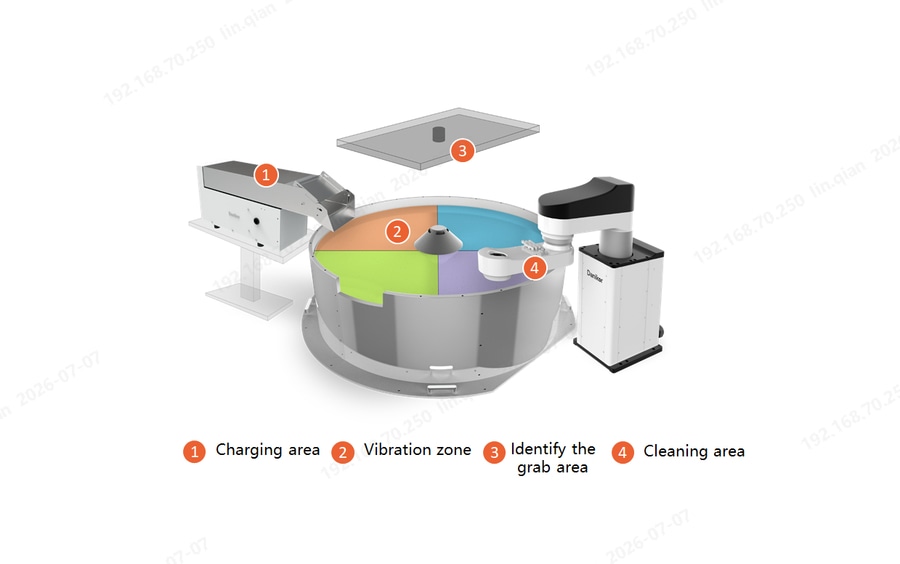
The feeding process of the DANIKOR centrifugal bowl feeder forms a closed-loop logic, ensuring efficient and orderly material flow:
Operators manually add materials to the hopper, which vibrates to supply material to the feeding area of the centrifugal bowl feeder.
A drive motor rotates the turntable, combined with the up-and-down movement of a cylinder, to adjust the orientation and pre-sort the posture of the materials.
A vision camera captures and identifies the correct posture of the material, sending the position coordinates to the robot.
Based on the visual positioning, the robot picks the material from the recognition and pick-up area for assembly. Remaining materials enter the clearing area and continue circulating.
Core Advantages for the Automotive Industry
Strong Load Capacity, Covering the Vast Majority of Large Automotive Parts
The centrifugal bowl feeder has large load parameters, enabling it to handle most large parts in the automotive industry, including those made of plastic, metal, and soft rubber. This solves the problem of traditional solutions having insufficient load capacity for large parts.
Stable and Reliable Feeding, 2D Recognition Mode Reduces Error Rate
It uses 2D vision recognition combined with the stable circulation of the centrifugal bowl feeder. Compared to 3D guidance solutions, this approach is lower in cost, while the recognition process is stable and less prone to errors, meeting the automotive production line's requirements for takt time stability.
Strong Adaptability, Meeting the Flipping and Separation Needs of Different Materials
It can be equipped with accessories such as brushes, baffles, and hooks. These effectively handle the irregular shapes of large plastic parts, the stacking issues of metal parts, and the tangling characteristics of soft rubber parts, enabling the flipping, separation, and posture organization of materials, adapting to the feeding needs of various large parts.
Low Damage and Low Noise, Balancing Material Protection and Production Environment
Using baffles and brushes to separate materials avoids the damage to fragile or easily worn materials that can be caused by vibration-based separation. Additionally, both peak and average noise levels are lower, aligning with the requirements of automotive workshops for a quality production environment.
The DANIKOR centrifugal bowl feeder effectively solves the challenges of cost, stability, and adaptability in feeding large parts in the automotive industry, providing reliable feeding support for the automated assembly of automotive parts.