#Product Trends
Solving the Challenge of Automated Feeding with Positive/Negative Identification for Materials with Minimal Differences
Automated Feeding with Positive/Negative Identification for Materials with Minimal Differences
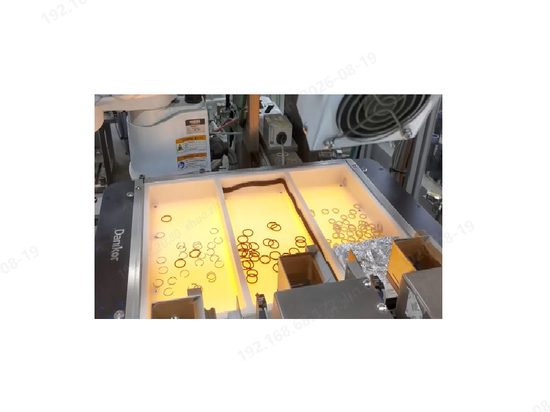
In high-end precision manufacturing fields such as 3C electronics, precision hardware, new energy auto parts, and semiconductors, flexible feeding is the core preliminary process of automated production lines. It directly controls the operational rhythm, production efficiency, and product yield of the entire line. Currently, the industry faces a common and thorny automation pain point: the identification of flexible feeding for precision materials with minimal visual differences between their positive and negative sides.
The front and back sides of such precision materials often have almost no difference in contour, structure, holes, or appearance. It is difficult for both the human eye and traditional machine vision algorithms to accurately distinguish the positive and negative orientations, which can easily lead to reverse feeding, posture misalignment, material misjudgment, and other problems. This has become a core bottleneck restricting enterprises' flexible automation upgrades and refined production.
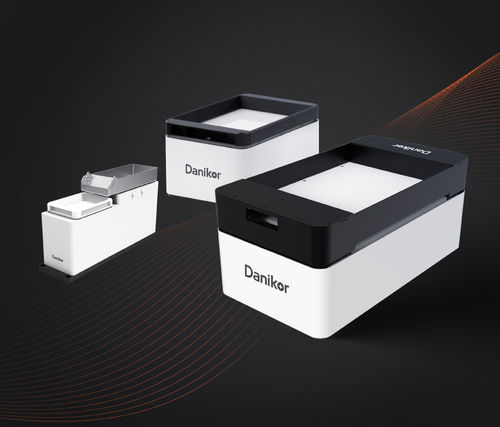
Danikor, with years of deep experience in flexible feeding equipment and AI vision technology, has leveraged deep learning algorithms to restructure the material visual recognition logic. This completely breaks the technical limitations of traditional vision solutions and efficiently overcomes the challenge of identifying the positive and negative sides of materials with minimal differences, thereby improving quality, efficiency, and reducing costs for precision manufacturing automated production lines.
I. Core Disadvantages of Traditional Flexible Feeding Vision Solutions
In traditional automated production, flexible feeding vision recognition systems have long relied on conventional machine vision algorithms, with the core operating model being manually calibrated features. This approach can meet the feeding needs of conventional materials with obvious appearance differences, suitable for standardized, single-type production scenarios. However, for precision materials with minimal differences and highly similar appearances, its technical flaws are fully exposed, making it unsuitable for the recognition requirements of high-end precision production.
The recognition logic of traditional vision algorithms is highly rigid and passive, only able to capture superficial explicit geometric features like material edges, overall contours, and image grayscale/brightness. They cannot extract the deep feature information of the material. During the production debugging phase, technicians must manually observe the material's shape, manually mark and annotate feature points for positive and negative sides, and pre-set fixed recognition matching rules. The equipment can only mechanically compare and passively identify based on these preset parameters. This operating mode, which requires high manual intervention, has three core shortcomings that severely affect the stability and accuracy of precision material feeding.
First, limited recognition accuracy and extremely low production fault tolerance. For precision small parts with highly consistent positive/negative textures, structures, and dimensions—such as micro-connectors, new energy battery electrodes, precision shims, and semiconductor micro-components—traditional algorithms cannot capture subtle differential information, making them prone to confusing the positive and negative orientations. Any recognition deviation can directly lead to reverse feeding and misplaced loading, causing issues like insufficient bonding in subsequent assembly processes, equipment jams, and assembly failures, ultimately resulting in product scrappage. In high-precision manufacturing scenarios, even millimeter or pixel-level recognition errors in orientation can lead to substandard product performance or even pose production safety hazards.
Second, poor environmental noise immunity and high susceptibility to lighting conditions. The effectiveness of traditional visual recognition heavily depends on a constant, standard lighting environment, imposing strict requirements on the production floor conditions. In daily workshop production, subtle environmental changes—such as light shifts, reflections from equipment lighting, changes in shadows and brightness on material surfaces, and variations in light transmission due to workshop dust—can alter image grayscale parameters. This invalidates the preset matching rules, leading to frequent misidentification, missed detections, and repeated identifications, directly reducing the material feeding pass rate and slowing down the overall line takt time.
Third, cumbersome debugging processes and poor adaptability to flexible production. The parameters of traditional vision solutions have very poor universality. Whenever an enterprise changes the material being fed, adjusts the production line conditions, or iterates the product, technicians are required to re-calibrate feature points, modify matching rules, and debug algorithm parameters. This entire process is time-consuming and labor-intensive, and heavily reliant on human experience. This model cannot adapt to the current manufacturing demands for flexible production characterized by multiple varieties, small batch sizes, and rapid changeovers. It not only increases the company's labor and maintenance costs but also causes frequent downtime for debugging, resulting in significant production losses.
II. Danikor's Flexible Feeding Solution
To completely resolve the numerous industry pain points associated with traditional visual feeding, Danikor has advanced its flexible feeding system technology. It has completely abandoned the old manual feature calibration mode and equipped the system with industrial-grade AI deep learning vision technology, fundamentally restructuring the recognition logic for materials with minimal differences. This represents a leap from traditional surface-level geometric feature matching to AI-driven autonomous learning of pixel-level essential features. It precisely overcomes the industry-recognized challenge of identifying materials with minimal positive/negative differences, addressing a key technical shortfall in precision flexible feeding.
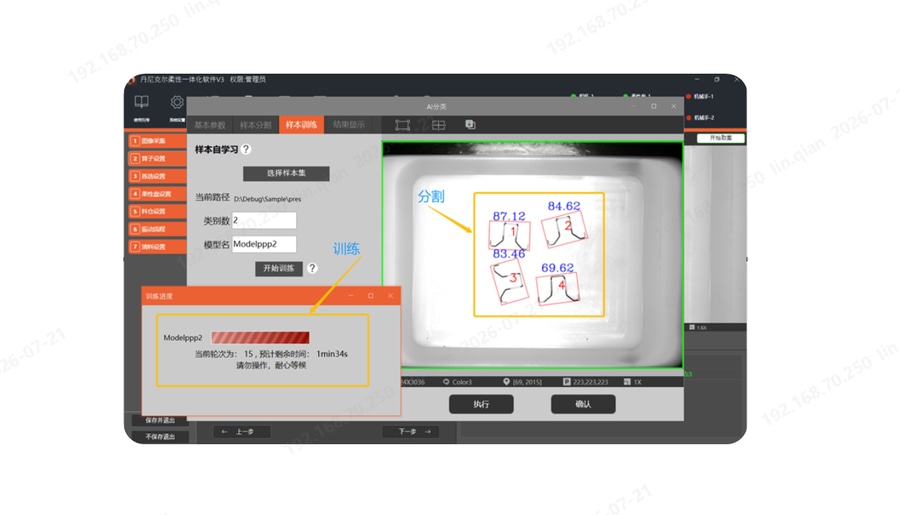
Compared to the passive matching of traditional algorithms, Danikor's flexible feeding system boasts core advantages of autonomous learning and intelligent iteration. It requires no manual feature annotation and no pre-setting of geometric or grayscale matching rules. After the equipment is online, operators only need to input sample images of the material in its positive and negative orientations, under different placement positions, different tilt angles, and different lighting conditions. The built-in deep learning model can then autonomously complete mass sample training, screening, and learning. It precisely captures pixel-level subtle differences that are invisible to the human eye and traditional algorithms, deeply mines and solidifies the core essential features of both sides of the material, and rapidly generates a dedicated, intelligent material identification model.
Currently, the automation upgrade in China's manufacturing industry has entered a refined and intelligent deep-water zone. Solutions for automated feeding of conventional materials are already widely adopted. However, the precise identification of materials with minimal positive/negative differences has become a key difficulty hindering the full-scale implementation of automation in mid-to-high-end manufacturing sectors like 3C electronics, new energy, semiconductors, and precision hardware. The technical bottlenecks of traditional vision solutions not only limit the capacity and efficiency improvements of production lines but also continuously increase production losses, quality control pressure, and operational maintenance costs for enterprises.
Danikor's flexible feeding system, leveraging its self-developed core deep learning technology, has successfully broken through industry technical barriers. It specifically solves the positive/negative identification challenges for various high-similarity precision materials in the feeding process, covering multiple workpiece types including micro-components for 3C electronics, precision fittings for new energy, micro-devices for semiconductors, and micro-stamped hardware parts. By replacing traditional rule-based algorithms with AI intelligent learning, and replacing cumbersome manual debugging with automated intelligent adaptation, it provides a one-stop solution to core pain points such as material misjudgment, poor adaptability to working conditions, low changeover efficiency, and high production costs. This achieves multi-dimensional optimization of production efficiency, product quality, and operational costs, providing robust technical and equipment support for the flexible automation transformation and upgrade of high-end precision manufacturing.