#Product Trends
Danikor's Synchronous Online Rework Strategy – Protecting Your Takt Time
Synchronous Online Rework Strategy
At multi-spindle synchronous tightening stations for critical automotive components like tires, chassis assembly, and transmissions, an abnormality in a single bolt often triggers a chain reaction of "full-group rework and production line stoppage," becoming a core pain point restricting capacity and quality.
Danikor's Synchronous Online Rework Strategy breaks the limitations of traditional rework methods. It integrates the repair process for abnormal bolts into the normal production cycle, ensuring that it neither interrupts the production line's operation nor affects the stable progress of other processes. This provides an efficient, non-destructive quality assurance solution for multi-spindle synchronous tightening scenarios.
I. Three Major Pain Points of Traditional Multi-Spindle Tightening Rework
In synchronous tightening scenarios for key automotive components, traditional rework models have always had inherent, unsolvable drawbacks:
1. Forced Production Line Stoppage, Incalculable Loss of Takt Time
Traditional solutions require setting up a separate rework process for abnormal stations. Once a single bolt fails to tighten correctly, the entire set of workpieces must be taken offline for rework, while other normal stations are forced to stop and wait. Taking a tire tightening station as an example: if only 1 out of 5 bolts is abnormal, the entire set of bolts must be loosened and re-tightened. This not only significantly extends rework time but also causes a halt in the takt time of the entire production line, leading to unquantifiable capacity losses.
2. Expanded Rework Scope, Exponentially Increased Quality Risks
In the traditional "full-group rework" mode, bolts that were originally tightened correctly also undergo repeated operations. The process of multiple loosening and re-tightening cycles can easily cause thread wear and torque deviations. Previously合格 (qualified) bolts can thus become new quality hazards. This expanded rework scope makes it difficult to ensure assembly consistency.
3. Complex Maintenance Processes, Poor Adaptability, and High Costs
A separately built rework station requires additional tooling, tools, and personnel. Furthermore, the rework processes for different stations are not interchangeable, leading to high changeover and maintenance costs. Facing the tightening needs of various components like chassis assemblies and transmissions with diverse specifications, traditional rework models struggle to adapt flexibly, becoming an obstacle to flexible production.
II. Danikor's Synchronous Online Rework Strategy: "Repair While Producing" Even When Abnormalities Occur
Addressing the pain points of multi-spindle synchronous tightening scenarios, Danikor's Synchronous Online Rework Strategy operates on the core principle of "no interruption to takt time, no expansion of rework scope, and no impact on normal spindles," enabling the simultaneous resolution of abnormal issues during the production process.
1. Core Logic: Synchronized Recovery at the Same Node, Preventing Abnormalities from Slowing Down the Overall Pace
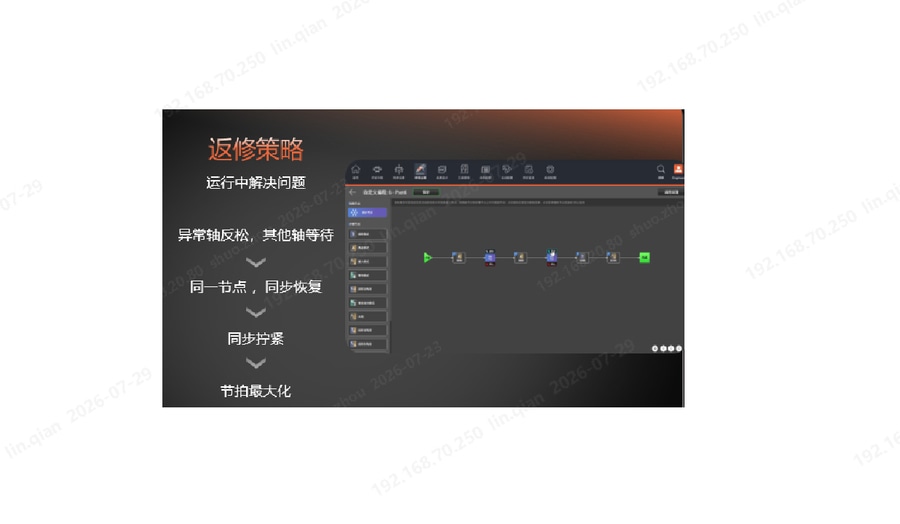
The core flaw of traditional rework models is that "after an abnormality occurs, the production line must stop to solve the problem." Danikor's Synchronous Online Rework Strategy, through a coordinated mechanism of "abnormal spindle reverse loosening, other spindles waiting," allows all spindles to converge at a set synchronization node and then proceed together to the next tightening step.
Using an automotive tire synchronous tightening scenario as an example:
When one tightening spindle detects a torque abnormality, the system immediately triggers the reverse loosening program for that spindle. Simultaneously, the other normally tightening spindles enter a waiting state and do not proceed to the next step prematurely.
After the abnormal spindle completes its rework and returns to a合格 (qualified) state, all spindles converge at the preset synchronization node and proceed synchronously to the next tightening action. This ensures the final tightening quality consistency of every bolt, while the production line's takt time remains completely unaffected.
2. Three Core Advantages, Redefining the Logic of Multi-Spindle Tightening Rework
No Interruption to Production Takt Time: No need to take workpieces offline or stop the production line. The repair process for abnormal bolts is completed during the normal operation of the production line. The loss of takt time at a single station is minimized, significantly improving the overall production line efficiency.
No Expansion of Rework Scope: Only the abnormal tightening is specifically reworked. The tightening status of all other normal bolts is completely unaffected, avoiding the risks of thread wear and torque deviations caused by repeated operations, and controlling quality risks at the source.
No Impact on the Status of Other Normal Spindles: Through precise node control, the system allows normal tightening spindles to only wait briefly at the synchronization node. They do not need to repeat loosening and tightening operations, which not only ensures the tightening consistency of other spindles but also reduces wear on tools and workpieces.
3. From Control Synchronization to Quality Synchronization, Fully Controllable Tightening Results
Danikor's Synchronous Online Rework Strategy not only achieves synchronization of actions but also ensures synchronization of the final quality results. Through real-time monitoring of torque-time curves, the system can precisely track the torque changes of each tightening spindle.
III. An Industrial-Grade Tightening Rework Solution Adaptable to Multiple Scenarios
Danikor's Synchronous Online Rework Strategy is not only suitable for automotive tire tightening scenarios but also flexibly adaptable to various multi-bolt synchronous operation scenarios, such as chassis assembly, transmission assembly, and new energy battery pack multi-spindle tightening. Danikor's Synchronous Online Rework Strategy breaks the limitations of traditional rework models, making exception handling a part of the production process rather than an interruption. It provides an efficient, stable, and traceable quality assurance solution for multi-spindle synchronous tightening scenarios.