#Product Trends
Damage-Free Feeding Solution for Semiconductor Refrigeration Thermoelectric Particles
Automated Feeding Solution for Semiconductor Refrigeration Thermoelectric Particles
The core P/N type thermoelectric particles used in semiconductor refrigeration chips are smaller than sesame seeds. Made of brittle ceramic material, they are extremely prone to chipping and fracturing from collision and friction. The rigid feeding method of traditional vibratory bowls results in a persistently high damage rate, which restricts the yield of automated TEC (Thermoelectric Cooler) production.
Danikor's fully self-developed flexible feeding system, featuring a custom high-polymer flexible vibratory plate, voice coil motor micro-amplitude vibration control, and AI visual closed-loop recognition technology, enables micron-level thermoelectric particle feeding with zero scratches and zero fractures throughout the entire process. It is ideally suited for the production requirements of semiconductor thermoelectric components, including multiple specifications, high cleanliness, and zero loss, making it the preferred automated feeding solution for miniature brittle semiconductor parts.
I. Three Major Industry Pain Points in Traditional Thermoelectric Particle Feeding
As the core components of TEC chips, semiconductor thermoelectric particles are made of brittle semiconductor ceramic, with extremely small dimensions and a fragile structure. Traditional feeding equipment has prominent production defects:
High Material Damage Rate, Soaring Production Costs
Traditional metal-track vibratory bowls rely on strong vibration to disperse materials. The tiny thermoelectric particles collide violently with each other and rub against the hard bowl surface, easily leading to chipped corners, cracks, and surface scratches. The defect rate for a single batch can reach 8%-12%, and the scrappage of these high-value thermoelectric grains severely compresses corporate profits.
Vibration Parameters Cannot Self-Adapt, Poor Posture Dispersion
Traditional electromagnetic vibratory bowls have fixed amplitude and frequency, which cannot match the weight differences of P/N particles of various specifications. Severe material stacking and agglomeration occur, leading to frequent missed detections and false detections by the vision system, requiring continuous manual intervention to arrange parts, resulting in low automation.
Complex Changeovers and Frequent Jams/Stoppages
Thermoelectric particles come in sizes suitable for cooling chips of different powers. Traditional vibratory bowls require custom-made metal tracks for each changeover, a process taking over 2 hours. Additionally, tiny particles easily get stuck in track gaps, causing frequent production line stoppages for cleaning, significantly reducing the production cycle.
II. Danikor Flexible Vibratory Plate: Core Advantages for Damage-Free Thermoelectric Particle Feeding
Custom High-Polymer Flexible Plate Surface, Preventing Scratches and Fractures from the Source
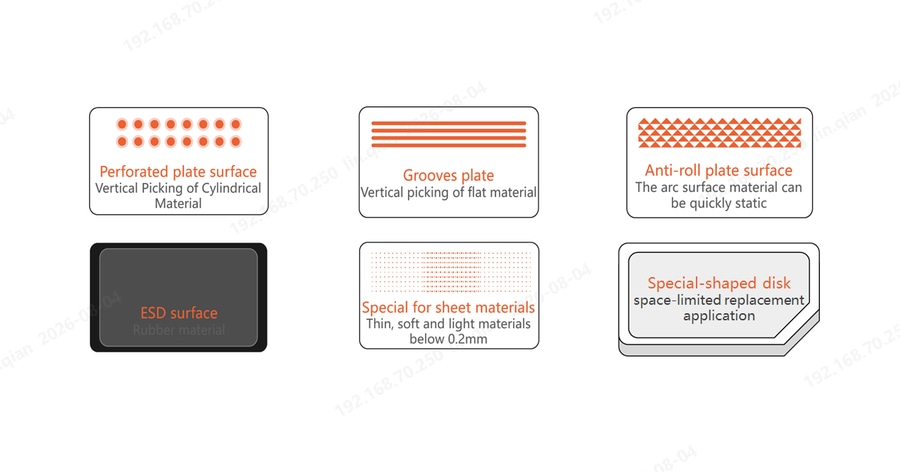
The Danikor flexible feeder plate supports custom ESD (Electrostatic Discharge) anti-static high-polymer surfaces. Developed specifically for brittle thermoelectric particles, this low-friction flexible material has a much lower friction coefficient than metal or standard plastic plates. Particles slide and roll without hard contact friction, eliminating surface scratches and edge damage.
For thermoelectric particles as small as sesame seeds, custom thin, slotted plates can be used to prevent tiny grains from tipping over or stacking. The elastic material absorbs vibration impacts, significantly reducing the force of collisions between particles. The breakage rate of thermoelectric grains is reduced to less than 0.1%, perfectly matching the high-yield production standards of the semiconductor industry.
Voice Coil Motor Intelligent Vibration Control, Gentle Micro-Amplitude High-Frequency Material Dispersion
The equipment uses a self-developed voice coil motor as the vibration power source, differing from the harsh excitation of traditional electromagnets. Its 12-second one-key intelligent frequency search function automatically detects the size and weight of the thermoelectric particles and dynamically matches the optimal vibration frequency and micron-level amplitude. It uses micro-amplitude, high-frequency vibration to gently separate materials, eliminating violent bouncing and strong impacts.
Vibration after-effect is reduced to 0.2 seconds, and the vibration start/stop response is rapid. During the vision imaging phase, the material is quickly stabilized, ensuring uniform particle distribution for easy identification while minimizing grain-to-grain impact. This perfectly matches the physical characteristics of brittle thermoelectric particles.
AI Self-Learning Material Posture Recognition, Improving Feeding Accuracy
The Danikor flexible feeding system incorporates a self-developed vision control platform with an optimized recognition algorithm specifically for miniature millimeter-sized brittle components. It solves the industry challenge of accurately identifying thermoelectric particles where the front and back are difficult to differentiate due to minimal differences:
Without the need for manual feature calibration, the vision system autonomously collects samples of the front, back, and multiple angles of the particles. It automatically extracts subtle features, accurately distinguishing the orientation of P-type and N-type grains. Recognition precision is unaffected by small size or color differences, preventing assembly scrap caused by incorrect orientation pick-up.
III. Conclusion
The feeding challenges of semiconductor refrigeration P/N type thermoelectric particles—being "minute, highly brittle, and easily damaged"—cannot be fundamentally solved by traditional rigid vibratory bowls. Danikor's flexible feeding system, relying on a high-polymer flexible plate, voice coil motor micro-amplitude vibration control, and AI visual closed-loop management, achieves complete damage protection throughout the entire process of material conveying, dispersion, and pick-up. It solves issues such as grain fracturing, scratching, jamming, and difficult changeovers, offering a standard flexible feeding solution for TEC semiconductor refrigeration chip automated production lines.
Given the semiconductor industry's trend towards multi-variety, small-batch, high-cleanliness, and high-yield production, replacing traditional rigid feeding equipment with flexible vibratory plates is an inevitable choice for industry upgrades. Danikor can customize dedicated damage-free feeding workstations based on different sizes of thermoelectric particles, adaptable to various cooling chip packaging and die-attach automated production lines.