#Product Trends
What Is Angle Tightening?
Intelligent Electric Screwdriver, Servo Screwdriver, Smart Tightening System
In modern manufacturing, simply reaching the target torque is no longer enough to guarantee a reliable bolted joint. As products become lighter, more precise, and more safety-critical, manufacturers increasingly adopt angle tightening to achieve consistent clamp load and improve assembly quality.
From automotive production and battery assembly to industrial automation and electronics manufacturing, torque-angle control has become one of the most trusted tightening strategies.
In this article, we'll explain:
What angle tightening is
How it works
Why it is more reliable than torque-only tightening
Where it is commonly used
How intelligent electric screwdrivers make angle tightening more accurate
What Is Angle Tightening?
Angle tightening is a fastening method that controls the rotation angle of a fastener after a predefined torque has been reached.
Instead of stopping immediately when the target torque is achieved, the tightening tool continues rotating the bolt by a specified angle, such as:
45°
90°
180°
360°
This controlled rotation stretches the bolt by a predictable amount, generating a more consistent clamping force.
The typical tightening sequence is:
Tighten to the snug torque.
Detect the joint contact point.
Continue rotating by a preset angle.
Complete tightening.
Because bolt elongation is directly related to clamp force, angle tightening generally provides much better preload consistency than torque-only methods.
Why Torque Alone Is Sometimes Not Enough
Torque is only an indirect indicator of clamp force.
In fact, approximately 85–90% of tightening torque is consumed by friction, while only a small portion actually creates bolt preload.
Many variables affect friction:
Surface coating
Lubrication
Washer condition
Thread quality
Material differences
Production tolerances
As a result, two bolts tightened to exactly the same torque may produce significantly different clamping forces.
This is why critical assemblies increasingly rely on torque + angle control rather than torque alone.
How Does Angle Tightening Work?
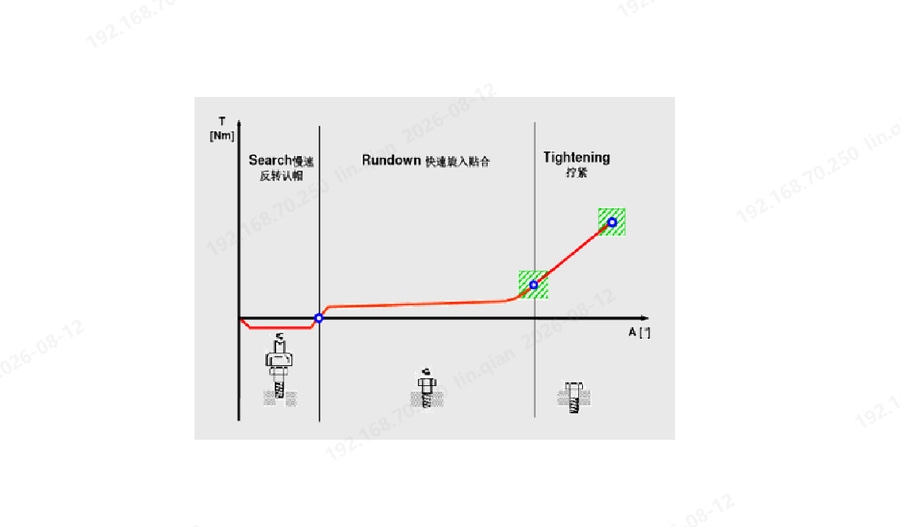
A typical torque-angle tightening process follows several stages.
Step 1: Fast Running
The screwdriver rapidly rotates the fastener until the joint surfaces begin to contact.
This stage focuses on productivity rather than precision.
Step 2: Snug Point Detection
The tool identifies the point where the joint becomes fully seated.
Modern intelligent screwdrivers determine this point by monitoring changes in the torque curve.
Finding the correct snug point is essential because the subsequent angle measurement begins here.
Step 3: Angle Tightening
After reaching the snug torque, the tool continues rotating through a precisely programmed angle.
Examples include:
Torque 8 Nm + 90°
Torque 20 Nm + 180°
Torque 50 Nm + 120°
The angle can be customized for different bolt sizes, materials, and joint designs.
Step 4: Verification
Smart tightening systems record:
Final torque
Rotation angle
Tightening curve
Cycle result
Timestamp
Operator or station information
These records support complete production traceability.
Benefits of Angle Tightening
1. More Consistent Clamp Load
Angle tightening reduces preload variation caused by friction changes.
This leads to more stable fastening quality across different production batches.
2. Improved Product Safety
Many safety-critical joints require precise bolt preload.
Examples include:
Automotive chassis
Steering systems
Brake assemblies
EV battery packs
Industrial machinery
Angle control helps ensure every bolt achieves the intended clamping force.
3. Better Process Repeatability
Even when friction varies slightly between parts, angle tightening delivers more consistent results than torque-only control.
This improves manufacturing repeatability.
4. Better Quality Monitoring
Modern controllers generate complete tightening curves, allowing engineers to detect:
Cross-threading
Missing components
Incorrect seating
Joint abnormalities
Tool wear
This enables early defect detection before products leave the production line.
Torque Tightening vs. Angle Tightening
Feature Torque Tightening Angle Tightening
Control Variable Torque Torque + Rotation Angle
Clamp Force Consistency Moderate High
Sensitive to Friction High Lower
Process Stability Good Excellent
Data Collection Basic Comprehensive
Best for Critical Assembly Limited Yes
Typical Applications of Angle Tightening
Angle tightening is widely used wherever joint reliability is critical.
Automotive Manufacturing
Vehicle assembly contains thousands of threaded fasteners.
Typical applications include:
Engine assembly
Chassis
Suspension
Steering systems
Wheel fastening
Seat assembly
Electric Vehicle Battery Packs
Battery systems require precise preload to protect sealing performance and electrical safety.
Angle tightening helps maintain consistent compression across battery modules.
Industrial Automation Equipment
Servo systems, robotic structures, and precision machinery often require repeatable bolt preload to maintain long-term positioning accuracy.
Electronics Manufacturing
High-value electronic products require controlled tightening to avoid:
Thread stripping
Component deformation
Loose fasteners
Angle-controlled intelligent screwdrivers improve process consistency.
Why Smart Electric Screwdrivers Matter
Angle tightening requires far more than a standard clutch screwdriver.
An intelligent electric screwdriver typically includes:
High-resolution encoder
Precision torque sensor
Closed-loop servo motor
Real-time controller
Torque-angle algorithms
These technologies allow the system to accurately measure both torque and rotation angle simultaneously.
The result is higher fastening precision and complete process visibility.
How Danikor Intelligent Electric Screwdrivers Support Angle Tightening
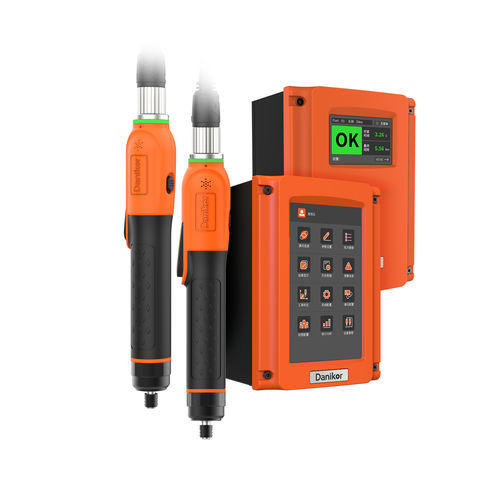
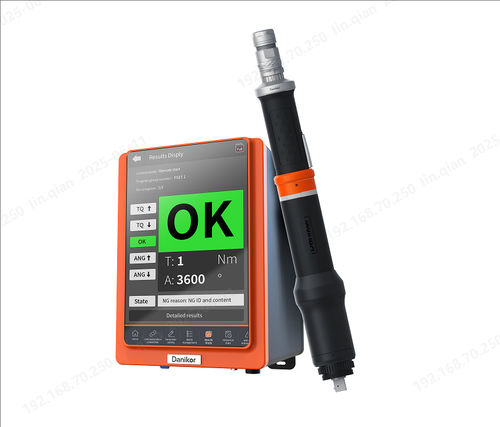
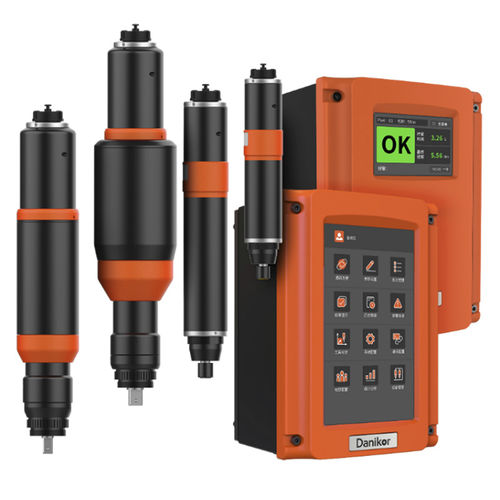
As industrial assembly continues moving toward digital manufacturing, Danikor has developed intelligent electric screwdrivers designed for high-precision tightening applications.
Key capabilities include:
High-Precision Torque & Angle Control
Danikor smart screwdrivers integrate precision torque sensors with high-resolution encoders, enabling accurate closed-loop control of both torque and rotation angle.
Multiple Tightening Strategies
The controller supports programmable fastening methods, including:
Torque control
Angle control
Torque + angle
Multi-stage tightening
Soft joint strategies
Hard joint strategies
Manufacturers can configure different tightening programs for different products without changing hardware.
Real-Time Tightening Curve Analysis
The system continuously monitors:
Torque curve
Angle curve
Tightening speed
Cycle time
This helps detect abnormal tightening conditions before defective products proceed to the next manufacturing stage.
Complete Data Traceability
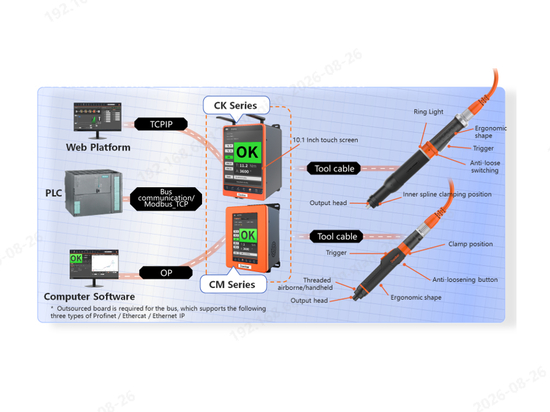
Danikor intelligent tightening systems can communicate with MES, PLC, and factory automation platforms through industrial communication protocols.
Every tightening cycle can be recorded for quality management and production traceability.
Wide Industrial Applications
Danikor intelligent electric screwdrivers are suitable for:
Automotive assembly
New energy vehicle manufacturing
Battery pack production
Electronics assembly
Industrial automation
White goods manufacturing
General industrial fastening
Frequently Asked Questions
Is angle tightening more accurate than torque tightening?
Yes. Because it controls bolt elongation after reaching a reference torque, angle tightening generally produces more consistent clamp force than torque-only tightening.
Does every assembly require angle tightening?
No. Standard torque control is sufficient for many general industrial applications. However, safety-critical or highly repeatable assemblies often benefit from torque-angle control.
What equipment is needed for angle tightening?
Angle tightening requires an intelligent tightening system capable of measuring both torque and rotation angle. This typically includes a servo-driven electric screwdriver, encoder, torque sensor, and programmable controller.
Can angle tightening improve product quality?
Yes. It reduces preload variation, improves assembly consistency, enables process traceability, and helps detect fastening abnormalities before final inspection.
Conclusion
As manufacturing quality requirements continue to rise, angle tightening has become one of the most effective methods for achieving consistent bolt preload and reliable fastening performance.
Compared with torque-only control, torque-angle tightening offers better repeatability, improved safety, and comprehensive quality data, making it the preferred solution for automotive, EV, electronics, and industrial automation applications.
For manufacturers looking to implement digital fastening solutions, intelligent tools equipped with closed-loop torque and angle control—such as Danikor's smart electric screwdrivers—provide the precision, traceability, and flexibility required for today's advanced production lines.