#Product Trends
Technical Principles and Engineering Advantages of Transit-Time Ultrasonic Flowmeters and Ultrasonic Bubble Detectors
Starting from the measurement principle, understand the capability boundaries of ultrasonic flowmeters and bubble detectors
In modern fluid engineering, as processes demand higher levels of sterility, corrosion resistance, and lower maintenance costs, non-invasive sensing technologies have gradually moved from laboratory research to large-scale industrial application. Among various flow measurement approaches, ultrasonic sensing stands out for its favorable physical characteristics. It performs both basic flow metering and real-time monitoring of fluid conditions, such as bubble presence, providing protection for piping systems from the two dimensions of flow measurement and fluid anomaly detection. A solid understanding of the underlying principles of transit-time flow measurement and bubble detection gives equipment engineers important guidance when integrating and selecting sensors for complex operating conditions.
1. Principle of Transit-Time Ultrasonic Flowmeters
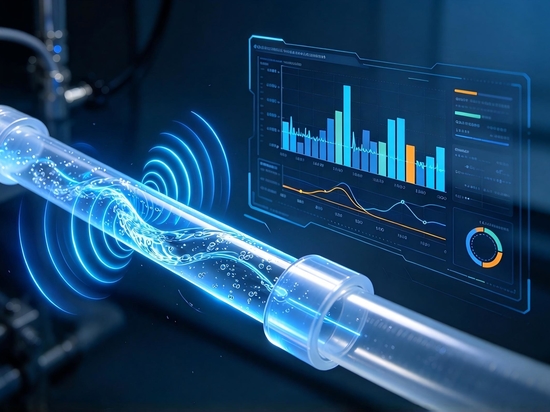
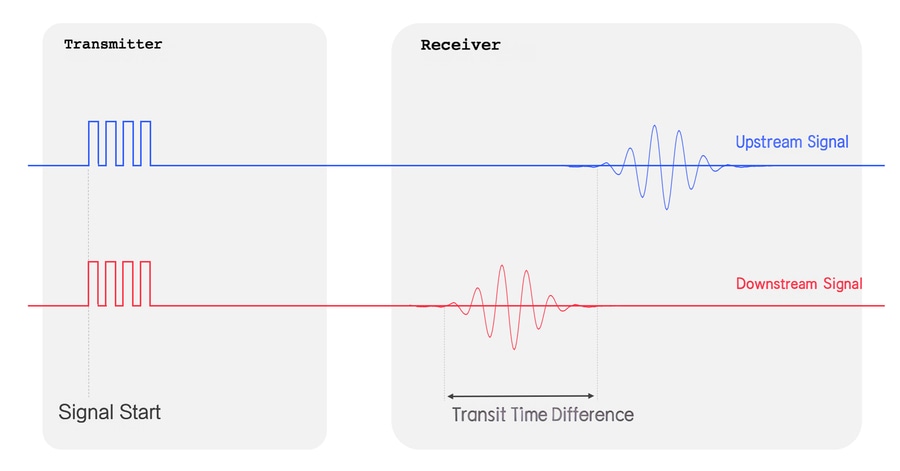
The measurement principle of an ultrasonic flowmeter is not complicated. In the transit-time method, a pair of ultrasonic transducers is mounted on the pipe, one upstream and one downstream, alternately transmitting and receiving ultrasonic pulses. When the fluid is moving, the ultrasonic pulse traveling downstream propagates faster, while the pulse traveling upstream propagates slower, creating a time difference between the two directions. This time difference is proportional to the average flow velocity, and the flow rate can be calculated by measuring it.
In engineering practice, the transit-time method does not depend on the electrical conductivity or concentration of the fluid. As long as the medium can transmit acoustic waves, stable measurement can be achieved for deionized water, organic solvents, or culture media used in biopharmaceutical production. The most essential value of the transit-time method is that no component intrudes into the fluid path, causing ultra-low pressure loss and mechanical wear. For clean fluids, corrosive media, or processes where contamination is not acceptable, this non-intrusive approach offers a clear advantage.
2. Principle of Ultrasonic Bubble Detection
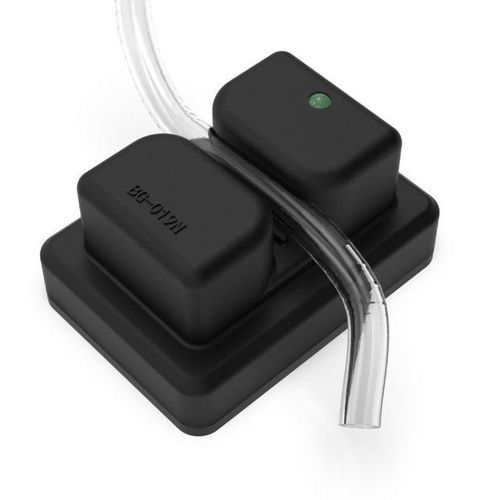
The principle of bubble detection is more straightforward. One transducer emits an ultrasonic pulse, and another transducer receives the transmitted signal. When the pipe is filled with liquid, ultrasonic waves propagate through the liquid with relatively low attenuation, and the received signal is strong. When bubbles or air enter the pipe, the ultrasonic waves undergo strong reflection and scattering at the gas-liquid interface, and the received signal attenuates significantly. By monitoring the change in received signal amplitude, it is possible to determine whether bubbles, gas, or an empty tube is present in the line.
Several practical issues require attention. The size and distribution density of bubbles, as well as the acoustic properties of the liquid itself, affect the degree of signal attenuation, so the detection threshold needs to be adjusted according to the specific medium. In addition, the effect of pipe material on ultrasonic attenuation must be considered; different pipe materials require appropriate transducer frequencies and signal gain. The engineering value of ultrasonic bubble detection lies in its ability to monitor medium changes within the pipe in real time without contacting the fluid. For applications requiring pump protection, prevention of gas entering downstream processes, or verification of pipe filling status, this method provides a simple and effective solution.
3. Advantages of Ultrasonic Detection over Other Measurement Principles
Each flow measurement principle has its own application boundaries. The advantages of ultrasonic technology are mainly reflected in the following aspects.
→ Compared with mechanical flow meters, such as turbine and gear flow meters, ultrasonic flow meters have no moving parts. After long-term operation, bearing wear and impeller fouling cause measurement drift in mechanical flow meters, requiring periodic maintenance and recalibration. In contrast, ultrasonic flow meter sensors have no mechanical contact with the fluid, so there is no wear, resulting in better long-term stability and significantly lower maintenance requirements.
→ Compared with optical bubble detection, ultrasonic detection is not limited by the color or transparency of the liquid. In biopharmaceutical and fine chemical applications, many fluids are dark-colored or contain solid particles, where optical detection can easily fail. Ultrasonic solutions are not affected by optical transparency, although media with extremely high acoustic attenuation may still present limitations.
→ Compared with electromagnetic flow meters, ultrasonic flow meters do not require the fluid to be electrically conductive. Electromagnetic flow meters can only measure conductive liquids, and cannot handle non-conductive media such as deionized water, organic solvents, and oils. Ultrasonic flow meters can be applied to most media that transmit acoustic waves, offering a wider range of applicability, except for highly attenuating or strongly scattering media.
→ In addition, clamp-on ultrasonic sensors do not require any modification of the existing piping structure during installation. This is a practical advantage for retrofit projects. There is no need to shut down the line for pipe cutting or re-welding; the sensor can simply be clamped onto the outer wall of the pipe.
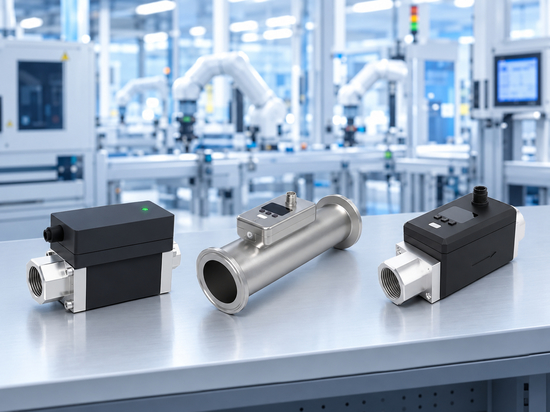
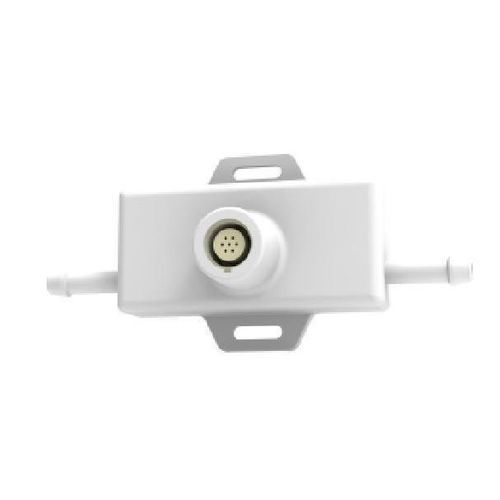
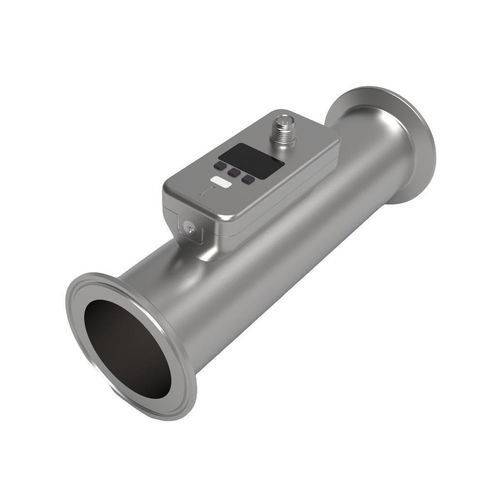
In XY-TEK's product line, transit-time ultrasonic flowmeters cover a variety of installation types, from clamp-on to inline. Clamp-on sensors are suitable for retrofitting existing pipelines, as they do not contact the medium and are convenient to install and maintain. Inline sensors are suitable for integration into new equipment, offering higher measurement stability and a more competitive price. Bubble detection can also be integrated into the sensor's signal processing logic, enabling simultaneous flow measurement and bubble alarm in a single device.
Understanding sensor principles is essentially about understanding the boundaries of measurement. Only when engineers are clear about the applicable scope, reliable operating conditions, and failure modes of a sensing technology can they make sound selections and use the equipment consistently. Ultrasonic sensing is not suitable for every operating condition. However, with its non-invasive measurement, absence of mechanical wear, and broad medium compatibility, it holds a distinctive place in industrial fluid monitoring — one that is difficult to replace in many clean and corrosion-resistant process environments.