#Product Trends
Why 10 cm of Extra Box Height Can Create a Much Bigger Transport Cost?
What does the external box height do to the number of boxes that fit in the truck?
When a returnable box is specified, most attention naturally goes to the product.
How much internal height do we need?
How much clearance should we allow?
Does the product fit safely?
All logical questions.
But there is another one that is sometimes checked too late:
What does the external box height do to the number of boxes that fit in the truck?
A difference of 100 mm does not sound like much. In practice, it can be enough to lose a complete stacking
level.
A simple example
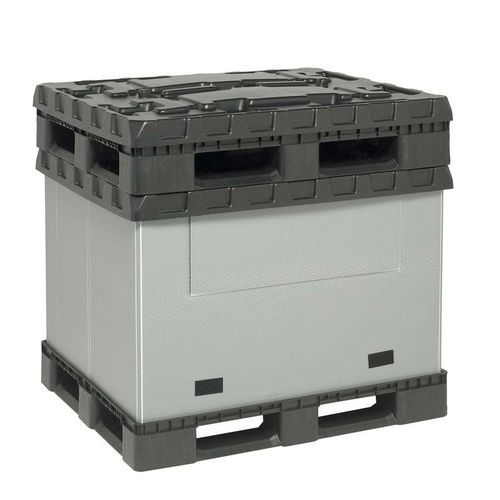
Take a returnable pallet box with a footprint of 1200 x 1000 mm.
Assume the trailer has around 2.7 metres of usable internal height and that the loaded boxes are approved
for stacking.
Now compare two versions.
Box A: 850 mm high
Three boxes on top of each other require:
3 x 850 mm = 2,550 mm
That fits.
With 26 pallet positions in the trailer, you can load:
26 x 3 = 78 boxes
Box B: 950 mm high
Now make the same box just 100 mm higher.
Three boxes would require:
3 x 950 mm = 2,850 mm
That no longer fits in the same trailer.
So instead of three levels, you are down to two.
That gives:
26 x 2 = 52 boxes per truck
The difference in height is only 10 cm.
But the difference in truck capacity is 78 boxes versus 52.
That is a big difference.
ZAMKO | DirectIndustry article | Box height and transport efficiency
What does that mean over a year?
Suppose you need to move 7,800 loaded boxes.
Scenario Capacity per truck Truckloads for 7,800 boxes
850 mm box 78 boxes 100
950 mm box 52 boxes 150
So in this example, those extra 10 cm lead to around 50 more truck movements for exactly the same
number of boxes.
Of course, real-life loading is not always this neat. Trailer dimensions vary. Weight can become the limiting
factor before volume does. Stacking approval and load stability also matter.
But the point remains the same.
Sometimes a small dimensional change moves the packaging across an important transport threshold.
And once that happens, the effect is no longer small.
Sometimes the extra height is necessary
This does not mean that the lowest possible box is always the best choice.
If the product needs the extra height, then it needs it.
There may be good reasons for additional space, such as:
product protection
separators or internal packaging
loading access
product variation
automated handling
structural requirements
The important thing is to know whether those extra centimetres are actually needed.
If they are, fine.
If they are mainly there because the old box was also that height, or because a generous tolerance was
added years ago, it may be worth checking again.
Are you using the extra volume?
There is another simple way to look at it.
A box with a 1200 x 1000 mm footprint that is 100 mm higher has roughly 120 litres more external volume.
If that extra space is filled with more product, that may be useful.
If it is mostly empty, you are paying to transport more air.
Across a few boxes, that hardly matters.
Across hundreds of truckloads, it starts to matter a lot.
This is why I think there are really two questions when choosing packaging dimensions:
How well does the product fit in the box?
How well does the box fit in the truck?
Both matter.
ZAMKO | DirectIndustry article | Box height and transport efficiency
Small specification choices add up
In practice, packaging dimensions are not always designed from zero.
Often an existing size is reused.
A new product goes into an old box. A safety margin gets carried over. A dimension that was important for
one project becomes standard for the next one.
That is understandable.
But if the packaging is going to circulate for several years, even a small dimensional decision can repeat
itself thousands of times.
This is especially relevant with returnable packaging because the same design keeps coming back into the
logistics flow.
A decision made once can influence transport cost on every cycle.
What should be checked before approving the height?
What is the minimum height the product really needs?
How much clearance is actually necessary?
Can the loaded boxes be stacked?
What is the usable internal trailer height?
How many pallet positions fit in the truck?
How many boxes fit per truck at the proposed height?
Would a small height reduction allow another stacking level?
How many shipments will this packaging make each year?
The last point is important.
Saving a few centimetres may not be worth discussing if the packaging only moves occasionally.
But on a regular transport lane, the result can be completely different.
Check the box and the truck at the same time
Packaging design and transport planning are often treated as separate subjects.
They really should not be.
A good returnable box should fit the product properly, but it should also work efficiently in storage, handling
and transport.
Sometimes 10 cm makes no meaningful difference.
Sometimes it is the difference between 100 trucks and 150.
That is worth checking before the final specification is approved.
More information about Sleeve Pack dimensions, stacking and transport efficiency:
ZAMKO Sleeve Pack Systems - Procurement Guide:
https://zamko.eu/sleeve-pack-systems/