#Product Trends
Product fit or truck fit?
How to optimise mesh wire pallet cages for the complete logistics cycle
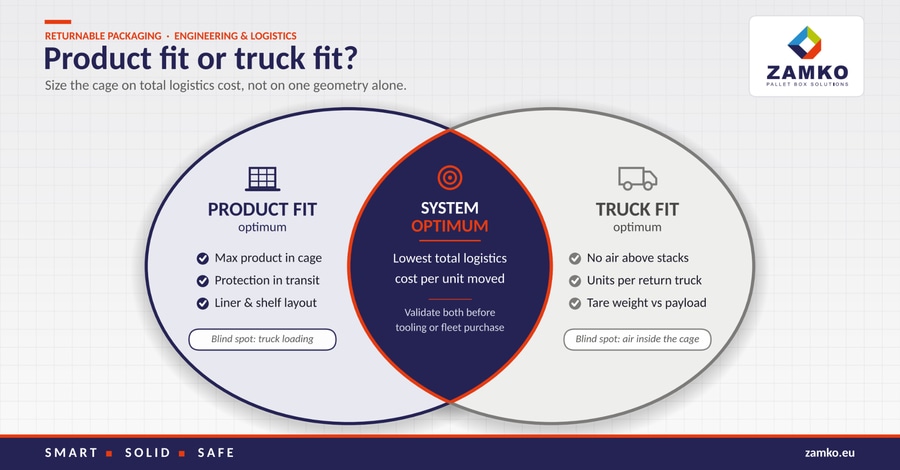
Ask an engineer how a returnable cage should be dimensioned and you will usually hear one of two answers.
The first: around the product. Minimal air, maximum protection, a clean fit on the drawing. The second: around the truck. A standard footprint, a full trailer, no wasted metres.
Both approaches make sense, but neither is sufficient on its own. A cage that fits its product perfectly can load poorly on a truck. A cage that makes excellent use of trailer space may leave too much unused space around the product.
The real objective is to minimise total logistics cost per unit transported, while maintaining the required product protection and handling performance.
What product fit asks for
Three factors determine how well a cage suits what goes inside it.
• Product capacity. How many products fit safely inside the cage? Calculations must use internal dimensions, not nominal external dimensions. The difference can be significant, especially when products are packed tightly.
• Protection in transit. Welded steel mesh is rigid, but rigidity alone does not protect every product. Shelves can reduce pressure on lower layers, while lids, dividers and protective materials can help prevent movement or damage.
• Liner and shelf layout. PP liners can prevent small or loose items from escaping through the mesh, while dividers separate products or SKUs. These features improve functionality but can also reduce usable internal space.
That is why product fit is an optimum rather than simply maximum fill rate. Capacity, protection and practical handling must be balanced according to the product.
Truck fit: the floor is solved, the height is not
For the cage configurations used in ZAMKO's loading calculations, a standard trailer accommodates approximately 32 cages with a 1208 footprint (1,200 × 800 mm) or 26 cages with a 1210 footprint (1,200 × 1,000 mm) per floor layer. Actual quantities depend on external dimensions and the loading arrangement.
But efficient floor utilisation is only part of the equation. Height is often where additional transport capacity can be gained.
Using a tautliner with 255 cm of available loading height as an example:
• H1200 cages: two layers reach 240 cm.
• H800 cages: three layers also reach 240 cm.
• H950 cages: two layers reach 190 cm, leaving 65 cm unused above the stacks.
On a 1208 footprint, two layers provide 64 cages and three layers would provide 96 cages geometrically. Whether either arrangement is permissible depends on the exact product specification, loaded stacking rating, load distribution and transport conditions.
Unused height only represents an economic opportunity when additional products can actually be transported safely. A taller cage does not automatically increase the quantity of goods carried.
IMPORTANT: Loaded stacking capacity must be assessed separately for each specific cage model and configuration, using its corresponding technical specifications and applicable load and handling conditions. A series name alone is not sufficient to establish the permitted number of loaded layers.
The return leg: units per return truck
The same question comes back empty. Folded height and practical stacking efficiency determine how many cages can travel home on one truck.
On the 1208 footprint, US (Budget) cages typically fold to approximately 190–200 mm. In the loading configuration used for this comparison, around 384 empty cages can be transported per truck.
EU (Standard) cages have greater variation in effective stacked height. Depending on their construction, folded cages may stack differently or partially nest together. Consequently, the total height of a folded stack does not always equal the nominal folded height of one cage multiplied by the number of cages.
For the EU configurations considered here, practical return capacity is approximately 224–256 cages per truck.
Using an illustrative international European full-truck return transport cost of €1,200:
RETURN TRANSPORT COST COMPARISON
US (Budget)
Empty cages per return truck: 384
Return cost per cage: €3.13
EU (Standard) – Configuration 1
Empty cages per return truck: 256
Return cost per cage: €4.69
EU (Standard) – Configuration 2
Empty cages per return truck: 224
Return cost per cage: €5.36
That represents a difference of approximately €1.56–€2.23 per cage per return cycle. Over 20 return cycles, the accumulated difference reaches approximately €31–€45 per cage.
This is why folded stacking efficiency deserves attention before investing in a returnable cage fleet. A relatively small difference in return capacity can become significant when the same packaging is transported repeatedly.
Actual return capacity must be verified for the specific folded stacking arrangement and its safety limits. Transport costs vary by route and market conditions; €1,200 is an illustrative FTL assumption, not a fixed market rate.
Tare weight against payload
Steel cages are relatively heavy. A 1208 mesh wire cage may weigh approximately 45–50 kg, depending on its construction. For lightweight, bulky products, this may have relatively little influence on transport efficiency.
For dense products, however, the cage’s own weight becomes important: every additional kilogram of cage weight reduces available product payload on a weight-limited trip.
This leads to a frequently overlooked question: does the truck reach its space limit or its weight limit first?
When payload becomes the limiting factor
Every truck has two fundamental capacity constraints: available loading space and maximum permitted payload. In logistics, these are commonly described as cubing out and weighing out.
A truck that fills its available loading space before reaching its maximum payload is volume-limited. Cage dimensions, stacking and trailer-space utilisation can then have a substantial impact on cost.
A truck that reaches its payload limit before the available space is filled is weight-limited.
For dense products such as engine blocks, gearboxes or heavy castings, a truck may reach its maximum payload well before all available cage positions are occupied. In such cases, increasing loaded cage height may offer little or no additional transport capacity.
Instead, three priorities become more important:
• Match load capacity to the product. Select a cage rated for the required load without unnecessary overengineering; higher load ratings may require heavier wire or base reinforcement.
• Control tare weight. Avoid unnecessary cage weight while preserving strength, durability and handling performance.
• Continue optimising the return leg. Even when loaded transport is weight-limited, empty returns are often volume-limited, so folded stacking efficiency remains relevant.
A quick weight check
Multiply the total loaded weight of each cage (product plus cage tare weight) by the number of cages in the volume-based loading plan. Compare the result with the truck’s available payload.
If it exceeds that payload, weight is a limiting constraint; if it does not, space optimisation may be worthwhile.
Always check axle loads, floor capacity, stacking limits and load securing as well.
Four checks before tooling or a fleet purchase
Start with weight, because it determines whether increasing space utilisation will actually improve loaded transport efficiency.
WEIGHT
What to establish: Loaded cage weight multiplied by planned quantity versus available truck payload.
What it tells you: Whether weight or space constrains the loaded transport.
HEIGHT
What to establish: Product height, cage height and product-specific permitted stacking versus available trailer height.
What it tells you: Whether more products can safely be transported.
RETURN
What to establish: Folded stack height and empty cages per return truck.
What it tells you: Return transport cost per cycle.
PRODUCT
What to establish: Internal capacity, protection, liners, shelves and handling.
What it tells you: Whether the cage performs correctly for the product.
Beyond transport: total cost per cycle
Transport efficiency is only part of the equation. Purchase price, handling costs, product damage risk and the frequency of return movements also influence the economics over a cage’s service life.
A more expensive cage may ultimately cost less per cycle if it reduces damage, simplifies handling or lowers recurring transport costs.
The correct comparison is therefore not simply cost per cage, but cost per product transported over the expected service life of the packaging.
Conclusion
The best mesh wire pallet cage is not necessarily the one that fits the product most tightly or fills the truck most completely. It is the one that achieves the lowest total logistics cost while providing the required protection, load capacity and handling performance.
For volume-limited transport, dimensions and stackability can make the difference. For weight-limited transport, cage weight and payload capacity may matter more. For both, the efficiency of empty return transport can substantially influence long-term cost.
Mesh wire cages can be manufactured with different heights, dimensions, stacking configurations and load capacities. Every proposed specification, particularly loaded stacking performance, must be validated against the technical documentation for the exact product before committing to tooling or a fleet purchase.
Planning a new returnable packaging system?
Send ZAMKO your product dimensions, product weight and truck or container loading requirements. We can help evaluate an appropriate cage configuration for your complete logistics cycle.
Further reading: Truck loading and return transport economics:
https://zamko.eu/mesh-wire-pallet-cages/#5_Fold_Ratio_Truck_Loading_and_Return_Transport_Economics
#ReturnablePackaging
#LogisticsOptimization
#MeshWireCages