#Industry News
From the Laboratory to the Cleanroom: Validating Before Scaling Up
A practical vacuum drying case study demonstrates how trials with real product can help define and optimize the process before manufacturing the industrial-scale equipment
In an industrial drying process, demonstrating that a product can be dried under vacuum is only the first step. To properly design an installation, it is necessary to understand how the product will behave during the process, how long it will take to reach the required moisture content, and which pressure, temperature and agitation conditions will provide consistent and repeatable results. When the equipment is also intended for installation in a cleanroom, these aspects become even more important, as the process must combine efficiency with appropriate conditions for cleanliness, containment and reproducibility.
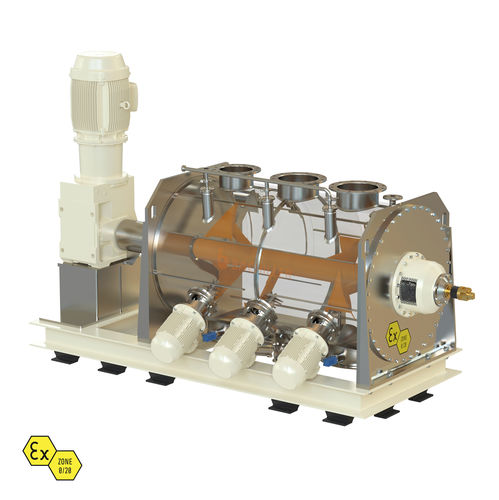
One way to reduce the uncertainties associated with design and scale-up is to carry out preliminary trials using the actual product. This was the approach followed in a project developed at our Test Center, where the drying of a solid product for the chemical industry was studied using a SANIDRY horizontal paddle vacuum dryer. The objective was not only to verify whether the product could achieve the required final moisture content, but also to understand its behavior throughout the entire cycle and obtain data that could subsequently be used to design the industrial-scale equipment.
The challenge: reducing moisture efficiently and under controlled conditions
The product had an initial moisture content of 7.15% and needed to reach a residual moisture content below 0.5%, without exceeding a specific temperature.
The process was studied using a SANIDRY SHV-200, a 200-liter horizontal vacuum dryer equipped with a low-speed agitation system.
Vacuum drying is based on a well-known principle: reducing the pressure lowers the boiling point of the liquid contained in the solid. This makes it possible to reduce moisture without exposing the product to excessively high temperatures. At the same time, agitation continuously renews the material in contact with the heated surfaces, promoting heat transfer and homogeneous drying of the solid.
However, the actual behavior of a product cannot be determined solely through theoretical calculations. Factors such as bulk density, filling level, tendency to form agglomerates or adhere to surfaces, ease of discharge, and the evolution of moisture content can significantly affect the process. For this reason, trials were carried out under different operating conditions in order to identify a suitable operating window before proceeding with scale-up.
The effect of vacuum on the process
One of the main parameters studied was the vacuum level. During the trials, different absolute pressures were tested to evaluate the actual relationship between pressure, drying time and product temperature throughout the process.
At 310 mbar, approximately 45 minutes were required before significant condensation was observed, as the product first needed to heat up until reaching the boiling point of the solvent at the operating pressure.
As the vacuum level was progressively increased, this time was considerably reduced. At 100 mbar, condensate began to appear after approximately 16 minutes. The reduction from 45 to 16 minutes experimentally confirmed how a lower pressure shortened the initial heating phase and accelerated effective moisture removal, thereby reducing the overall batch time.
The final results also confirmed the effectiveness of the process. Under the optimized conditions, the product went from an initial moisture content of 7.15% to approximately 0.20%, with a drying time of less than two hours.
Beyond the final value achieved, the trial made it possible to identify the pressure and temperature conditions under which the product exhibited suitable behavior, thus establishing an experimental basis for the subsequent design.
This is particularly important in an industrial project. Instead of sizing the future equipment solely on the basis of estimates or literature data, it can be designed with prior knowledge of how the actual product responds under controlled vacuum, temperature and agitation conditions.
Much more than measuring final moisture content
A drying trial provides information that goes far beyond simply measuring the moisture content of a sample at the end of the cycle.
During the trials, the evolution of the product's behavior is also analyzed: how it moves inside the dryer, whether agglomeration or adhesion occurs, how its consistency changes as moisture is removed, and how it behaves during discharge.
These observations are particularly useful because some of these phenomena are difficult to predict from a technical data sheet. Two products with apparently similar characteristics may behave very differently when simultaneously subjected to vacuum, temperature and agitation.
Being able to observe these phenomena at pilot scale makes it possible to better define agitation and discharge conditions, as well as to establish a cleaning strategy adapted to the actual behavior of the product.
The trials can also be used to verify the suitability of the materials that will come into contact with the product and its vapors. Material selection for the industrial equipment can therefore take into account the actual process conditions rather than relying solely on the theoretical composition of the product.
This prior knowledge is especially relevant for cleanroom installations, where hygienic design, ease of cleaning and the correct selection of components are an integral part of the process.
From testing to process control
Another objective of the trials was to gain a better understanding of how to determine the drying endpoint.
In an industrial installation, relying exclusively on a fixed drying time may not be sufficient, as small variations between batches can affect the evolution of the process. Therefore, in addition to measuring final moisture content, it is useful to analyze variables such as pressure, product temperature and condensate generation.
During drying, a significant proportion of the supplied energy is initially used to evaporate the moisture contained in the solid. As the moisture content decreases, condensate generation also decreases and the product's heat transfer behavior progressively changes.
Monitoring these variables together provides a better understanding of when the process is approaching its endpoint and provides a basis for subsequently developing a more robust control strategy at industrial scale.
Final moisture content can be confirmed using the appropriate analytical method, but having additional process indicators can help improve batch-to-batch reproducibility.
In this way, the results obtained at the Test Center are not limited to defining suitable drying conditions; they also contribute to establishing how these conditions should be monitored during production.
From the SANIDRY test unit to industrial-scale equipment
Once the product behavior has been characterized, the next step is to transfer the process to a larger capacity.
Scaling up a vacuum dryer does not simply involve increasing the vessel volume proportionally. Appropriate relationships must be maintained between the amount of product, heat transfer surface area, available power, vacuum level, filling level and agitation system.
The data obtained during the trials make it possible to carry out this work on an experimental basis. The amount of moisture to be removed is known, as are the conditions under which evaporation occurs, the physical behavior of the product and the variables that influence the final result.
Based on this information, the heating system, vacuum system and main components of the industrial equipment can be sized to reproduce the conditions that have proven effective during testing.
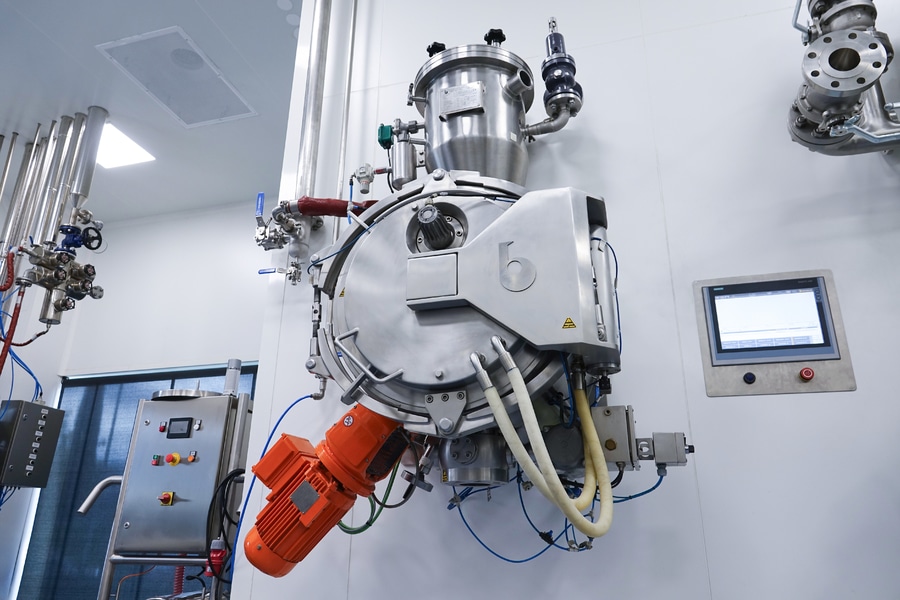
This approach becomes particularly important for equipment intended for cleanroom environments. In addition to drying performance, the design must consider aspects such as ease of cleaning, product-contact surfaces, filtration, controlled discharge and integration of the equipment into the production environment.
Having previously worked with the actual product makes it possible to incorporate these requirements from the engineering stage and adapt the SANIDRY design to the specific needs of the process.
Validate first to scale up with confidence
The trial carried out at the Test Center demonstrated that the product's moisture content could be reduced from 7.15% to approximately 0.2%, while also identifying suitable pressure and temperature conditions and gaining an understanding of its behavior throughout the different stages of the drying process.
With this information, the design of the future industrial equipment could be approached using empirical data, thereby reducing the uncertainty associated with working solely from theoretical assumptions, which may not account for process disturbances or changes in product behavior that are difficult to estimate without testing the actual product.
This is precisely one of the main benefits of experimentation prior to scale-up. A Test Center is not only useful for determining whether a particular product can be processed in a specific piece of equipment, but also for understanding how it should be processed and which characteristics the industrial installation will require to reproduce the same result.
In this way, the main process variables can be studied before manufacturing the final equipment, reducing uncertainty during scale-up and facilitating a more predictable commissioning process.
The product has been tested, the operating conditions have been defined, and the critical parameters have been identified. Based on this knowledge, the industrial equipment can be designed to reproduce a process that has already demonstrated its feasibility.