#Product Trends
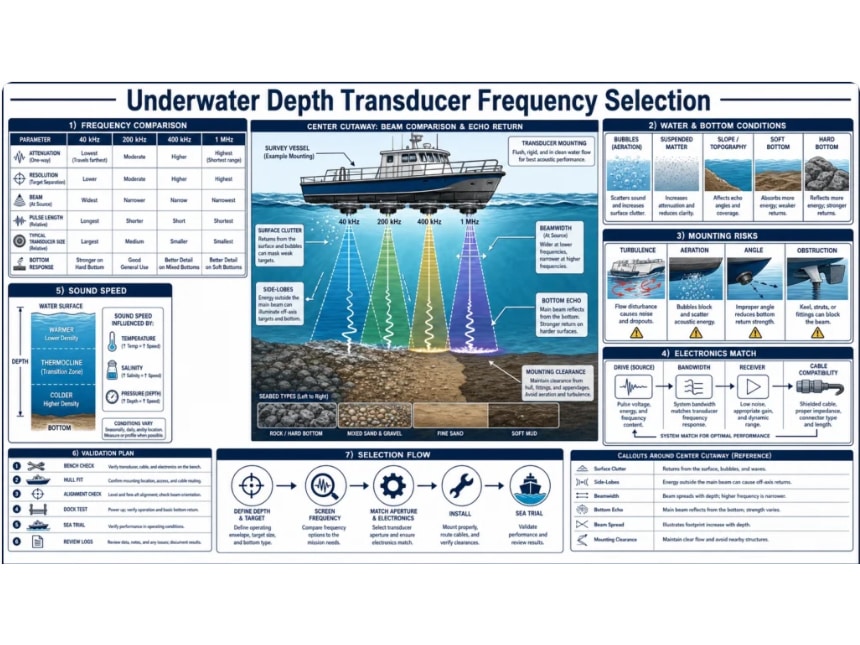
Underwater Depth Transducer Selection: 40 kHz vs 200 kHz vs 400 kHz vs 1 MHz
Underwater Depth Transducer Selection: 40 kHz vs 200 kHz vs 400 kHz vs 1 MHz
Frequency is a system trade-off, not a depth label
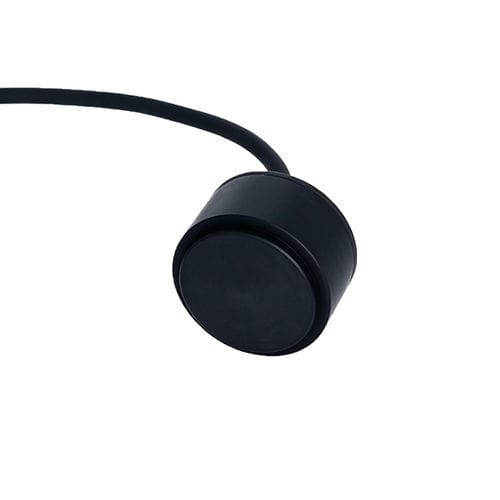
An underwater depth transducer sends acoustic energy toward the bottom and receives returned echoes. Frequency affects wavelength, attenuation, beam pattern, transducer size, pulse design, and the way different bottom materials appear, but it does not assign a guaranteed maximum depth by itself. The result also depends on transmit energy, pulse length, receiver noise, bandwidth, aperture, installation, vessel motion, water properties, bottom slope and reflectivity, bubbles, and signal processing.
A 40 kHz, 200 kHz, 400 kHz, 500 kHz, or 1 MHz product should therefore be selected from the complete sounding requirement. A low frequency may support a longer or more penetrating path under suitable conditions, while a high frequency can support a shorter wavelength and finer temporal or spatial detail. Neither statement replaces a link budget and field validation.
Translate the survey task into acoustic requirements
Minimum and maximum water depth, including draft and transducer offset.
Required vertical resolution, update rate, and confidence during motion.
Fresh, brackish, or seawater; expected temperature, salinity, and pressure range.
Bottom type: hard rock, sand, silt, vegetation, soft sediment, or layered material.
Vessel speed, heave, pitch, roll, bubbles, wake, turbulence, and mounting location.
Available aperture, beam requirement, hull or pole interface, cable route, connector, and sealing.
Transmitter voltage and waveform, receiver bandwidth and noise, time-varying gain, and processing.
Whether one bottom interface or differences between two frequency responses are required.