

#Product Trends
Underwater Communication Transducer Selection: Robots, Beacons and Acoustic Coverage
Underwater Communication Transducer Selection: Robots, Beacons and Acoustic Coverage
Start with what the underwater node must do
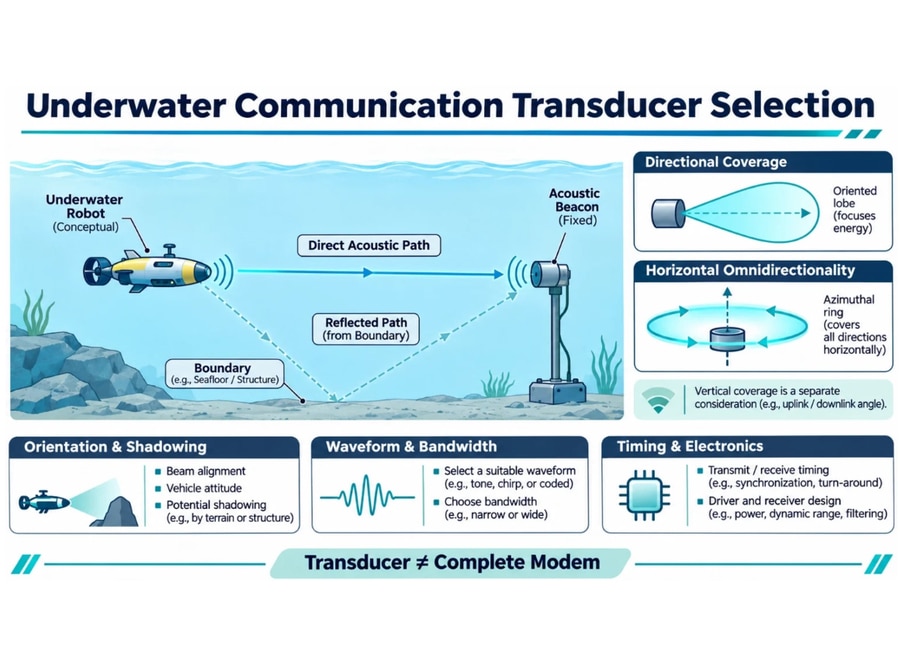
An underwater robot sending status messages, a positioning beacon answering an interrogation and a fixed acoustic-network node can all use ultrasonic transducers, but they do not have the same requirements. A useful component specification begins with the communication or positioning task, the relative motion of the nodes and the directions that must remain covered.
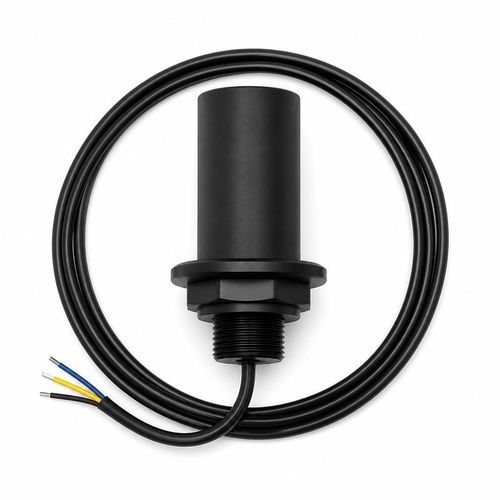
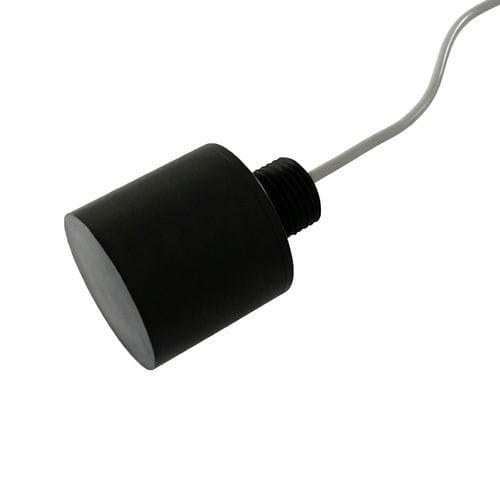
Deep Minds Ultrasonic offers the BBUA-C underwater communication and positioning transducer series for acoustic links, beacons, underwater robot communication and acoustic networks. The series supplies acoustic components for system development. A transducer is not a complete modem, positioning controller or network; it does not independently define data rate, packet reliability or navigation accuracy.
Communication, ranging and listening need different evidence
A communication link needs a signal that can be detected and decoded under the required channel conditions. A ranging system additionally needs a timing reference and an understood path. Passive listening instead emphasizes reception without transmitting its own pulse. NOAA’s explanation of active and passive sonar provides a useful foundation for this distinction; a component suitable for listening is not automatically a complete active communication solution.
One-way time-of-flight ranging requires a relationship between the transmitting and receiving clocks. A two-way arrangement needs a defined response delay as well as the travel-time model. Sound-speed variation changes the conversion from time to distance. Reflections can create a detectable arrival later than the direct path, so a strong received signal is not by itself proof of an unbiased range.
For communications, decide whether occasional delayed messages are acceptable or whether the control task has a strict latency requirement. Packet retries can improve delivery probability while increasing delay. For a moving robot, changing orientation and relative motion also affect the acoustic channel. State those operating conditions before requesting a frequency recommendation.
 鄂公网安备42018502009509号