

#Product Trends
Ultrasonic Spirometry Transducer Integration: Acoustic Paths, Flow and Condensation
Ultrasonic Spirometry Transducer Integration: Acoustic Paths, Flow and Condensation
A respiratory-flow component serves a different task from an imaging probe
Ultrasound in a pulmonary-function instrument can measure airflow rather than create an anatomical image. That distinction opens a separate component requirement: a transducer and acoustic channel able to support repeatable timing through a breathing-flow passage. The useful specification starts with the flow module, not with the familiar linear, convex or phased-array categories used for medical imaging.
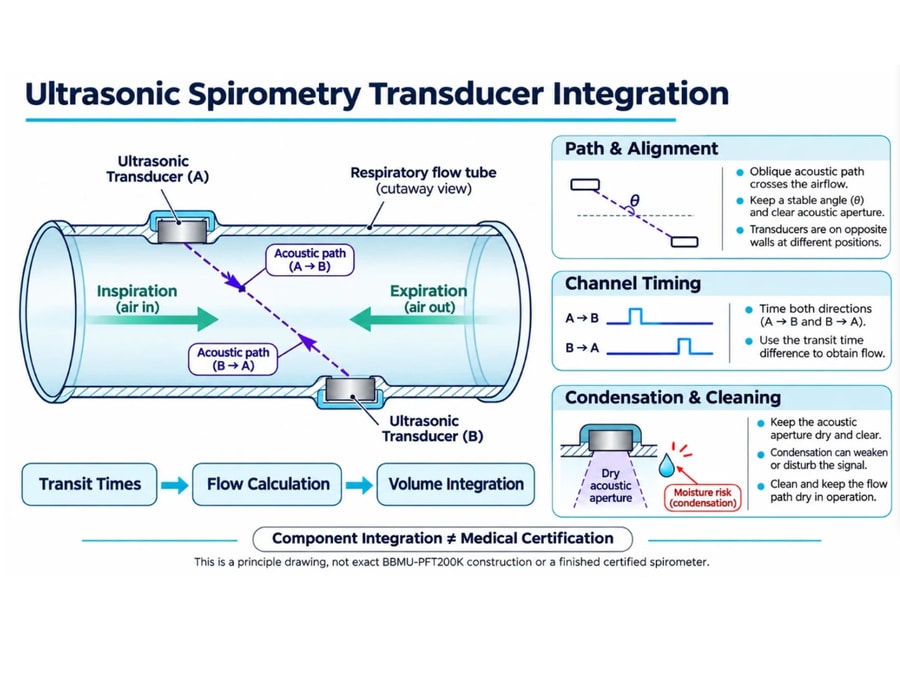
Deep Minds Ultrasonic offers the BBMU-PFT200K transducer for pulmonary-function instruments, spirometry, respiratory-flow measurement and medical airflow sensing modules. It is a sensing component for equipment integration. Clinical performance, hygiene, calibration, software and regulatory requirements belong to the complete device; they are not established by selecting a transducer with a medical application.
Trace the calculation from acoustic time to respiratory volume
In a transit-time flow arrangement, sound travels between transducers in both directions. Flow assists one direction and opposes the other, producing a time difference related to the velocity component along the acoustic path. With an ideal fixed path and uniform conditions, reciprocal transit times can separate much of the common sound-speed contribution from that flow component.
The instrument still needs the path length, its angle to the flow and a relationship between sampled velocity and the mean velocity across the channel. Multiplying a suitable mean velocity by cross-sectional area gives volumetric flow. Integrating that flow over time gives volume. Errors in geometry, zero offset or timing therefore propagate into the respiratory result; a precise timer does not remove them.
Real breathing gas changes temperature and humidity during a maneuver. Condensation, nonuniform temperature and different delays in the two channels can violate the ideal assumptions. The algorithm must also address how the reported gas volume is referenced. The 2019 ATS/ERS technical statement on standardization of spirometry addresses equipment quality assurance, hygiene and BTPS adjustment, meaning body temperature and ambient pressure with gas saturated with water vapor. It is a complete-instrument reference, not certification of the BBMU-PFT200K.
 鄂公网安备42018502009509号