#Product Trends
Ultrasonic Gas Flow Transducer Selection: Frequency, Acoustic Path, Pressure, and Temperature
Ultrasonic Gas Flow Transducer Selection: Frequency, Acoustic Path, Pressure, and Temperature
Gas flow transducer selection is a system-design task
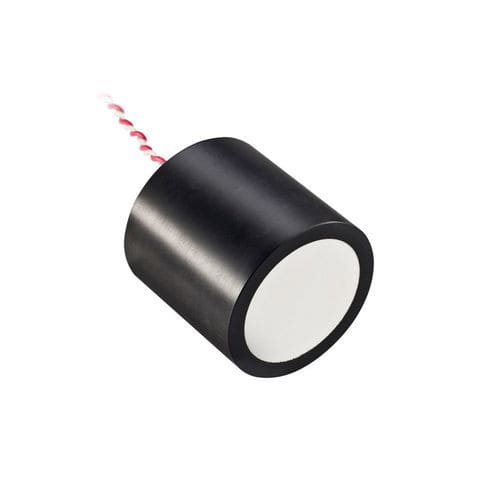
Ultrasonic gas flow measurement is used in residential and commercial gas meters, industrial process lines, ventilators, analyzers, combustion systems, and stack or duct monitoring. The transducers are only one part of the system. Their suitability depends on the gas, flow tube, acoustic path, pressure, temperature, frequency, electronics, calibration method, and production consistency.
A transducer that produces a strong signal in room air on a bench may not remain stable in the final meter. Pipe geometry, reflectors, gas composition, pressure, temperature, contamination, cable loading, and the analog front end can change the amplitude, phase, zero-flow offset, and time-of-flight measurement.
How transit-time gas flow measurement works
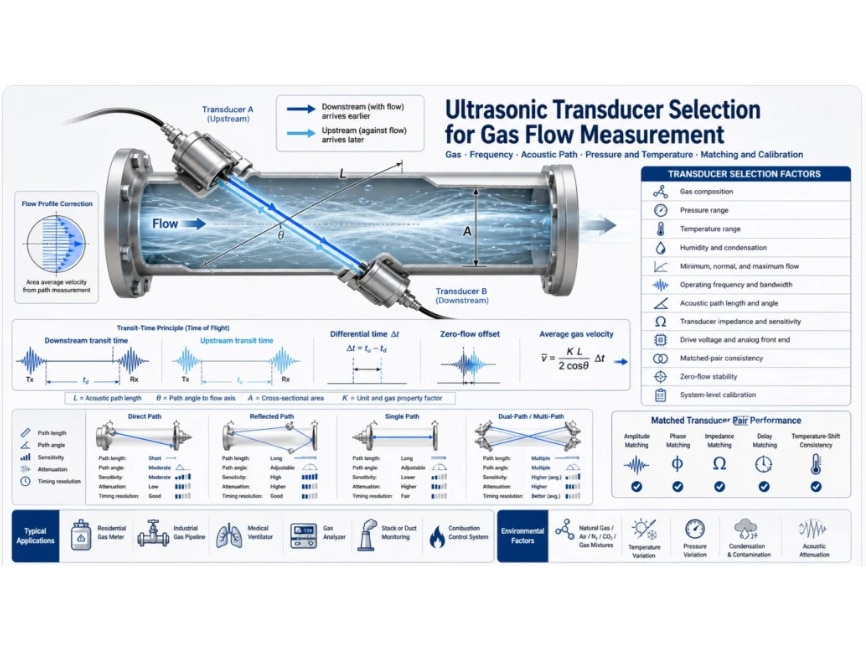
A typical meter uses two transducers. One measurement is made with the flow and another against it. The acoustic wave travelling downstream arrives slightly sooner, while the upstream wave arrives slightly later. The differential transit time is related to the average gas velocity along the acoustic path. Pipe area, path geometry, calibration, and flow-profile correction are then used to calculate volume or mass flow.
The time difference is usually much smaller than the total transit time. For this reason, waveform stability, transducer matching, timing resolution, and low-noise detection are critical. At zero flow, the ideal differential time is zero, but real transducers and electronics introduce offsets that must be characterized and compensated.