#Product Trends
Ultrasonic vs Radar Level Measurement: How to Choose for Real Process Conditions
Ultrasonic vs Radar Level Measurement: How to Choose for Real Process Conditions
The correct choice depends on the vapor space and the process, not only the tank height
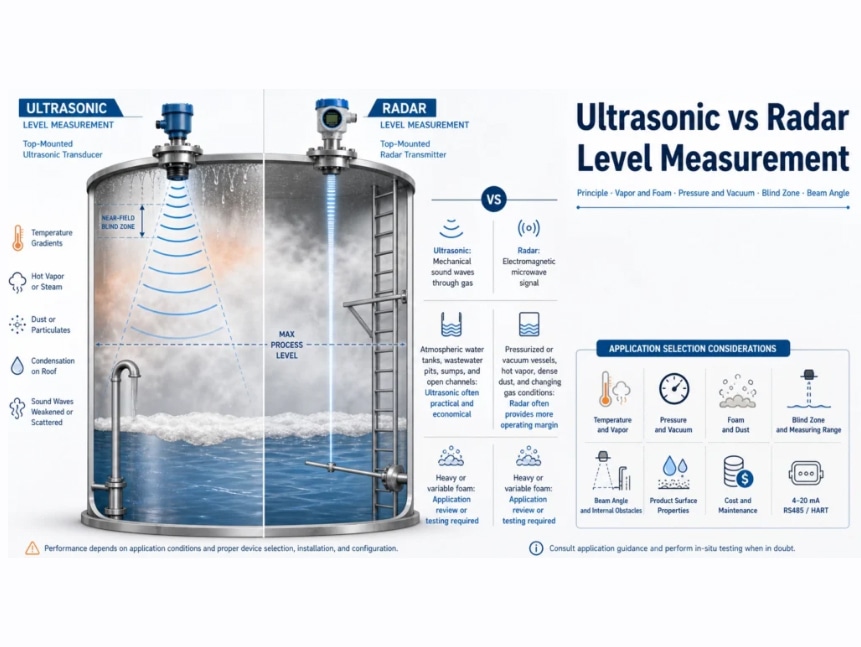
Ultrasonic and non-contact radar instruments both measure the distance from a sensor to a product surface and convert that distance into level. Their physical signals are different, however. Ultrasonic instruments use mechanical sound waves travelling through the gas space, while radar instruments use electromagnetic waves. That difference determines how each technology responds to temperature gradients, pressure, vacuum, vapor, dust, foam, condensation, internal structures, and product properties.
Ultrasonic measurement remains a practical and economical choice for many water, wastewater, open tank, sump, and standard storage applications. Radar generally provides more operating margin when the vapor space or process conditions are severe. The purpose of selection is not to declare one technology universally better, but to match the measurement principle to the real process.