#Industry News
Replacing an Existing Ultrasonic Transducer: What Specifications Must Match?
Replacing an Existing Ultrasonic Transducer: What Specifications Must Match?
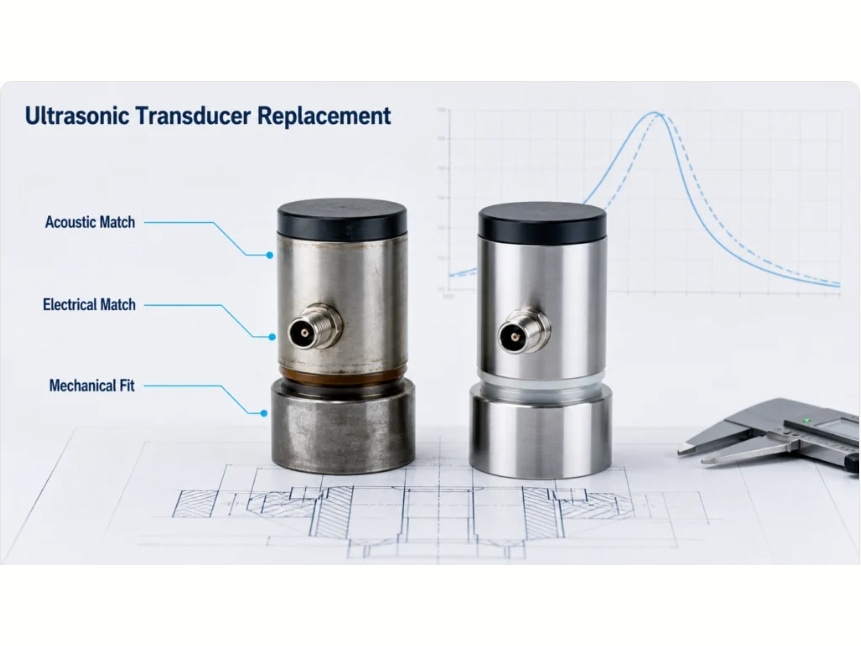
A Same-Size, Same-Frequency Part May Not Be a Replacement
Two ultrasonic transducers can share a nominal frequency and outside dimensions yet differ in bandwidth, capacitance, impedance, sensitivity, ringing, beam, cable loading, housing and acoustic matching. Replacement succeeds when the new component remains compatible with the actual system, not when the label looks similar.
Begin by deciding the required level of equivalence: an exact drop-in replacement, a form-fit-function replacement within stated tolerances, or a functionally equivalent redesign that allows circuit, mounting or calibration changes.
Recover the Original Application Boundary
Document what the original transducer does, in which medium, over what path, with what target or paired receiver, and under which temperature, pressure and duty cycle. Identify whether the system uses pulse-echo, through-transmission, flow timing, resonant power or another mode.
Also identify why replacement is needed: discontinuation, supply risk, failure, changed environment, cost review or performance redesign. A failure investigation and a sourcing replacement are different projects.