#Product Trends
Ultrasonic NDT Probe Selection: Straight Beam, Angle Beam and Immersion Probes
Ultrasonic NDT Probe Selection: Straight Beam, Angle Beam and Immersion Probes
Start with the inspection path, not the probe catalog
An ultrasonic NDT probe is one part of a measurement chain that also includes the test material, couplant or water path, instrument, scan method, reference standard, calibration block and acceptance procedure. A probe that produces a clean echo on a flat steel block can still be unsuitable for a weld, a rough casting or an automated immersion line. Selection should therefore begin with the defect orientation and the accessible inspection surfaces, then move to beam direction, frequency, element size and packaging.
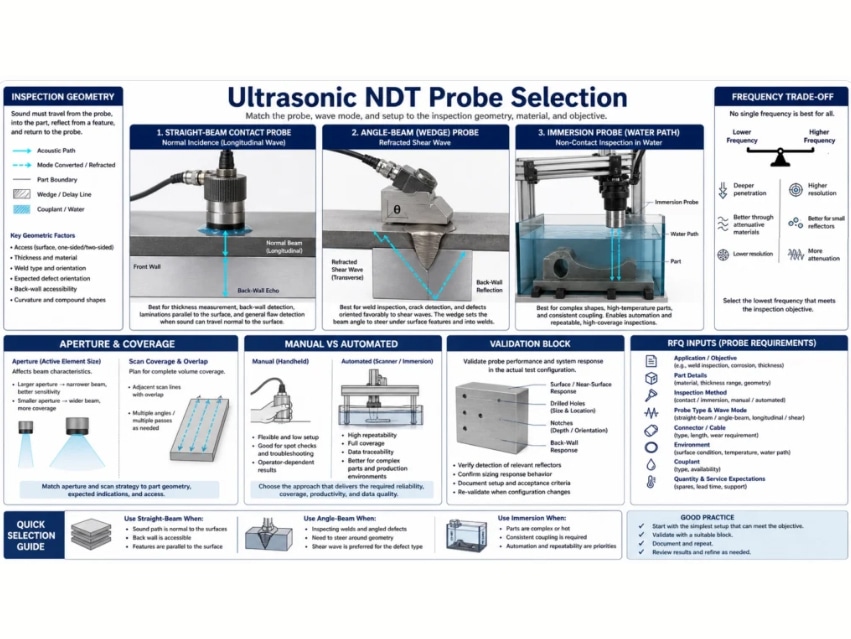
The practical first decision is geometric. Use a straight beam when the required sound path is approximately normal to the entry surface. Use an angle beam when the sound must enter at a refracted angle to intercept a weld or another planar discontinuity. Use immersion when a controlled water path, repeatable scanning position or non-contact coupling is central to the process. These are selection categories, not guarantees of detectability. The final procedure must be demonstrated on representative reference reflectors under the intended inspection conditions.
What the probe controls in an ultrasonic inspection
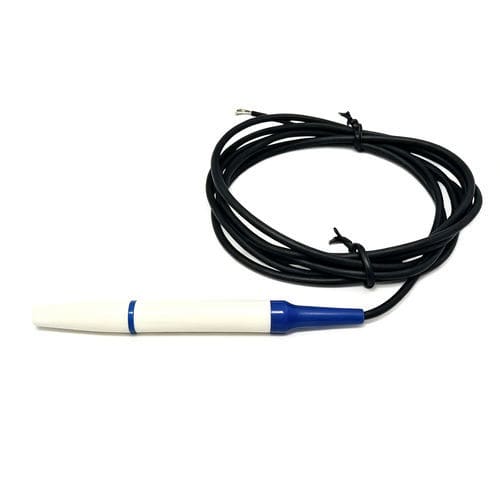
The probe converts an electrical pulse into an acoustic pulse and converts returning acoustic energy into an electrical signal. Its frequency spectrum, aperture, damping, construction and interface shape influence pulse length, penetration, beam spread, near-field structure and sensitivity to particular reflector sizes and orientations. The instrument settings cannot fully compensate for a fundamentally unsuitable beam path.
Probe choice also affects repeatability. A hand-held contact probe follows surface condition and operator pressure. A wedge fixes a nominal incident geometry but can wear and change the sound path. An immersion probe separates the element from the part with a water column, allowing mechanized positioning and stable coupling when water-path control is adequate.