#Product Trends
Types of Medical Ultrasound Transducers: Linear, Convex, Phased Array, and Frequency Selection
Types of Medical Ultrasound Transducers: Linear, Convex, Phased Array, and Frequency Selection
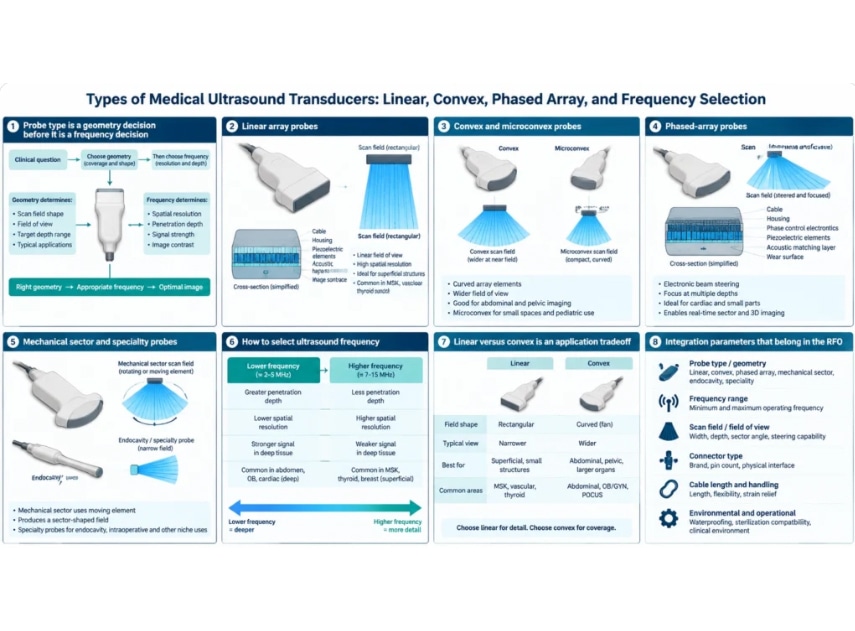
Probe type is a geometry decision before it is a frequency decision
A medical ultrasound transducer converts electrical excitation into acoustic pulses and returning echoes into electrical signals. The probe type determines how elements are arranged, how the beam is steered and what field of view reaches the system. Frequency then trades penetration against spatial resolution within that geometry.
For an OEM project, “linear or convex” is not enough. Define clinical application, target depth, access window, footprint, channel count, connector, beamforming architecture, acoustic output limits, cleaning method and regulatory pathway. A transducer is one component of a medical device and does not establish diagnostic performance by itself.
Linear array probes
A linear array has elements arranged along a straight aperture and normally produces a rectangular image. Its broad near-field contact and parallel scan lines suit superficial structures, vascular access, musculoskeletal imaging and other applications requiring fine near-surface detail.
Linear probes often operate at higher frequencies than general abdominal probes. That improves resolution but reduces penetration. The footprint may be too large for narrow acoustic windows, and element pitch must be controlled to manage grating lobes when steering.