#Product Trends
Transit-Time vs Doppler Ultrasonic Flow Meters: Working Principle, Accuracy, and Selection
Transit-Time vs Doppler Ultrasonic Flow Meters: Working Principle, Accuracy, and Selection
The liquid determines whether transit time or Doppler is viable
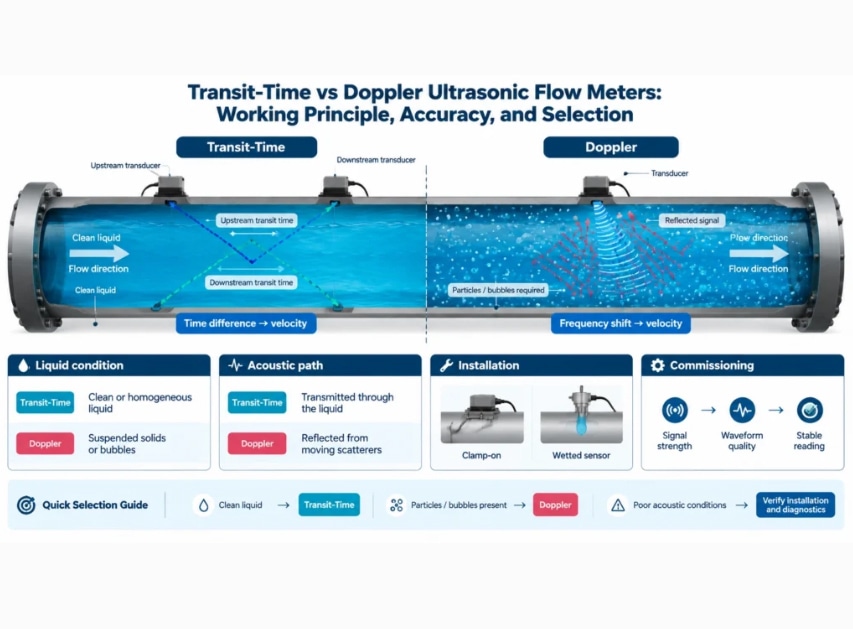
Transit-time and Doppler instruments both use ultrasound, but they depend on different information in the pipe. Transit time compares acoustic travel in the upstream and downstream directions. Doppler measures a frequency shift from moving reflectors such as suspended solids or bubbles. A liquid suitable for one method may be unsuitable for the other.
Start by describing the process fluid over its full operating range. Include solids, bubbles, viscosity, temperature, pressure, pipe material, liner, diameter, flow range and whether the pipe remains full. Choosing from pipe size alone is not enough.
How a transit-time ultrasonic flow meter works
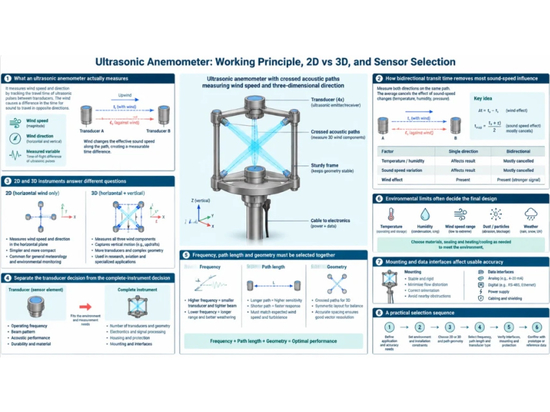
Two transducers exchange pulses along an acoustic path across the pipe. Flow shortens the downstream transit time and lengthens the upstream time. The meter converts the difference into axial velocity and then volumetric flow using the configured pipe area and a flow-profile model.
Transit time usually performs best in relatively clean, homogeneous liquids that transmit a stable signal. Too many bubbles or solids can scatter and attenuate the pulse. However, the exact tolerance depends on path length, frequency, signal processing and the specific instrument.