#Product Trends
Ultrasonic Welding Transducer: Frequency, Horn Matching, and Troubleshooting
Ultrasonic Welding Transducer: Frequency, Horn Matching, and Troubleshooting
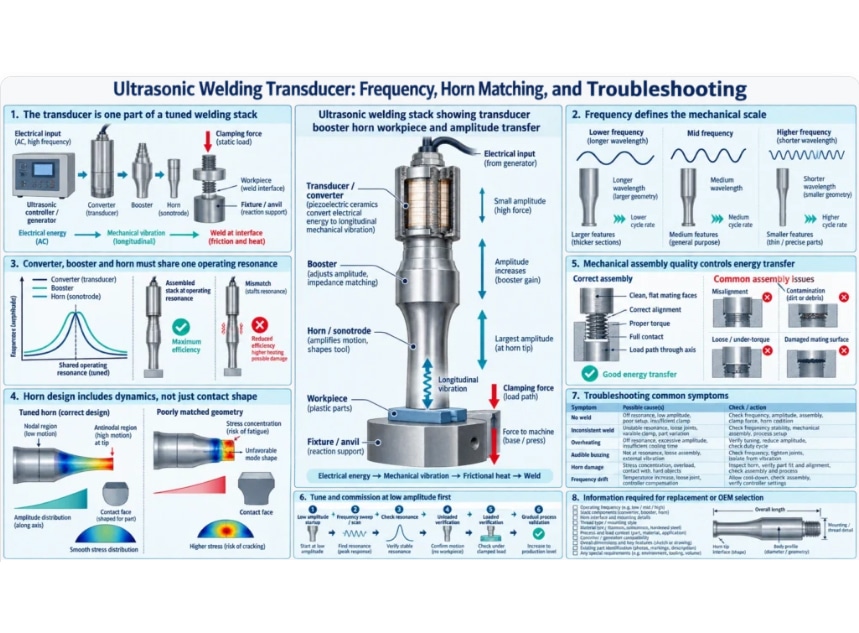
The transducer is one part of a tuned welding stack
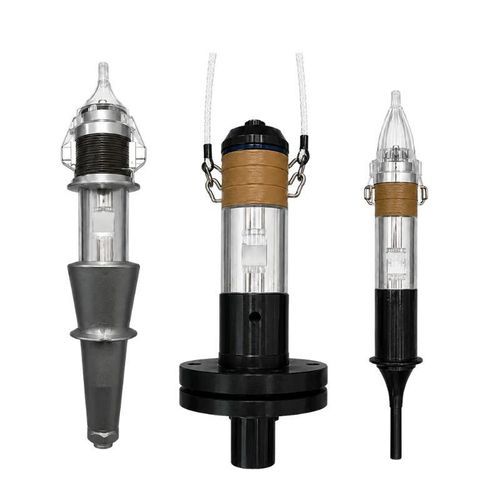
An ultrasonic welding transducer converts generator voltage into high-frequency mechanical vibration. It is normally connected to a booster and horn, which transmit and transform amplitude into the workpiece. The converter, booster, horn, interfaces, generator and fixture operate as one tuned system.
Replacing a converter by frequency and power label alone is risky. Resonance, impedance, capacitance, bolt pattern, interface diameter, preload, amplitude rating and mass loading must fit the existing stack. The process material, joint design, clamp force and weld control also determine the result.
Frequency defines the mechanical scale
Lower-frequency systems such as 20 kHz commonly support larger horns, higher displacement and high-power industrial welding. Higher frequencies can use smaller acoustic components and may suit small or delicate assemblies. Frequency selection changes the wavelength and therefore the physical dimensions of every resonant component.
The BBWD-20KP2000 20 kHz 2000 W welding transducer is intended as a converter-level component. Its rating does not establish the allowable horn geometry, weld force or cycle rate of a finished machine.